

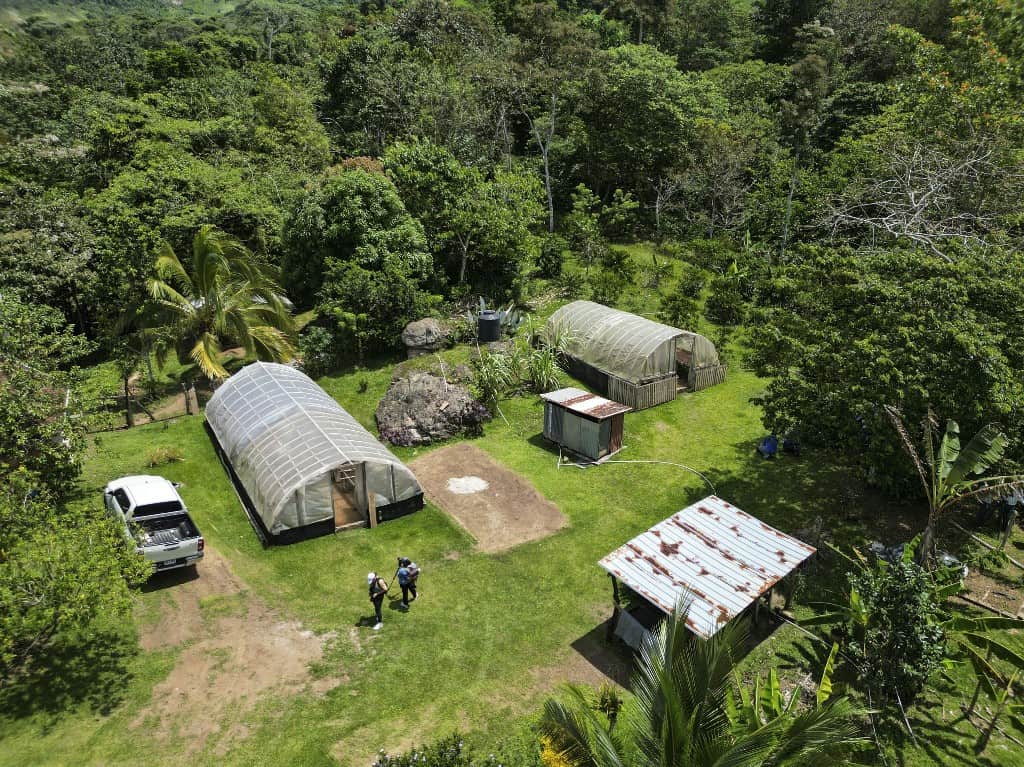
Yalisbeth Gill raises chickens and Liduvina Rivera grows coffee in Las Gaitas, an agricultural area 50 kilometers west of the Panama Canal. Despite the distance, both have boosted their operations, in part thanks to the agency that manages the waterway. “The Canal has given us the materials needed to build the chicken coop […] and on top of that it has also provided us with training,” says Gill, 26.
“The Panama Canal Authority has always been there, watching over us. It’s basically been our umbrella,” adds Rivera, 63, referring to the ACP—the autonomous government agency that has operated the inter‑oceanic route since the United States handed it over to Panama on December 31, 1999. Even amid threats by U.S. President Donald Trump to retake control of the Canal, its administrators continue with an ambitious investment plan and technical‑assistance and subsidy programs for hundreds of small rural producers.
This support aims to guarantee the Canal’s water supply—the essential element for navigating its 80 kilometers of locks and channels connecting the Atlantic and Pacific Oceans. Unlike the Suez Canal—the only other artificial waterway of its kind in the world—Panama’s Canal operates with fresh water, because the rocky terrain prevented construction at sea level.
Between October 2023 and September 2024, the Canal recorded 11,240 transits—5% of global maritime trade—and each transit uses 200 million liters of fresh water that is ultimately discharged into the sea. “As my grandmother used to say, one hand washes the other, and both wash the face. They need the water, and so do we,” says Rivera.
A Strategic Partner
ACP agricultural engineer Alejandro Figueroa explains that the goal of the technical‑assistance program is to ensure the “economic, social, and environmental sustainability” of producers in the Canal watershed. The Canal watershed covers 500,000 hectares and includes six main rivers plus numerous streams and creeks. Water is stored in the Gatún (450 km²) and Alhajuela (50 km²) artificial lakes.
“Within the watershed, we’ve worked with over 1,200 families, reforesting more than 4,500 hectares,” he says. “We also work with local cattle ranchers on agro‑pastoral systems […] so that livestock production does not come at the expense of soil and water resources,” Figueroa adds.
There is also a forest‑protection program that pays landowners $130 per hectare per year to maintain tree cover. The ACP supports a coffee producers’ association in Las Gaitas. “We are like a strategic partner of the Canal,” says the association’s president, Dionisio Delgado, whose organization operates a modern roasting and packaging facility supplying supermarkets.
Gill says ACP workshops taught her how to work the land “properly” rather than in the “traditional” way. “To protect the soil, they showed us not to use chemicals or herbicides to clear the land,” adds Gill, who also grows fruits and vegetables. “Now it’s like a boom for us,” says Rivera, who used her increased income to fulfill her dream of installing a bathroom in her home instead of using an outdoor latrine.
Quantity and Quality
Although these assistance programs are not new, they became more critical when rainfall declined during the 2023 El Niño event. To prevent future crises, the ACP decided to bring a new river into the watershed. The plan calls for building a reservoir and an eight‑kilometer tunnel.
Construction on the Indio River project will take six years and require a multimillion‑dollar investment—but faces resistance from families who must be relocated because their homes will be flooded. The Canal watershed also supplies drinking water to 2.5 million Panamanians—more than half the country’s population—but ACP efforts have not won universal approval among environmentalists.
“You can see areas within the watershed […] being devastated for agriculture and livestock, which is not productive at all,” says biologist Guido Berguido, leader of the NGO Bosques Panamá Adopta, in an interview. “That leads to a decrease in both the quantity and quality of water.”





