
The hammock on my front porch is one of my most important writing tools. I often enjoy a light swing while contemplating the subject of my next wildlife article. Last week, while swaying lightly in the hot dry season breeze, a streak-backed oriole appeared and began constructing a nest on the power line in front of my house.
I usually require two things to draft a successful article about a species. First, I need at least one interesting camera trap video of the subject. I have several nice videos of streak-backed orioles. Second, I need an observation or personal interaction with the species. As I watched the oriole weave dried grass on the powerline above me, I knew their nesting behavior was what I was going to highlight because their nests have been catching my eye for years. So, let’s meet the streak-backed oriole.
The streak-backed oriole (Icterus pustulatus) has been the streaked-backed oriole in my head for years, and I couldn’t figure out why. After some searching, I found that a Costa Rica bird book published in 1989 that I have lists that as the bird’s name, so that’s where I got that from. My more current bird books say it’s streak-backed, so we’ll stick with that. In Spanish they’re known as the chorcha, or more formally, the bolerso dorsilistado.
They are one of a handful of species of orioles that live in Costa Rica and while many of those species live in Guanacaste, they are the one that I see and record most frequently. They live in a variety of habitats including forests, forest edges, savannas, scrubby forests, and people’s gardens. Their prey includes beetles, caterpillars, and whichever other insects they can spy amongst the foliage. They also eat seeds and fruit.
The part of the natural history of the streak-backed oriole that has always fascinated me are their nests. They construct long teardrop nests of woven material that appear to drip down from the tip of the branch on which they are constructed. The beauty of the nest was enough to grab my attention, but then I noticed two more aspects about them that added some more intrigue. First, they’re often completely black. Second, they’re regularly constructed on bull-horn acacia trees which are famous for being protected by stinging ants. It turns out that those two observations are related.
I always wondered what the material was that the black nests were made of. Growing up I noticed that other birds would often use the hair from the tails of my mom’s horses in their nests. It almost appeared that streak-backed orioles were making their nests exclusively using strands of hair from the tails of black horses. Knowing that couldn’t possibly be the answer, I’d ask others but nobody ever knew what the construction material was.
After some research, I finally came across the answer. Their nests are made of black fungal rhizomorphs! Of course, nobody knows what that means, so I did some more searching. It turns out black fungal rhizomorphs are long, black, string-like strands of fungus found around the roots of trees or on decaying longs.
I was happy enough with that fact. I finally knew what their nests were made of and if I could memorize the term black fungal rhizomorphs, I’d even sound smart when I shared my little fact with others. But it gets even better. I came across a research paper that studied why streak-backed orioles and other birds use these black fungus strings while constructing their nests in bull-horn acacias. They found that the ants that aggressively sting every creature that touches the acacia tree are repelled by the black fungal strings.
How fantastic is that? The observations that they have black nests and often make those nests in trees with stinging ants led to the discovery that the black nests are made of a black fungus that repels the ants from stinging the growing juveniles inside.
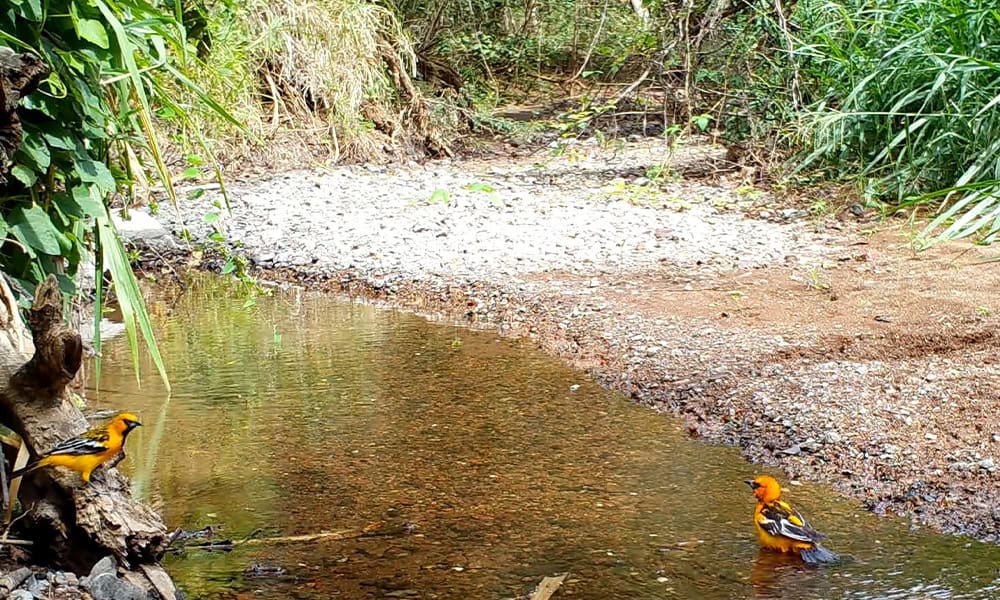
Unfortunately, I do not have any videos of streak-backed orioles with their black teardrop nests. They are almost always too difficult for me to reach with a camera trap and even if I could, they would move so frequently in the breeze that my camera’s batteries would die in a day’s time. So please enjoy these videos of streak-backed orioles splashing around in pools of water.
About the Author
Vincent Losasso, founder of Guanacaste Wildlife Monitoring, is a biologist who works with camera traps throughout Costa Rica.