
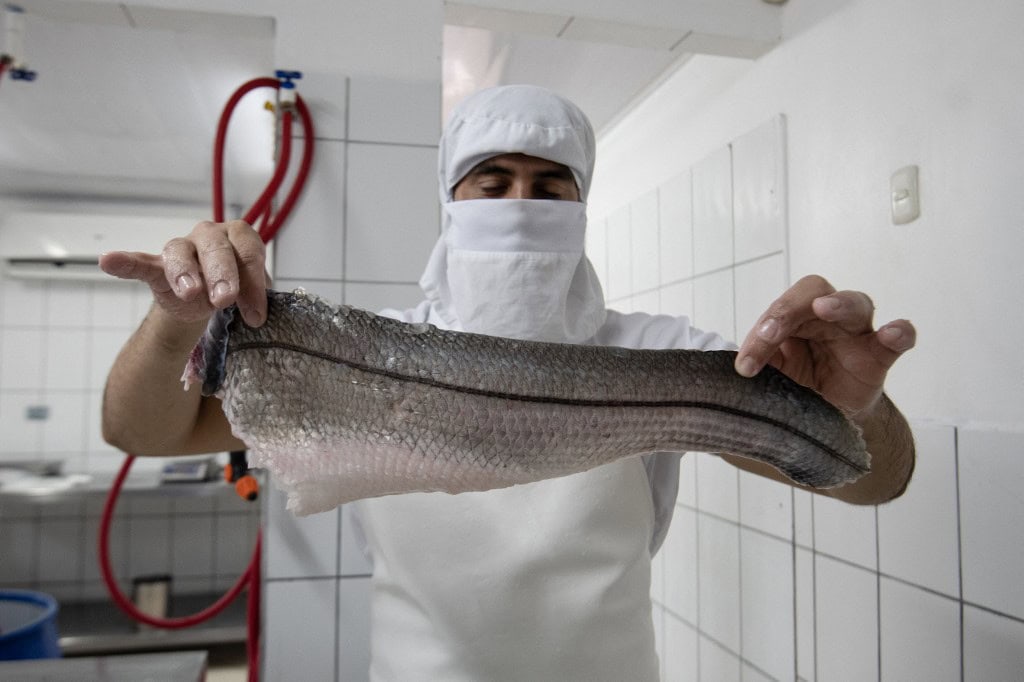
On a beach in Costa Rica’s Pacific, two women clean fish skins to turn them into leather for making clothing and other items like earrings and necklaces. Marta Sosa and Mauren Castro were housewives until two years ago, but they started on this initiative to generate income for their families by using fish skins discarded by fishermen in Costa de los Pájaros, a town located 100 km west of San José. “These skins used to be thrown into the sea, but now they won’t contaminate, and instead they’ll be used to make leather, skins, or fabric,” says 41-year-old Castro.
Fifteen women are part of the cooperative Piel Marina, including Sosa and Castro. Sitting by the sea as fishermen deliver the day’s catch, the women scrape fish skins with metal spoons to remove flesh and use their hands to remove scales. Previously discarded into the sea, the skins are now tanned and dyed to make leather for jewelry, earrings, necklaces, and bracelets. In the future, they hope to create bags, wallets, and shoes, adds 70-year-old Sosa.
Super-Recycling for Fashion
According to the UN, the fashion industry contributes between 2% and 8% of global greenhouse gas emissions and 9% of microplastics in the sea, while underusing materials worth $1 billion annually. The women of the Piel Marina cooperative craft their own jewelry but sell the leather to textile factories in Puntarenas, the main port on Costa Rica’s Pacific coast.
“It’s very innovative,” Castro says. Using waste to create new products aligns with the concept of “super-recycling,” says biomaterials designer Sofía Ureña. “We start from the idea of giving an extra use to what is considered waste in another production chain,” she adds.
From Skepticism to Success
Traditional fishing drives the economy in this area, but the industry is in decline. The cooperative empowers women in Puntarenas by providing them with a source of income beyond domestic chores.
Currently, 15 families in a region with high unemployment and poverty benefit from this business. Castro admits that initially, the women didn’t believe in the project, questioning how foul-smelling fish skin could become raw material. However, with the help of the NGO MarViva, which provided training and financing, they became artisanal tanners.
Sosa explains the process: “First, we clean the skin, wash it with soap, dye it with glycerin, alcohol, and natural dyes, and then let it dry.” After eight days, the leather is soft, elastic, durable, waterproof, and no longer smells like fish.
Aspiring to Global Fashion
Although the cooperative’s business is growing, the women have bigger ambitions. They dream of entering the international market and seeing their leather used by renowned sustainable fashion designers. Global fashion trends are increasingly focused on environmentally responsible production, with recycled and natural materials gaining prominence on runways, according to UN studies.
“The most sustainable and eco-friendly garment is the one that already exists and does not require new resource consumption,” notes Ureña. Castro shares her excitement: “I’d love to see it in Hollywood, on the big runways in Paris, where the top designers are.”