
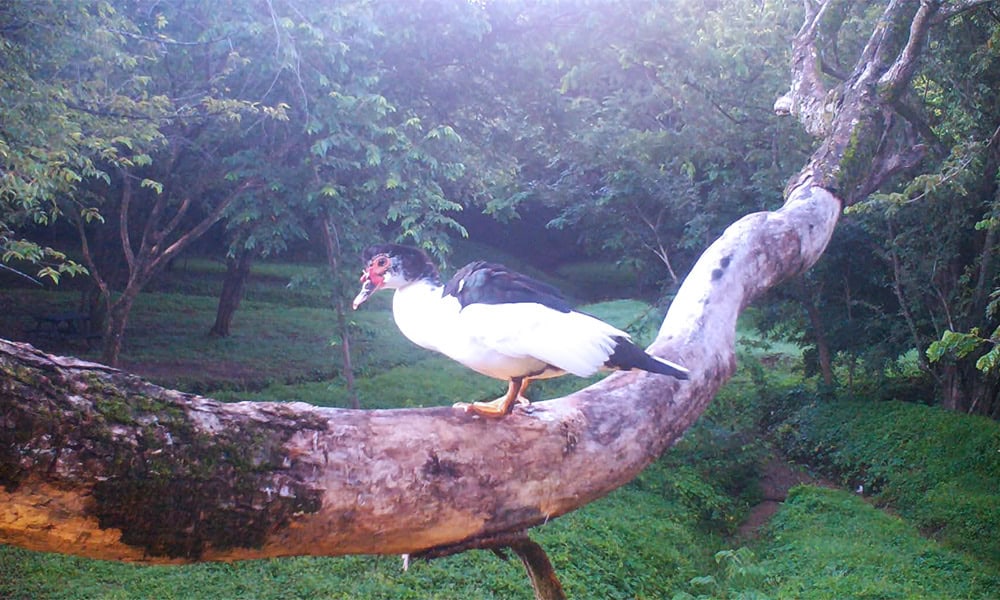
Today we discuss the “king” of Tico ducks, the Muscovy duck. A species of duck that has been taken under the wing of humanity to such a degree that it split into two subspecies.
The Muscovy duck (Cairina moschata) is known as the pato real in Spanish. That translates to royal duck in English but for the life of me I couldn’t figure out how it earned such a moniker. I’m sure this isn’t the reason, but it could be declared the king of all Tico ducks because it’s by far the largest duck in Costa Rica.
Males are heavy-bodied and have broad wings, weighing several kilograms. Females are noticeably smaller. Both sexes are generally black with some metallic green with a white patch on the wings. The male’s face comes complete with red caruncles, which is a fantastic word that’s defined as ‘small, fleshy excrescence that is a normal part of an animal’s anatomy.’ To you and me, that means they have red fleshy bumps on their faces.
Muscovy duck’s have a large natural range starting in starting in Texas and stretching down to Argentina and Uruguay. These ducks have shared that territory with different indigenous human populations for centuries and those populations saw the value in domesticating them early on. Columbus encountered domesticated Muscovy ducks in the 16th century and shipped a few back to Europe on the Santa Maria.
The domesticated ducks have bred separately enough from the wild population that they are recognized as a separate subspecies (Cairina moschata domestica). Domesticated ducks are heavier than wild ducks and thus have more difficulty flying. They can also be differentiated because they frequently have a larger proportion of white feathers than their wild brethren. Both domesticated and wild Muscovy ducks can be found in Costa Rica.
Wild Muscvoy ducks inhabit wet areas of all sorts. They can be found in rather enclosed areas like forested rivers and streams, mangroves, and wooded swamps, but they can also be spotted out in the open in marshes and grain fields. They swim around in small flocks eating mostly seeds and vegetation but also scarfing down the occasional insect, frog, or crustacean.
They often roost in trees at night. They also frequently make their nests in trees with natural cavities. The 8 to 10 white eggs are incubated by the hen for a period of about 35 days.
I see Muscovy ducks every so often in the field. I’m secretly looking for birds the entire time I’m driving, so sometimes I see them fly across the road in Guanacaste. Otherwise, I’ve seen them most frequently along the Tempisque River and in sugarcane plantations in the Tempisque basin which jives with the literature which says their population is greatest around Palo Verde National Park.
I have a few camera trap videos of wild Muscovy ducks from cameras placed near rivers flowing through woodlands. I also recorded a domesticated Muscovy duck in a tree in an area with more people around. I’ll include both subspecies in the video below so you can note the difference between them.
About the Author
Vincent Losasso, founder of Guanacaste Wildlife Monitoring, is a biologist who works with camera traps throughout Costa Rica. Learn more about his projects on facebook or instagram. You can also email him at: vincent@guanacastewildlifemonitoring.com