
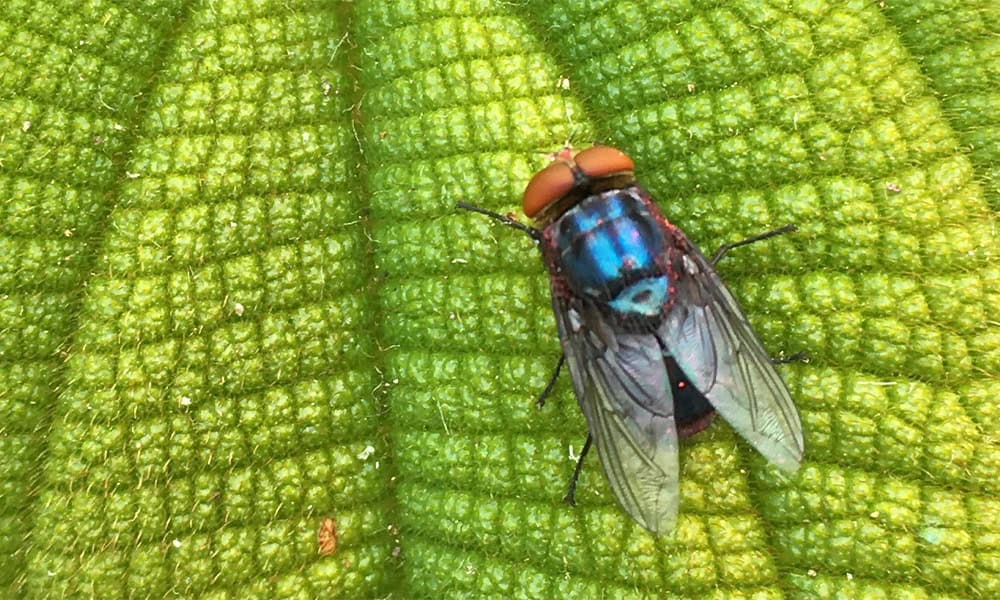
Costa Rica has faced an increasing number of cases of Cochliomyia hominivorax, popularly known as the screwworm, a pest that affects both animals and humans and can be deadly.
Information from the Ministry of Health indicates that, as of June 26, eleven human cases have been reported, and two people have died due to complications. Most cases are concentrated in rural areas, where exposure to infected animals and people is higher.
Dr. Adriana Troyo, a specialist in medical entomology at the Faculty of Microbiology of the University of Costa Rica (UCR), explained that one reason for the danger of Cochliomyia hominivorax is its ability to feed on living tissue.
The expert said that the preferred place for adult flies to lay their eggs is in open wounds of animals and humans, where the larvae then begin to feed. Flies can also lay eggs in body cavities such as the mouth and nose, where there are odors or secretions.
In a short time (approximately six to eight days), the infestation can cause serious damage and, in some cases, even death if the infestation is not treated in time.
Dr. Olger Calderón, also a medical entomologist at UCR, stated that this infestation caused by Cochliomyia hominivorax generates a condition known as myiasis. Myiasis is a parasitic disease produced by fly larvae that develop in living vertebrate tissues.
“Cochliomyia hominivorax lesions present as maggots. This type of myiasis is also typified as obligate myiasis, where the larvae are obligate parasites and always depend on a living organism to be able to carry out this larval period,” he noted.
SENASA indicated that, although the screwworm is currently very common in South American countries such as Uruguay, northern Chile, and Argentina, Costa Rica had been declared free of this harmful fly since 2000.
In 23 years, the country had not had any cases of these larvae. However, the panorama has changed, and specialists said humans must learn to live with this fly again.
“This fly will not be eliminated in months; it will take years if we manage to do it again. So, we have to learn to live with it, as well as with the other flies that are capable of producing myiasis,” Dr. Troyo commented.