
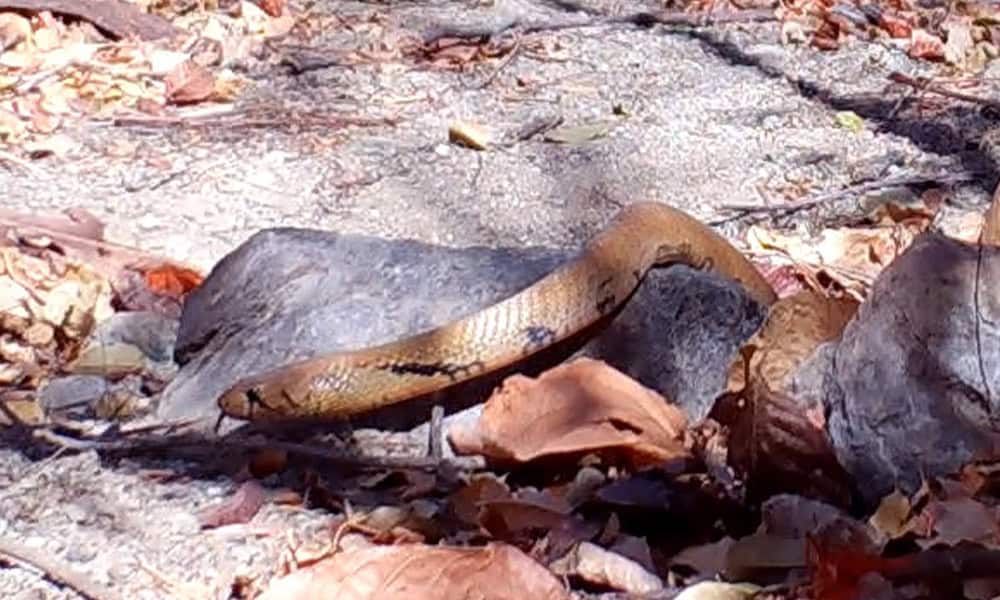
While having dinner last night with friends from the US who are here vacationing in Guanacaste, I was presented with a common question, “You’re the wildlife guy. What snakes do we need to worry about?” Costa Rica is home to 141 species of snakes, and it’s a common concern that several of those species are going to invade your house, slither into your suitcase, or bite your unsuspecting children.
My response was one sourced from my own experience, “Chances are that you’ll see zero snakes during your weeklong beach vacation.” Of course, the frequency with which one encounters snakes depends on the type of habitat you’re vacationing in. Here at the beach in Guanacaste, I spend more time than most tramping around in the forest and snake interactions are a pleasant and infrequent occurrence. When I do happen upon one, quite frequently it is the blacktail cribo.
The blacktail cribo (Drymarchon melanurus) is also known as the Middle American indigo snake. In Tico Spanish it’s known as the sabanera real. These snakes are among the largest in Costa Rica, reaching lengths of over nine feet. Most of their body is a yellowish-tan/pale brown that darkens at the tail end. The features that make them easiest to identify in the field, besides their length, are black lines on the sides of the head and neck.
They range from Mexico down to South America. In Costa Rica their population is mainly centered in the dry forests of Guanacaste, but there have been scattered sightings in other regions of the country. In the dry forests, they’re most frequently found along sources of water.
These big, fast-moving, nonvenomous snakes have an extremely varied diet. It seems like an ‘I eat whatever fits in my mouth’ situation. They’re known to eat fish, eels, frogs, lizards, birds, bird eggs, small mammals including bats, and even juvenile turtles. What really stands out about their diet is that includes a lot of other snakes. A quick search of the scientific literature on blacktail cribos brought up a series of articles that could all share the same title of ‘Hey I saw this snake eating another species of snake.’ Highlights of snakes on the menu include other blacktail cribos, boas, and several venomous species like the Middle American rattlesnake, the Central American jumping pit viper, and the terciopelo.
As I mentioned before, blacktail cribos are one of the species of snake that I see most frequently in Guanacaste. Sometimes I see their large bodies slithering across dirt roads while driving to camera sites and sometimes I happen upon them while making my way through the forest to reach a camera trap. Usually, I’m walking alongside a stream in a wooded area, we bump into each other, I think “Neat! A snake!” and the snake streaks off in the opposite direction.
Camera trap snake videos are an infrequent treat but blacktail cribos tend to trigger the cameras more than most, probably for two reasons. First, I like to place my cameras near water sources in Guanacaste and that’s where they like to hunt. And second, the movement of their large bodies is enough to trigger the motion sensor on the cameras. Take a look at a few of my favorite blacktail cribo camera trap clips in the video below.
About the Author
Vincent Losasso, founder of Guanacaste Wildlife Monitoring, is a biologist who works with camera traps throughout Costa Rica. Learn more about his projects on facebook or instagram. You can also email him at: vincent@guanacastewildlifemonitoring.com