
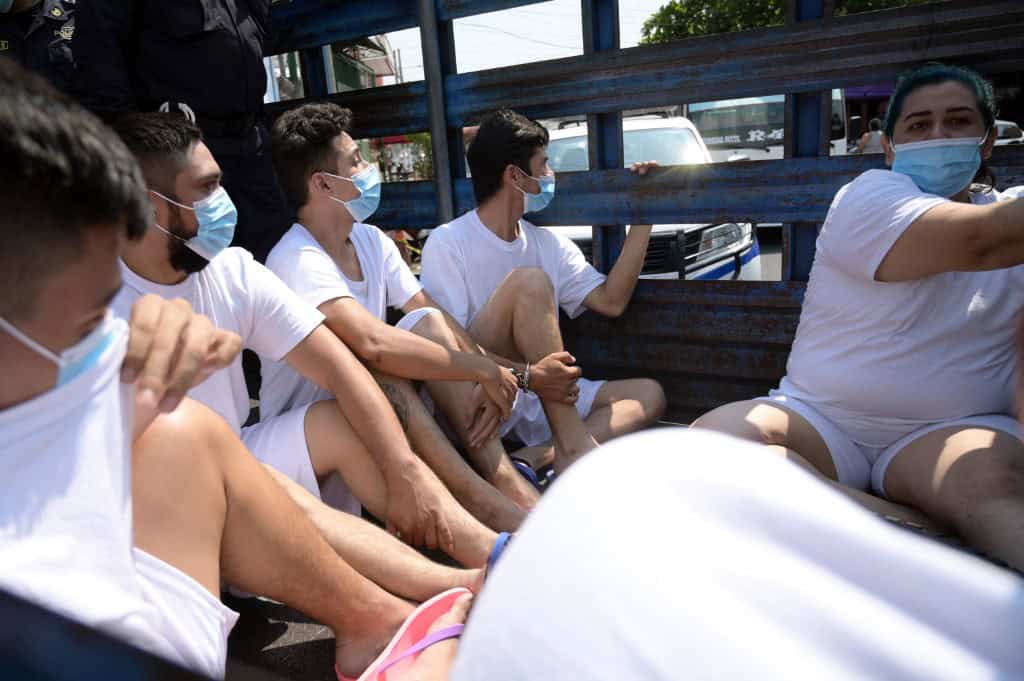
The “parallel state” created by the gangs in El Salvador was destroyed with the “war” of President Nayib Bukele, but the state of exception that allows arrests without a judicial order must continue, affirmed the minister responsible for this crusade.
“What we knew as that parallel criminal state that the terrorist gangs had established in this country is basically already destroyed,” said the Minister of Justice and Security, Gustavo Villatoro
Bukele declared “war” on the gangs on March 27, 2022, after an escalation of 87 homicides in one weekend, under a questioned state of exception that allows the military and police to make arrests without a judicial order.
“In terms of dismantling the crime industry, that criminal state with its collection apparatus, understood as income or extortion, was generating 1.5 to 2 billion dollars a year [for the gangs], which right now does not even reach 5%,” Villatoro assured.
The maras or gangs controlled 80% of the national territory, according to Bukele, and financed themselves by charging extortion to thousands of Salvadorans, mainly merchants and transporters. Those who did not pay were murdered. The massive recruitment that the maras did is “neutralized,” said the minister.
“It was an organized crime that usurped five elements of every State of Law: territory, population, collection, justice and army,” Villatoro stressed. He highlighted that 492 gang leaders who controlled the maras or gangs are in prison and “are being prosecuted,” and must answer for the 120,000 homicides they perpetrated in the last three decades.
Bukele’s crusade returned tranquility to the streets and raised his popularity, which allowed him to be re-elected in February for a second five-year term.
Almost 80,000 prisoners
Since the “war” began, the authorities have arrested 79,800 alleged gang members, of which 7,600 have been released, Villatoro said. He affirmed that they were not released for being innocent, but because they are going to be tried in freedom by virtue of the fact that it “has been established that they were working in the gang under duress.”
However, human rights groups maintain that among those detained there are many innocent people and that the “crisis” of human rights can be “perpetuated” in the country.
In March, Amnesty International warned that the Salvadoran government tends “to minimize, hide, delegitimize and deny the accusations” made against it. This “suggests that during the second term of President Bukele there could be a deepening of the crisis [in human rights] that has been observed during the last years”, sustained the NGO.
Amnesty and other organizations demand an end to arrests without a judicial order. The same is wanted by 64% of Salvadorans, according to a university survey released two weeks ago, although 87.5% declared that they now feel “safe.”
But Villatoro maintains that the “deactivation of the state of exception” should only be done when there are no gang members left free. “We don’t want any ‘homeboy’ (gang member) free in Salvadoran territory,” he said.
Faced with complaints of overcrowding and mistreatment in prisons, he said that “in any democracy there are accusations” and assured that the government does nothing outside the law.
Fewer homicides
The minister indicated that of the total number of those captured, almost 65% were part of the Mara Salvatrucha (MS-13); the remaining 35% were from the Barrio 18 gang with its two factions, Sureños and Revolutionaries.
75% of the gang members have been arrested, indicated Villatoro, and many of the remaining 25,000 “are out of the country,” in Guatemala or Mexico. Others “returned to their origins in California” (western United States), where Salvadoran residents created the Mara Salvatrucha in the 1980s.
The minister highlighted the reduction in the number of homicides in the country, as well as the unsolved cases. From 105 homicides per 100,000 inhabitants in 2015, the figure was reduced to 2.4 per 100,000 inhabitants in 2023.
And the projection is to close this year with 1.4 or 1.7 murders per 100,000 inhabitants, he said. 97% of homicides remained unpunished nine years ago, but in 2023 justice was served in 95% of the 155 homicides registered in the country, according to Villatoro.