

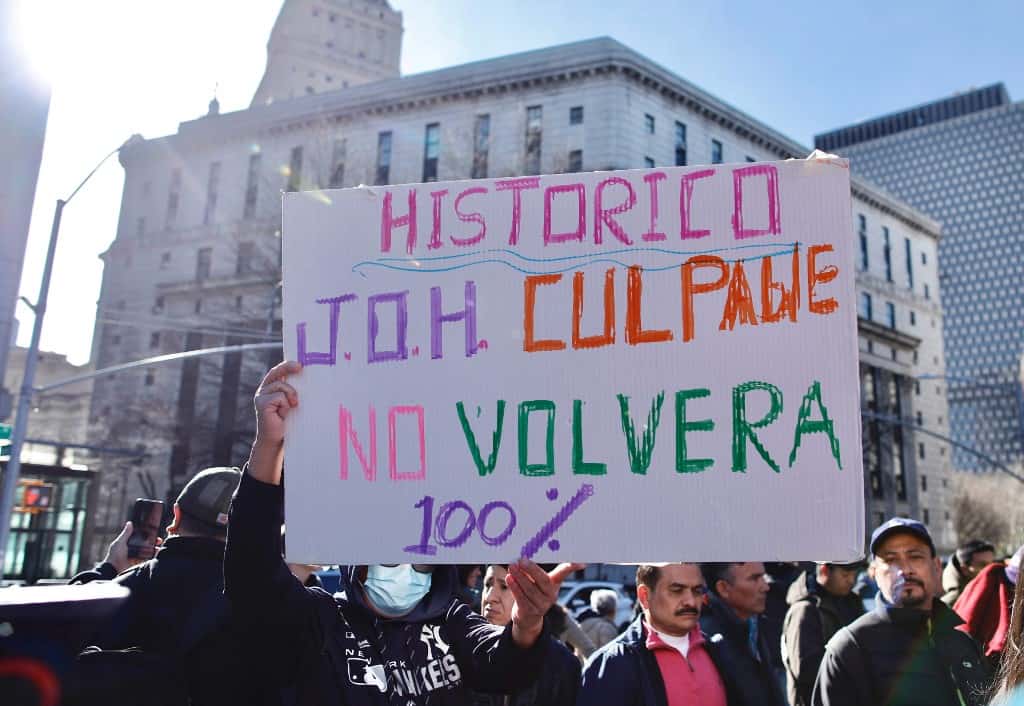
A jury in New York on Friday found former Honduran president Juan Orlando Hernandez guilty of trafficking hundreds of tons of cocaine into the United States, enriching himself while protecting and abetting some of the region’s most infamous drug cartels.
A 12-member jury in federal district court returned its unanimous verdict midway through its second day of deliberations.
The 55-year-old Hernandez, who appeared to pray while awaiting the verdict, shook his head in disbelief as the jury foreman delivered guilty findings for each of three counts: conspiracy to import cocaine, illegally using and carrying machine guns, and possessing machine guns as part of a “cocaine-importation conspiracy.”
Hernandez, 55, who US federal prosecutors say turned his Central American country into a “narco-state” during his presidency in 2014-2022, faces possible sentences of up to life imprisonment. Sentencing was scheduled for June 26. His lawyer Raymond Colon said Hernandez would appeal the verdict.
“I am innocent, tell the world,” he told friends, relatives and supporters — including three generals who testified on his behalf — as he was escorted from the courtroom. “I love you.”
Money for protection
Hernandez is accused of having facilitated the smuggling of some 500 tons of cocaine — mainly from Colombia and Venezuela — to the United States via Honduras since 2004, starting long before his presidency.
Prosecutors said he had worked in particular with the powerful Sinaloa drug cartel, at the time headed by infamous Mexican drug trafficker Joaquin “El Chapo” Guzman. “He paved a cocaine super-highway to the United States,” prosecutors said.
Hernandez used the drug money to enrich himself and finance his political campaign, and to commit electoral fraud in the 2013 and 2017 presidential elections, they said.
Extradited to the United States in 2022, shortly after leaving office, he was accused of aiding drug smugglers — saving some from extradition, and even providing military and police protection for drug shipments — in return for millions of dollars in bribes.
Prosecutors say that while Hernandez enriched himself, the country was suffering from dire levels of poverty, crime and corruption. “Today justice has been done,” said a euphoric human rights activist, Lida Perdomo, standing outside the New York courthouse, where dozens of boisterous Hondurans had gathered to await the verdict.
“We hope they sentence him to at least three life sentences… to make him pay for all the damage he did to my country,” she said.
Shoveling drugs into the US
Hernandez denied wrongdoing, insisting that, far from being involved in trafficking, he was a regional leader in the fight against the cartels, and an ally of the United States.
But assistant US attorney Jacob Gutwillig said Hernandez had lived a dual life: publicly promoting a crackdown on drug trafficking, and basking in praise from Trump administration officials for his alleged help in the drug war — while behind the scenes he was “a drug dealer.”
Some of the most damning testimony against Hernandez came from former traffickers who secured reduced sentences from US authorities in exchange for their cooperation.
Witnesses included Devis Leonel Rivera, head of the powerful Los Cachiros cartel; former El Paraiso mayor Alexander Ardon, from Hernandez’s own political party, and Fabio Lobo, son of former president Porfirio Lobo (2010-2014).
They said they had “contributed” thousands of dollars to Hernandez’s first presidential campaign in exchange for his protection. “We are going to shove drugs under their noses,” one witness quoted Hernandez as saying of the Americans, “and they won’t even notice.”
Throughout the trial, some one dozen witnesses — several of them already convicted and sentenced — described in detail what they said were close connections between the drug traffic and politics in the Central American country.
One of Hernandez’s lawyers, Renato Stabile, appeared distraught after the reading of the verdict, telling AFP, “Obviously the ruling is harsh, but mentally he is very strong.”
But US attorney Damian Williams said that while Hernandez “had every opportunity to be a force for good in his native Honduras, instead, he chose to abuse his office and country for his own personal gain and partnered with some of the largest and most violent drug trafficking organizations in the world.”
With the guilty verdict, Hernandez follows in the footsteps of other former Latin American heads of state convicted in the United States, like Panama’s Manuel Noriega in 1992 and Guatemala’s Alfonso Portillo in 2014.





