

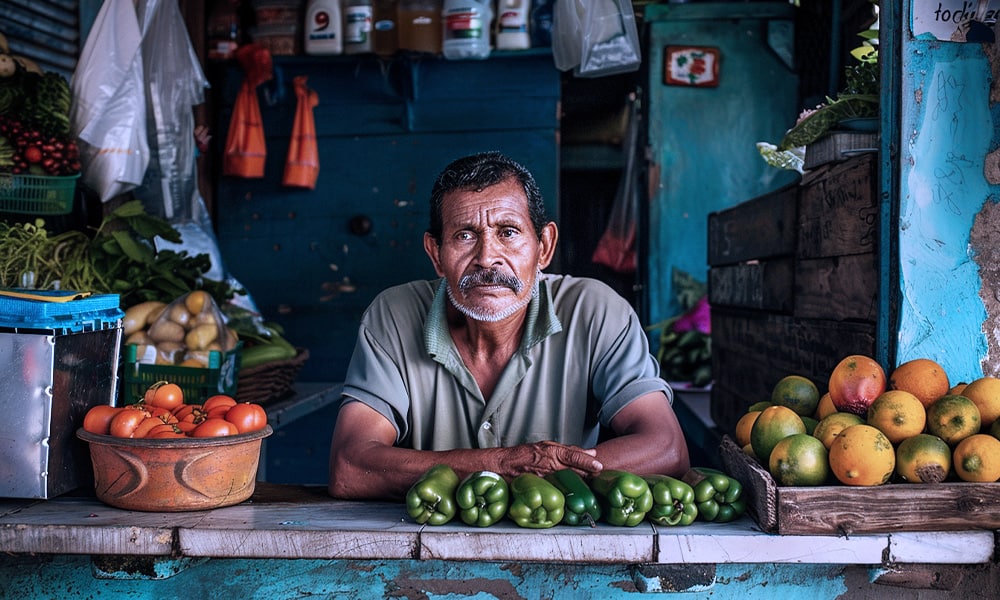
Before inaugurating his sauna in eastern Lima, Eduardo began to be extorted by cell phone. He ignored the threat. The next warning was very different: one night from a motorcycle someone opened fire on the empty premises he was conditioning.
From Mexico to Colombia, Ecuador and Peru, through El Salvador, Honduras or Guatemala, extortion has undermined citizen security. Its millionaire profits place it behind drug trafficking or human trafficking, and it can be more profitable than illegal mining, according to intelligence sources.
In Eduardo’s case, he learned of the attack through a video sent to his mobile phone. “The owners of San Juan de Lurigancho,” a gang that operates in this district, the most populated in the Peruvian capital, with 1.2 million inhabitants, demanded an installation “registration” of $13,300 and a monthly fee of $1,300.
“I’m almost hiding because I imagine they’ve already studied everything, and they know where I live, where I have breakfast, where I have lunch, where I stay overnight,” says this 40-year-old man who hides his true identity for fear.
Small and large merchants, transporters, residential complexes and entire towns are victims of local or international organizations. In Peru, extortion even knocked on the doors of football. Striker Paolo Guerrero was about to give up playing for César Vallejo club because of threats to his family.
We know who you are
It is the same evil with multiple names: in Peru they are The Octopuses, in Colombia it is the Gulf Clan and in Ecuador, Sharks. There is also the feared Aragua Train from Venezuela, the organization with the greatest expansion in the last five years with a presence in Colombia, Chile and Peru.
These groups have become “criminal companies” in search of markets and “partners in other countries,” says Peruvian anti-crime prosecutor Jorge Chávez.
Despite the intimidating power of these gangs, complaints have skyrocketed. Last year Peru received 19,401 compared to 4,119 in 2021, a 471% increase in two years.
In Ecuador, which is facing an unprecedented onslaught of drug trafficking, complaints increased by 482%, going from 2,801 cases in 2021 to 13,500 until September 2023.
In Colombia, where for decades guerrillas and paramilitaries have also extorted, the figure has quadrupled since 2012: 2,316 cases compared to 9,297 last year, according to all official data.
And in Mexico an extortion is reported every hour, according to the business association Coparmex. Fear spreads with similar methods and messages.
“We know who you are, we already know what time your business opens (…) we know when you go to the market, we know where your son studies,” is the warning that has become common via WhatsApp, says Andrés Choy, president of the Bodegueros Association of Peru, which brings together 22,000 small merchants.
He estimates that 13,000 of them were blackmailed last year. The next notice can be the “photo of your family member walking,” after which some close or send their children abroad, he adds.
Widow of 43 with two daughters, Anita is another frightened victim. In January they launched an explosive device and fired at the facade of her hardware store in Lima. “The threats changed my life. I have to be hidden with my girls between four walls,” she laments.
Parallel state
The gangs have practically created a “parallel state”: they control territories to later establish a tax system, maintains Ecuadorian Colonel Roberto Santamaría, police chief of Nueva Prosperina, one of the most violent districts in the port of Guayaquil.
After imposing terror through threats, they ensure revenue by often using minors who are not liable to prosecution. Another faction is responsible for attacking those who resist or fail to comply. In a more sophisticated phase of the crime, one group yields to another “the administration” of its area for a regular sum of money.
The colonel sizes up its financial muscle: in a single set of 2,000 homes in Nueva Prosperina, each was charged two dollars a day; 120,000 per month that can reach 200,000 dollars with the collection from transporters.
In Colombia control can extend to entire populations. In Buenaventura, its main port on the Pacific, with 311,000 inhabitants, “everyone has to pay” either to “open a business, build or improve a building,” says Elizabeth Dickinson, Crisis Group analyst in Colombia.
From the call center to AI
Facing the advance of extortion, Peru created an elite force last November to combat this crime, whose methods have also mutated. At first the gangs extorted in exchange for guaranteeing the security they themselves snatched away. Then came the drop-by-drop modality, small weekly interest loans of up to 20%.
“When the ‘client’ can’t pay, the extortion issue starts: if you don’t pay we’ll burn down your kiosk, grab your family, sister or kids and injure or kill them,” says prosecutor Chávez.
Lately ‘call centers’ offer loans with lower interest through an application, which victims download to their cell phones. They receive the money after sharing personal information, which is then used to blackmail the entire family.
In addition, criminals are using artificial intelligence to create nude photos with women’s real faces. The image, with the message “I’m a whore call me at this phone number,” they circulate among some relatives and friends. To avoid going viral, victims have to pay, explains the prosecutor.
Despite the high impact of the crime, in Peruvian prisons – from where an endless number of extortion calls are also made – there are just over a thousand convicted for this crime, less than 1% of the entire prison population.
And despite the fear, in many places, business goes on: Eduardo finally opened his sauna and Anita continues with her hardware store.





