
In Brazil, the proverbial goose that lays the golden egg is in reality something closer to a pheasant that excretes coffee beans.
At the Camocim coffee farm, deep in the bucolic hills of Espirito Santo state in Brazil’s southeast, jacus — a type of pheasant native to tropical forests there — are considered some of the most astute pickers (or rather, eaters) of coffee cherries.
“He chooses the best fruits, the ripest,” said worker Agnael Costa, 23, delicately scooping up droppings left behind by one of the birds between two tree trunks.
What goes in as ripe cherries comes out as beans, which can go on to be sold as some of the most delicious — and expensive — coffee in the world. The coffee at Camocim grows in the middle of the lush forest, and the jacus here are wild, eating (and defecating) at their own pace.
“It was this agroforestry system that created the necessary conditions for this exotic coffee to exist here,” said farm owner Henrique Sloper.
Domestically, jacu coffee can sell for 1,118 reais per kilogram (or around $100 a pound) — a price that can rise significantly upon export. Foreign distributors include British department store Harrods, among others.
From enemies to allies
The jacu, with its black feathers and red throat, wasn’t always welcome at the farm. It was originally seen as a hungry pest feeding off precious crops.
But when Sloper discovered “kopi luwak,” an expensive Indonesian coffee made with beans from civet excrement, he figured jacus might make good allies in the quest to make a better brew.
Kopi luwak sometimes has a bad reputation, with farmers accused of pressing civets — small mammals similar to weasels — into captivity to boost production. The wild jacus at Camocim, meanwhile, roam, eat and poop at their leisure.
“It’s 100 percent natural,” said farm production supervisor Rogerio Lemke. “The jacu is within its own natural habitat,” in Brazil’s Atlantic Forest. Linking production to the whims of a jacu’s appetite is just one of the reasons it fetches such a high price.
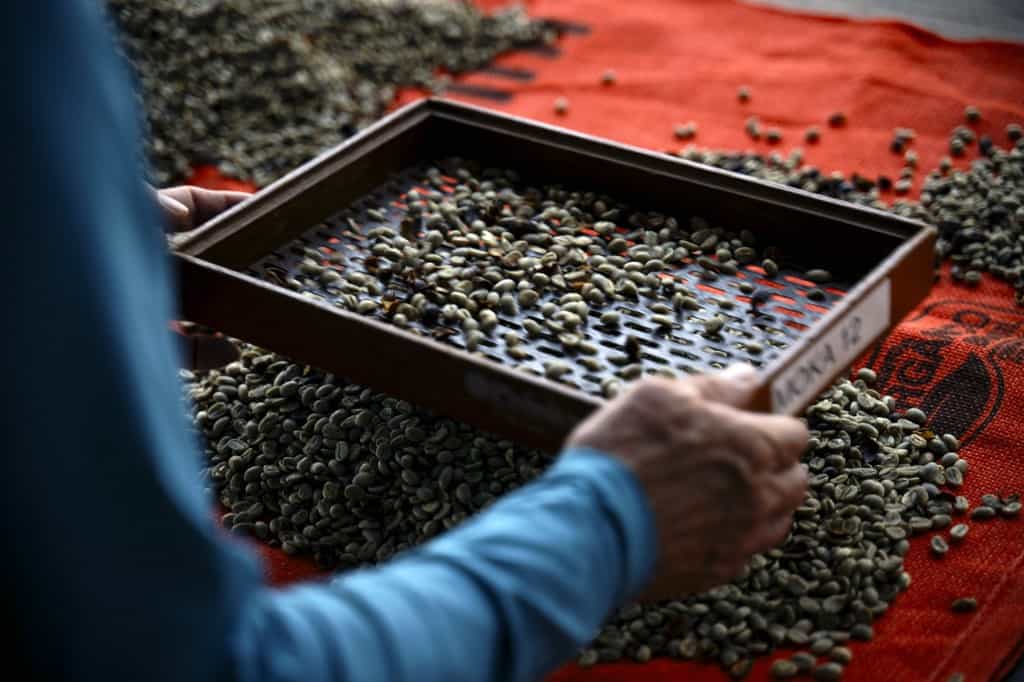
Jacu droppings look a bit like a cereal bar, with beige grains protruding from a blackish, pasty mess. Once collected and dried, the beans are carefully sorted and hulled, and put into a chilled room.
“It is naturally expensive. There is no way to make a jacu coffee at a low cost,” says Sloper. All told, jacu coffee represents less than 2 percent of the estate’s production.
The bird also carries other advantages, both for farmers and those seeking a cheaper — if less intestinally intimate — cup of Joe. “It serves not only as a selector (of the best beans), but also as a harvest alarm” says Sloper. “Where it eats, the coffee is ripe.”
Delicious
While jacus help select the best coffee, there’s nothing in particular about their digestive system that imparts a different taste on the beans.
“The birds have an extremely short intestinal transit time,” said Ensei Neto, a coffee specialist. “So there is not exactly any kind of biochemical process, there is no time.”
Their digestive process is much faster than civets or elephants — another animal whose dung is used, in Thailand, to produce specialty coffee.
Some think the fermentation process stemming from those animals’ longer digestion times imparts a better flavor on the resulting beans. The jacu “only goes for the ripe fruits,” says Neto, producing a coffee with “sweet notes, with good acidity.”
“It doesn’t add anything else. But the story is good.” The jacus have found a fan in Poliana Cristiana Prego, 37, a Brazilian tourist who has come to visit Camocim.
“It’s a delicious coffee and the story behind its production is very original. It’s a new experience for us,” she says. “Our customers are lovers of exotic products, but also those who value the idea of sustainable development,” says Sloper.
For him, “the future of coffee will come from Brazil,” already the world’s top producer. Whether it comes from jacus or otherwise, Brazilian coffee “is showing the world that we really are able to do what nobody else can.”