

In recent years, global warming has become a fact, not a theory; a reality, not a possibility. Few scientists challenge the data showing that the earth’s surface temperature has increased about one degree Fahrenheit over the past century. And every day, stronger evidence is released attributing this warming, at least for the past 50 years, to human activity, according to the Intergovernmental Panel on Climate Change.
Last month, the Kyoto Protocol, a multilateral agreement to combat global warming across the globe, went into effect with the support of more than 140 countries, excluding the United States. The question scientists are now struggling to answer is: What does global warming mean, and how will the environment adapt? Can we expect a rising sea level? A more turbulent climate? Fewer species?
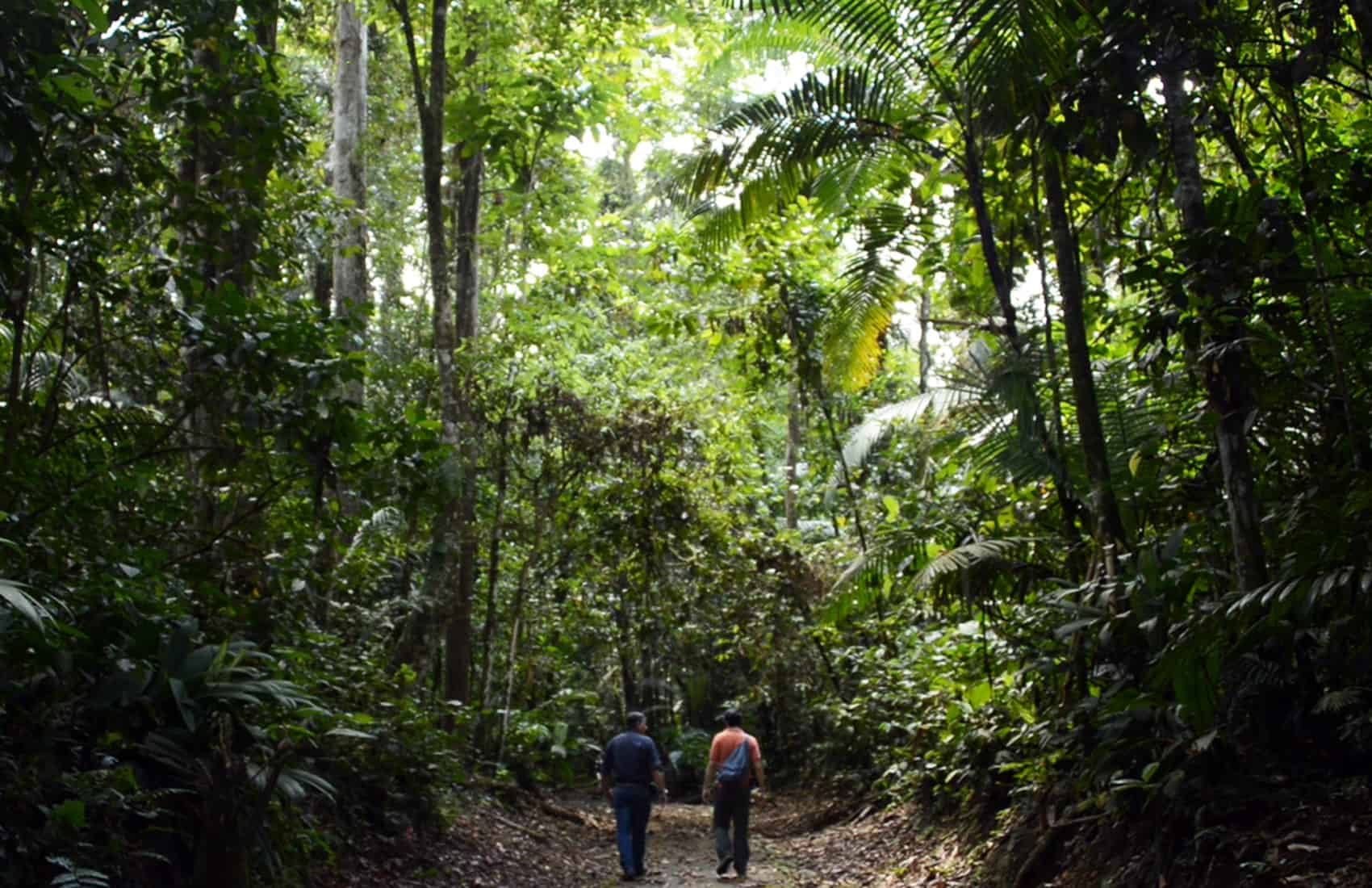
Researchers in northeastern Costa Rica are asking this question about the very thing often viewed as a solution to the excess of so-called “greenhouse” gases produced by humans, particularly carbon dioxide – the tropical rain forest. A project of the Organization for Tropical Studies (OTS) at La Selva Biological Station, in the Caribbean lowlands outside Braulio Carrillo National Park, aims to find out how the rain forest responds to climate change.
Scheduled to end in a few months, the project known as “Towers” has been unprecedented in its scope of measuring various functions of the rain forest canopy. Using a moveable tower, which at its tallest reaches 44 meters (144 feet), scientists have been able to study the primary forest from top to bottom in more than 50 different locations around the La Selva protected area.
“There is not a place in the world where this is being done,” said OTS researcher and eco-physiologist Javier Espeleta. Since the study began in June 2003, a team of 20 researchers and crew members has been erecting the scaffolding tower at each of the 50 sites – a job that entails carrying as much as 4,500 pounds of equipment on backs and shoulders on hikes as long as one-and-a-half hours through dense jungle terrain.
Scientists then spend eight hours a day for two weeks at a time collecting data and leaves that are studied in labs by night. The scaffolding is then deconstructed, moved and reconstructed. Though arduous, the comprehensive picture of the forest they are capturing has made the effort worth it, according to project coordinator Paulo Olivas, who has a degree in forestry from the Technology Institute of Costa Rica (ITCR).
By erecting the tower piece by piece, researchers have been able to slowly move up the forest canopy, collecting information as they go. They are particularly interested in data on plant respiration and photosynthesis rates, and the quantity of leaves in a given area – a figure researchers say is hugely important but deceptively complicated to determine. With this data, researchers are hoping to understand how plants may be affected by global warming. One of the hypotheses of the project is that increased temperatures mean the forest is respiring more, which in turn would mean the forest is absorbing less and releasing more of the greenhouse gas carbon dioxide.
Espeleta said this could result in a “catastrophic cycle” in which the forest is less capable of absorbing carbon dioxide, therefore temperatures would continue to increase, further affecting plants’ ability to absorb the greenhouse gas. Olivas is careful not to forecast too much, particularly because the project is not complete so no preliminary conclusions have been made.
“We don’t know if plants are going to get used to it in the long term… if they are going to adjust to the situation so they become capable of working with high temperatures,” he said. It is not likely the forest will ever become a significant producer of carbon dioxide, Olivas said. The possibility of the forest no longer absorbing carbon dioxide at the present rate is the real threat that could have considerable impact, he explained.
Scientists already point to some measurable effects of the global temperature increase. According to what some scientists say are conservative estimates from the U.S. Environmental Protection Agency (EPA) – operating under the administration of U.S. President George W. Bush who withdrew the United States from the Kyoto Protocol – globally, the sea level has risen 4-8 inches in the past century, worldwide precipitation over land has increased by about one percent and the 20th century’s 10 warmest years all occurred after 1985. The exact level of responsibility of human activity for these effects, and the warming, is still under study.
If temperatures continue to rise – and scientists expect they will, by 1-4.5 degrees Fahrenheit in the next 50 years – the impact could be even more dramatic. Warmer temperatures would bring more evaporation, which would increase average global precipitation, and in tenser rainstorms are likely to become more frequent, the EPA warns. The sea level could also rise two feet in areas. Other scientists predict effects could be even more severe.
In the tropical forest, species that require high humidity may die if temperatures continue to increase. In addition, more extreme climatic conditions usually mean the forest is more homogenous, Olivas said, pointing to the mountainous tundra and the desert as examples. But these are only possibilities, he emphasized.
The research part of the Towers project will conclude in May. Scientists will then begin analyzing the data and should have scientific models of the forest’s possible reaction to global warming within a year, Olivas said. These models will offer predictions that are more precise in the short term and less exact in the longer term, he said. “Models aren’t perfect or exact with how things might change. The only thing that drives evolution is time,” he said. “This is the really cool thing. We try to understand nature and predict what might happen. But Mother Nature is so magical she might change and adapt to the situation.”





