

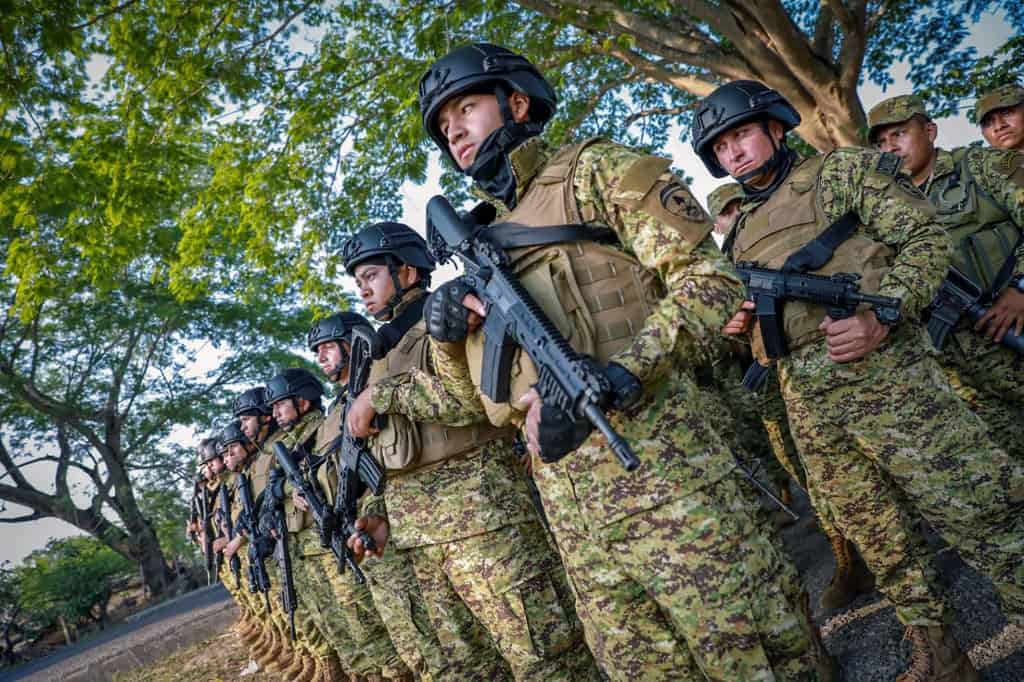
With bulletproof vests and rifles, some 150 police board numerous armored cars and depart in different directions to look for gang members on the second day of a military siege imposed by President Nayib Bukele in an entire region of El Salvador.
Before leaving, the agents receive instructions inside an old prison in Ilobasco, a small city in the central department of Cabañas, which since Tuesday has been under siege by military and police.
“May God take care of you, goodbye, my love,” a barefoot woman manages to cry out to her husband as police take him from his home in the rural community of Maquilishuat, a few kilometers from Ilobasco.
The officer in charge of the arrest assures that this 44-year-old man “belongs” to the feared Mara Salvatrucha (MS-13) gang. “He is in charge of mobilizing his gang’s weapons,” said the officer.
With the “war” against gangs declared by Bukele in March 2022, almost 72,000 alleged gang members are in prison in El Salvador, by virtue of an emergency regime that allows arrests without judicial order.
Human rights organizations criticize Bukele’s methods and allege that his war involves abuses and many innocents are detained.
It’s very good
The police set up roadblocks on Cabañas roads to stop vehicles and ask occupants for identification, while others, with lists of names in hand, searched for gang members in their homes.
These agents from the Tactical Operations Section are part of the operation of 7,000 military and 1,000 police that Bukele deployed in Cabañas after last Sunday alleged gang members injured two police officers in this area.
“I say it’s very good [the military siege] so that people can walk around calmly,” said Cruz Peña, a 63-year-old newspaper vendor in Ilobasco’s central square.
When he worked on buses, a gang member once put a dagger to Peña’s body to rob him of his money, while other neighbors were forced to close their stores and leave the country to safeguard their lives.
They killed two nephews
José Escobar, who has lived in Washington for 33 years and has been visiting El Salvador for a week, says gangs killed two of his nephews in recent years.
“In my case I had to emigrate, my family had to pay [extortion] to live in our own home, [it was a] very unpleasant situation,” says the 56-year-old man.
Sitting on a bench in front of Ilobasco’s church, Escobar says that in one more week he will return to his home in the United States, but that by virtue of the new atmosphere of security in El Salvador, once he retires he will return to live in Ilobasco.
Root intervention
All the roads in Cabañas were monitored this Wednesday by soldiers with armored vehicles equipped with machine guns.
On the road from San Salvador to Sensuntepeque, the departmental capital, soldiers stopped vehicles at random and asked occupants for documents.
After opening his vehicle to the soldiers and showing his documents, Steven Pocasangre, a 36-year-old agronomist, says there were places in the area “where you couldn’t get to” because they were under gang control and celebrates that the authorities “are intervening root cause”.
Cabañas has 150,000 inhabitants and is one of the smallest departments in El Salvador, covering just 1,100 square kilometers. It is an agricultural region, with coffee and sugarcane crops and small cattle farms.
We already went through the civil war
The presence of military and police has generated concern in the Santa Marta community, because that area faced the harshness of the civil war (1980-1992) and its inhabitants fled to Honduras, where they remained for seven years.
“Many mothers are worried because they have seen that quite a few soldiers are around our community and they are afraid that their children may lose their freedom,” said Vilma Escamilla, 43.
In Santa Marta, even mothers are afraid that their sons who have cornfields (maize crops) in the immediate hills “may be arrested,” the woman adds.
“For us it is like reliving what we already went through in wartime (…), we ask for respect for our community because we have the right to walk free,” she emphasizes.





