
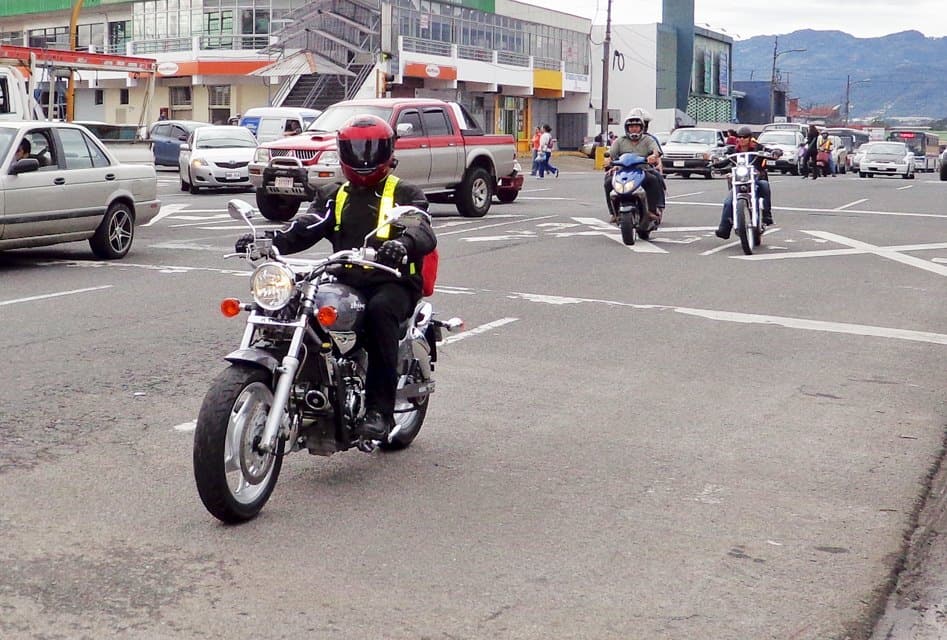
Nearly 50% of accidents on Costa Rican roads involve motorcycles. Not only are two-wheelers an economical way of commuting to their workplace or delivering food, but for many, it is a way of seeking some adventure and adrenaline rush. But riding a motorcycle brings its own share of risks!
It’s not that two-wheelers are unsafe, but they definitely require more care and caution from the riders. Car drivers also need to do the job of watching out for motorcycles and maintaining a safe distance from them.
Let’s take a look at some of the tips that will keep riders safe on the road.
10 Tips for Safe Motorcycle Riding in Costa Rica
1. Wear appropriate gear
You should ALWAYS wear a helmet and other important gear while riding a two-wheeler. That is a non-negotiable clause of riding a motorcycle. Not only because you will be fined by the cops, but for your own safety.
Invest in a good quality helmet, and make sure it covers and protects your jaw as well. Always have the visor down as it will protect your eyes from dirt, dust, and rainwater.
Costa Rica requires all two-wheeler riders to wear reflective bands during the night. This enables them to be visible on the road. If there is a pillion rider, that rider wears the band.
2. Always follow traffic rules and signs
It is essential to follow traffic rules and watch out for traffic signs. These have been designed keeping road safety in mind. Be mindful of the speed limits mentioned on the roads and do not cross the limit. Do not hit the brakes abruptly or take sudden turns. Give an appropriate signal before doing the same.
3. Maintain a safe distance
It is advisable to maintain a safe distance from other vehicles on the roads. This practice gives you enough time to apply brakes in case of an emergency. It also saves you from bumping into the vehicle in front of you in the event of sudden applications of brakes by them.
It is also important to practice this while overtaking other vehicles on the road. Do not try cutting ahead when there isn’t enough space.
4. Mind the potholes
The quality of roads varies in Costa Rica. Some are smoothly paved while some are bumpy. But, one thing that is quite commonly known among Costa Ricans is that potholes here are hardly ever repaired. So, you need to mind the potholes and exercise caution on both paved and dirt roads.
5. Pay attention to any wildlife crossing the road
Always be prepared for animals crossing the road. In Costa Rica, there are generally traffic signs suggesting that wildlife is crossing along with a picture of the animal.
It is not unusual to see iguanas, coati, monkeys, and sometimes even a sloth crossing the road. It is advisable to not be taken by surprise but to exercise caution in such situations.
6. Be careful in the rainy season
The rainy season can pose many risks to two-wheeler riders in Costa Rica. Therefore, it is important to maintain a high level of alertness. Some of the risks are –
● Roads are in worse condition at this time of the year.
● It is not easy to spot potholes when it’s raining. Even if you do, it is not easy to judge the depth of the pothole.
● Flash floods can occur at any time during the rainy season.
● Your vehicle is more likely to break down in the rainy season.
● A river crossing may be required during the rainy season.
7. Ensure you have an Insurance Policy
NEVER, and I repeat never, ride a vehicle on the roads of Costa Rica without a valid insurance policy. In case of an accident, things can get very messy without insurance. Moreover, only insurance coverage can save you from the hefty amount of repairs and medical bills.
8. Be absolutely sober while riding
NEVER drink alcohol or take drugs before riding. Doing this puts you at a greater risk of an accident. Moreover, no insurance company will cover you if you are found to be under the influence of drugs or alcohol. Be a responsible rider!
9.Always check your two-wheeler before long trips
Checking your vehicle frequently and before long trips ensures there are no unforeseen breakdowns in the middle of a highway or a dirt road. Get the vehicle serviced regularly.
A few things to look at –
● Gas tank – Make sure you have enough gas to last you the trip. Gas stations are not hard to find in Costa Rica, but there may only be a few in remote areas.
● Brakes – A quick check of your brake discs is important and easy to do.
● Tires – Check the pressure of your tires.
● Lights – Make sure all lights are functional and working.
10. Do not ride with more than one pillion rider
Always have only one passenger rider with you. Riding with more than one passenger rider is a very BAD IDEA. Not only do you increase the possibility of an accident but also compromise the safety of all riders.