

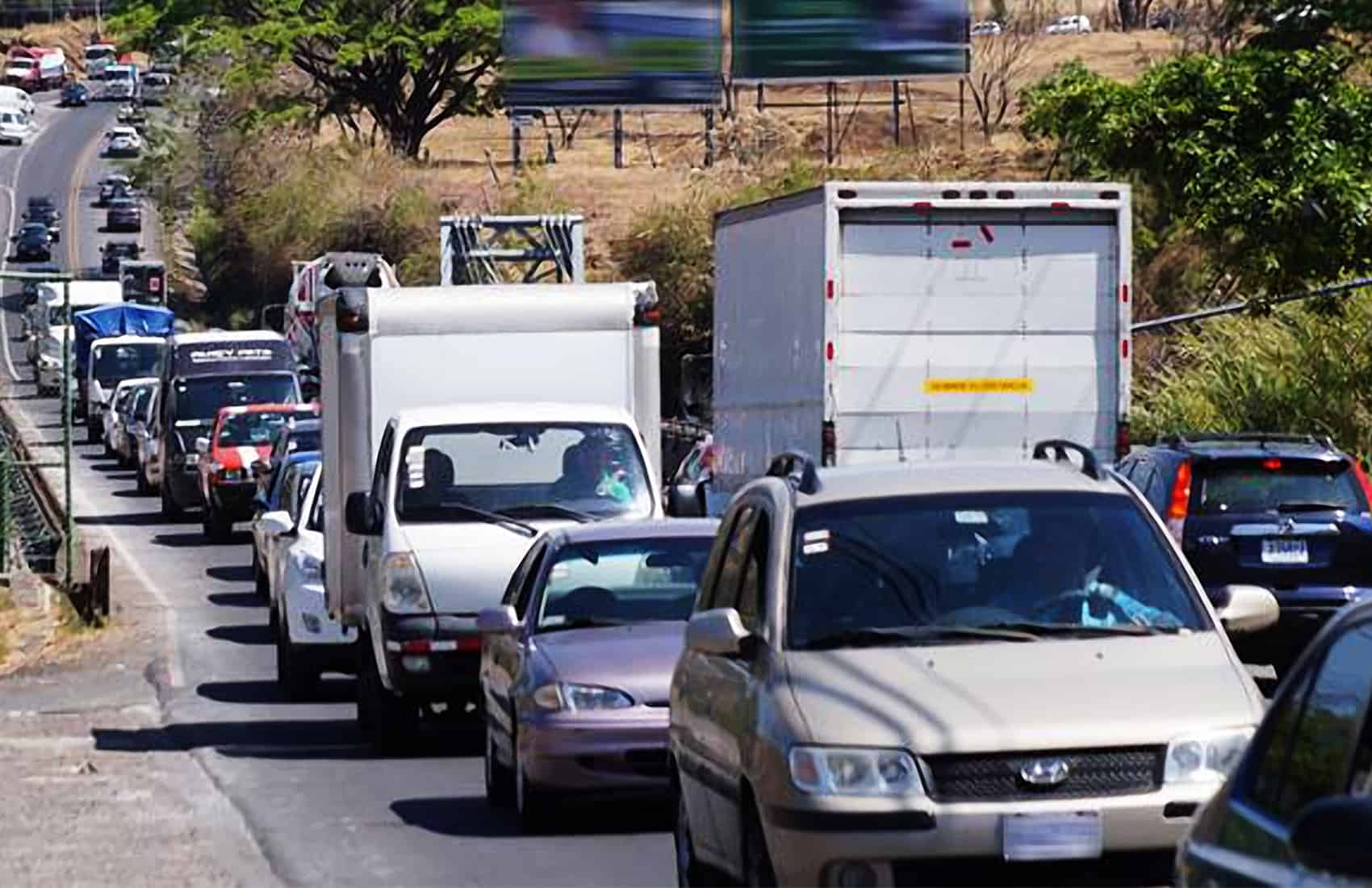
Weather events are among the many hazards drivers face in Costa Rica. Below is a list of vehicle safety tips compiled from a 2006 Tico Times story.
Frequently asked-for and necessary documents
- A valid driver’s license. Costa Rica honors other countries’ valid driver’s licenses for 90 days. After 90 days in the country, you should obtain a Costa Rican license.
- Passport or resident’s cédula card.
- Vehicle papers: copy or original title/registration, up-to-date Riteve (vehicle inspection) and marchamo (vehicle circulation permit) stickers.
- Front and rear plates.
- Emergency kit: Spare tire and associated tools; a fire extinguisher; at least two warning triangles; a reflective vest.
Basic traffic laws and hazards
Costa Ricans drive on the right side of the road with traffic rules and signs approximating those of the United States and Canada. However, the country’s challenging terrain and sometimes subpar road infrastructure means drivers should expect to maintain a high level of concentration behind the wheel.
Especially for newcomers to an unfamiliar area, we recommend avoiding nighttime driving.
The paved and dirt roads of Costa Rica have many dangerous challenges that are not easily foreseen. Below are a few obstacles drivers frequently encounter, both night and day:
- Large potholes
- Roadside and road-bed washouts
- Narrow bridges
- Other motorists, pedestrians, bicycles, motorcycles
- Horses, cattle, dogs and other animals on the roads
- Narrow roads with very little, if any, shoulder
- Roads with poorly painted lines and no street lights
More concentration is needed while on the highways of Costa Rica than one might expect; there are a lot of hills and most of the highways are single-lane. Passing slow-moving, large trucks on hilly highways adds risk.
Driving on unpaved roads or on paved roads in poor condition requires the driver to concentrate on the path of both sets of wheels, left and right.
Be sure to leave some space if you are following vehicles in front of you. If you are to swerve, you need to be able to see if you have room on the shoulder as well as the oncoming traffic in the other lane.
Be aware of dry- versus wet-season differences.
During the dry season, visibility on dirt roads can be impeded by the high level of dust. Leave an extra amount of space between you and the vehicle ahead to allow the dust to settle or blow aside off the road. Dirt roads also become washboarded and rocky this time of year.
During the wet season, the roads are in worse condition, paved and unpaved. Water fills the potholes, preventing you from seeing the depth of the hole. If you can’t find a path around all of the potholes, adjust your speed and drive slowly enough so you don’t hammer on your suspension system as you pass through them. More things on your vehicle will fail or break down in the wet season than any other time. The rain, humidity and poorer quality of the roads all take their toll on your vehicle.
Don’t put off vehicle repairs during the wet season.
Many Costa Rican roads have poor drainage gradients, resulting in water pooling on the surface during storms. This increases a vehicle’s risk of hydroplaning.
A few words about river crossings: the rivers are deeper and faster moving during the rainy season. Most vehicles have the ability to ford a depth up to the center of their wheels, more or less. When in doubt, watch other vehicles cross or walk across the river yourself to measure its depth. If you are still unsure, don’t cross.
Note that many rental companies will not cover damage caused when fording a river. Do so at your own financial and personal risk.
Road closures and driving smart
First, remember that Costa Rica measures distances in kilometers, not miles. The speed limit is not always posted on road signs. Often, speed-limit changes (and stops, and yields) are indicated by painted indicators on the road itself.
Though Costa Ricans are generally considered friendly people, Costa Rican drivers are a different story. You may be passed on uphills, on turns, on solid yellow lines, etc. Motorcyclists often weave through high-speed traffic or use the shoulder as a lane. Stay alert to these and other potential dangers caused by fellow drivers.
During the rainy season, landslides and floods sometimes cause hours-long closures of important roads. GPS applications such as Waze can help alert you to closures, traffic, police checkpoints and road hazards. (Waze is by far the most-used navigational tool in Costa Rica.)
It is not uncommon while driving in Costa Rica to be stopped by police. Be prepared by having your papers in order. Unattended vehicles should be locked. Do not leave belongings unattended in a vehicle, locked or otherwise, as this may be an invitation to thieves.





