
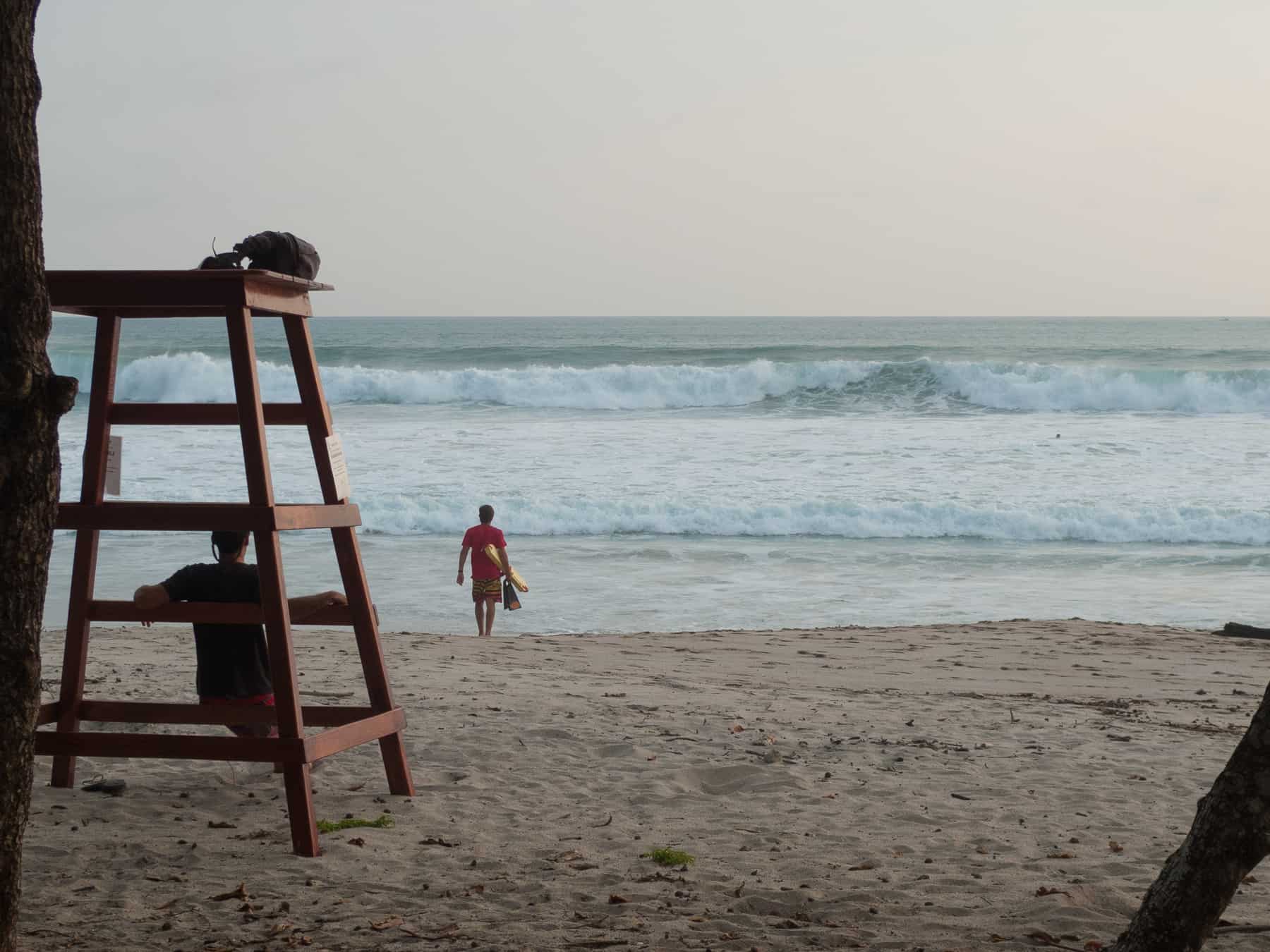
Along the most visited beach in Costa Rica, Playa Jacó, lifeguard towers rise up from the sand amidst the palm trees, a misleading reassurance to the thousands of beachgoers who head into the waters as the central Pacific coast heats up for the Costa Rican summer.
It’s misleading, because four days a week, and throughout the tourism low season, those towers sit empty. The four dedicated community lifeguards who once watched over the shoreline of Jacó, a beach town known for high-volume tourism and hardcore partying, have found other places to work after the community stopped donating money to pay their salaries. For the time being, the Red Cross is supplying volunteers Friday-Sunday – but only until the end of Holy Week, in early April – a situation that nearly all parties agree is insufficient for a beach where six people drowned last year alone.
Not here nor at any other beach in Costa Rica does the Costa Rican government, either at the municipal or national level, set aside funds so that a permanent lifeguard can be employed. This task has been left to the communities; however, accusations of corruption and disagreements have made even those efforts unreliable in some beach towns.
“In Costa Rica, nobody is responsible (for beach safety),” Eduardo Villafranca, the president of the National Chamber of Tourism (CANATUR), told The Tico Times.
“At the same time, we are all responsible. The business representatives must have the initiative to work together with the municipalities and other institutions in these types of alliances and look for sustainable solutions – not for a season or a month, but sustainable.”
Jacó History
In Jacó, the business community pitched in for years to keep the beach under supervision, donating funds monthly to the Jacó Chamber of Tourism which would then pay the salaries and other costs associated with the four lifeguards. The equipment was mostly lent to them from the Red Cross.
However, in the last half of 2005, the lifeguards stopped receiving their salaries as the Chamber of Tourism unraveled. While a representative from the former Chamber of Tourism – which has disbanded and has yet to be reformed – says the money was just not enough for all the associated costs, others have alleged corruption in the chamber.
“The Jacó lifeguards were paid by way of fixed donations from businesses in the area,” explained Luis Hidalgo, president of the National Lifeguard Association of Costa Rica. “But the money began to get lost.
“The people that were in charge of maintaining the salaries earned the distrust of the people,”Hidalgo added, and so they stopped donating.
“Sometimes, the money didn’t arrive, and we wouldn’t get our salaries. We never got an aguinaldo (mandatory year-end bonus equal to one month’s salary),” said Marvin Pérez, one of the former Jacó lifeguards.
“So we formed a group, and when we began to go by the businesses, they closed their doors on us.”
According to Pérez, people in the community said others had already passed by to collect money, and they had already paid these people – people whose names Pérez didn’t recognize and who never turned any of that money over to the lifeguards.
“They said they had given their money to a person we did not know who was supposedly from the chamber. In the end, the money disappeared and there was no one responsible for it,” the lifeguard said.
After the Jacó Tourism Chamber gave up the project, Lifeguard Association president Hidalgo said, the Municipality of Garabito, which oversees Jacó, should have kept the program going.
“The municipality has neither made itself present nor does it have an interest in developing security on the beach,” Hidalgo criticized.
Garabito Mayor Fernando Villalobos told The Tico Times he had requested funding from the Comptroller General’s Office to employ two lifeguards on the beach, but was denied. However, he added that some hotels employ lifeguards on their beachfronts, which adds security.
“No, it’s not sufficient,” he said. “But it helps that we have a lot of surfers on the beach who always help out.”
National Efforts Needed
Hidalgo’s criticism does not stop at the Municipality of Garabito. In a National Lifeguard Association statement released at the end of December announcing a nearly 50% rise in the number of drowning deaths in Costa Rica from 2004 to 2005 (from 85 to 120), Hidalgo criticized the Costa Rican government, and in particular the Costa Rican Tourism Institute (ICT).
“Our country does not currently have the necessary mechanisms to guarantee the safety of national and foreign tourists. The ICT and private tourism organizations invest millions to promote our country as a tourism destination of the highest quality, but safety stands out for its absence,” Hidalgo said in the statement.
“The government is a ghost,” he later told The Tico Times. “All the money that comes in to the country for the state… and they don’t invest a single colón. They don’t invest nor do they demand that there are lifeguards.”
The ICT, for its part, denies responsibility. “This is not a function that corresponds to the ICT by law,” ICT General Manager Guillermo Alvarado told The Tico Times in an e-mail. “We understand it is important for the communities to provide these types of services, and so the institution has financed specialized equipment for those who have directly assumed this labor, the Costa Rican Red Cross and the local chambers of tourism.”
Villafranca explained that to this end, the private National Tourism Chamber has “some important programs this year” for safety training and links between area businesses and local government.
“In this country, when there isn’t something, we can’t wait for the government to fix it.We have to go out and look for a way to fix it,” he said.
Beaches with Lifeguard Programs
Pacific Coast: Dominical, Matapalo de Aguirre, Manuel Antonio, Tamarindo, Langosta, Playas del Coco, Playa Hermosa and four small beaches along the Gulf of Papagayo (courtesy of the Four Seasons Hotel): Cascol, Blanca, Huevo and Iguanita.
Caribbean Coast: Cahuita and Playa Cocles
Source: Luis Hidalgo, president of the Costa Rica National Lifeguard Association.