

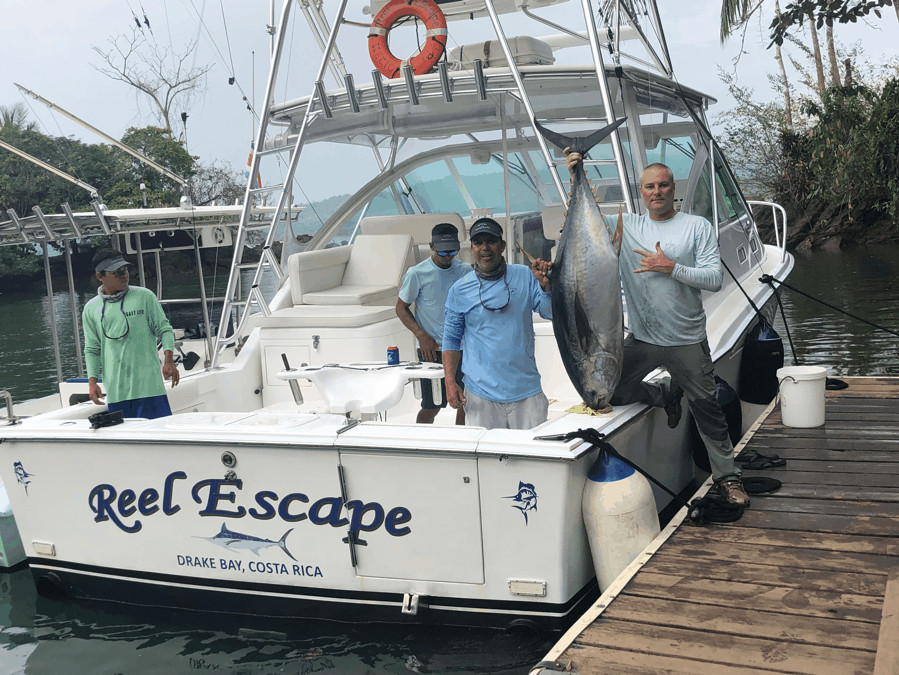
Thanks to the efforts of FECOP and other organizations that protect the waters of Costa Rica, tuna are back with a vengeance for sport fishermen.
My fellow Captains and I can remember how just a few years ago, catching a tuna was a big deal and a real treat for our clients. Nowadays, the tuna are plentiful, and we hope and expect it to stay that way for many years.
Having said that, it’s not so easy to consistently catch these beauties. Often times, traditional tuna lures like cedar plugs simply don’t work. As more people fish for tuna, the fish get smarter and more selective (especially the bigger ones). However, because we are in such a remote location in Drake Bay, Puntarenas, the fishing pressure here is virtually non-existent.
When trying to locate the big schools of fish, it’s imperative to have state-of-the-art technology. The Garmin Radar on the Reel Escape can spot birds and other activity many miles away. When these huge schools of tuna are either south or north of Drake Bay, we will get a few more boats on the school. Unlike the big fishing destinations in Costa Rica where 50-plus boats could be in the same area, we may get eight to 10 boats. When this occurs, it’s imperative that all the Captains work together to stay “around” the fish.
One amateur captain can ruin the day for all the boats and their clients. This happens when the inexperienced captain plows right through the middle of the school instead of staying on the edges of the school. Imagine one inexperienced driver in a NASCAR race.
Now to the catching part. The most important thing to remember is that tuna don’t act the same way every day, and it’s important to have a lot of different clubs in the bag. Just like us, our favorite meal may be a steak, but that doesn’t mean we want to eat it every day.
We have all heard the expression, “match the hatch.” This means you have to watch the behavior of not only the tuna but also the baitfish, birds and other marine life that may be in the area. Everything offshore has a symbiotic relationship; when one hunts and feeds everyone hunts and feeds.
The main thing to watch is the surface activity. Are the tuna busting baitfish on top, or are they feeding below the surface? When the tuna are feeding on top, which is an amazing sight, the tuna literally will jump 5-10 feet out of the water in their pursuit. When this happens, it’s clearly a good time to cast top water baits like big colorful Yozuri plugs. When the fish are a little less active, it’s time to switch to jigs or other similar baits that will run below the surface. For clients who may be less experienced or find it difficult to cast the top water plugs, this is an exciting way to fish. Our clients actually hold spinning rods, slowly jerking the rod back and forth. This method can produce some ferocious bites that the client can feel firsthand instead of grabbing a rod where the fish has already been hooked.
While the above-mentioned methods produce fish, we probably catch the lion’s share on livebait. It’s always tough for a tuna to resist a large sardine or small Bonita dropped in front of their noses. When fishing with live bait, it’s important to move the boat very slowly. We are not really trolling, but occasionally bumping the boat into gear. This will keep the bait looking as natural as possible in the water. We use only circle hooks when fishing with live bait. This means DO NOT SET THE HOOK when the fish hits. You have to give the tuna time to eat the bait — less time for small baits, and more time for larger baits.
For many clients who grew up bass fishing, where you set the hook as hard as possible, “not” setting the hook is really hard to do. Once the captain or mate thinks the time is right, the angler simply closes the bail and reels, nothing else. The circle hook is perfectly designed to hook the fish in the corner of the mouth and, as an added benefit, do the least amount of damage to the fish.
Once again, thanks to FECOP and INCOPESCA for their efforts to protect the Tuna population in Costa Rica. My fellow captains and I look forward to many more years of a healthy Tuna population for the sport fishermen. I hope this article has offered some good information for the incredibly exciting tuna bite in Costa Rica.
Capt. Willy Atencio
Reel Escape
Drake Bay, Costa Rica
This story was originally published in Fish Drake Bay. It was republished with permission.





