

By expanding the use of renewable sources in combination with greater electrification, the world would be able to reduce more than 75% of greenhouse gas (GHG) emissions in the energy sector by 2050 and, as a result, meet the targets climatic conditions established in the Paris Agreement.
Even more promising: If energy efficiency is added to the equation, these reductions could reach up to 90%.
This is detailed in the latest report of the International Renewable Energy Agency (IRENA), titled World Energy Transformation: Roadmap to 2050, which was officially presented during the Berlin Dialogue on Energy Transition (BETD).
According to the report, GHG emissions should be reduced by 3.5% per year from now until 2050 and continue downwards after that date in order to prevent the average temperature of the planet from increasing more than 2 degrees Celsius — and ideally not more than 1.5 degrees. Moreover, the emissions derived from the energy sector should peak in 2020 and decline.
“A global energy matrix based on 50% renewable energy is needed to reach the 1.5-degrees target,” said Dolf Gielen, director of IRENA’s Innovation and Technology Center.
Is it possible? For Simone Peter, president of the German Renewable Energy Federation (BEE), it is, and he put his country as an example. In 2018, Germany avoided releasing 100 million tons of carbon dioxide into the atmosphere thanks to renewable sources representing 38% of the electricity matrix.
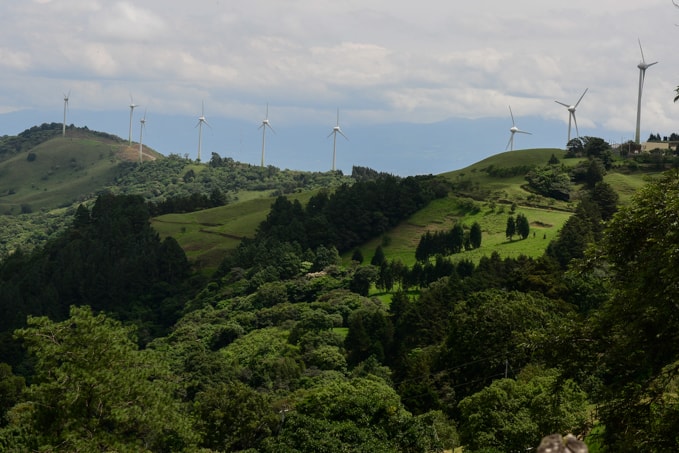
According to IRENA, 40% of the electricity generated by Spain during 2018 came from renewable sources. In the United Kingdom, that percentage was 33%. In Latin America, countries such as Costa Rica generated more than 90% of their electricity from renewable sources.
For Francesco La Camera, CEO of IRENA, this is possible in part because the costs of renewables are rapidly declining.
“It is becoming cheaper to invest in new solar, wind and hydroelectric plants,” he said.
In September 2018, the Carbon Tracker Initiative — in its report titled 2020 Vision: Why you should see peak fossil fuels coming — had already warned that the costs of solar photovoltaic, wind and battery storage were decreasing rapidly, to the point of being able to compete with fossil fuels without the need for subsidies.
“Costs have fallen by around 20% for each capacity doubling, and this is expected to continue. By 2020, renewable energies will be cheaper than fossil fuels in all the major regions of the world,” the Carbon Tracker report reads.
Thanks to this drop in prices and popularization of renewable technologies, photovoltaic and wind solar sources accounted for 84% of the new energy capacity in 2018, according to IRENA.
“The level of additional investment necessary for the world to move towards a path more respectful of the climate over current plans and policies is $15 billion by 2050, a significant sum, but 40% less than the previous analysis, due, to a large extent, to the rapid fall in the costs of renewable energies, as well as to the opportunities to electrify transport and other end uses,” the IRENA report reads.
Carbon Tracker was optimistic about the future scenario: “With a global energy demand that is expected to grow between 1 and 1.5%, and solar and wind energy production growing between 15 and 20% per year, the demand of fossil fuels will peak between 2020 and 2027, most likely in 2023.”
The turning point, according to Carbon Tracker, will be when solar and wind energy represent around 6% of the total energy supply and 14% of the world’s electricity supply.
“Although the market reacts to good prices and this works, political action is also required to achieve the transition,” La Camera said.
According to the IRENA report, the energy transition would be a good economic investment. For example: if the energy transition is accelerated under these principles of renewable sources, electrification and efficiency, the world economy could generate cumulative savings of up to $16 billion in the next 30 years due to avoided costs in terms of healthcare, subsidies related to energy and climate damage.
According to IRENA, each dollar for the energy transition would be amortized up to seven times, while the world economy would register a growth of 2.5% in 2050.
“The transition to renewable energies is logical from the economic point of view,” La Camera said. “By the middle of the century, the world economy would have grown and jobs created in the energy sector would boost employment by 0.2%.”
That 0.2% equals 7 million jobs by 2050, though La Camera emphasized the need to adopt measures to ensure a just transition for those who lose their jobs in fossil fuel-related industries.

The Tico Times is a member of Latin Clima, a collection of journalists and newsrooms working together to report on climate change throughout Latin America. This story was originally published by Michelle Soto on May 25, 2019. Read the original Spanish version here.





