

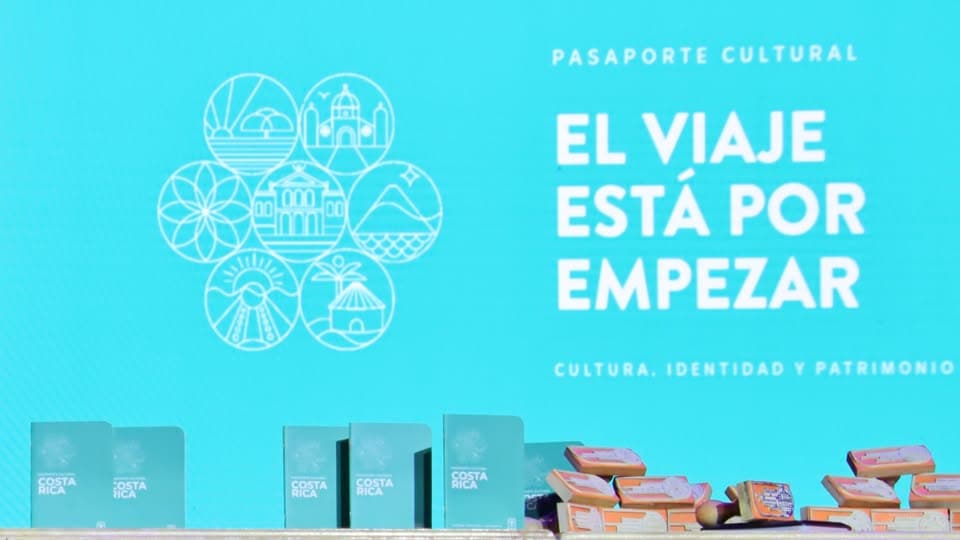
If you have already done Arenal, Manuel Antonio and Monteverde and want a reason to drive somewhere new, Costa Rica just handed you one. The Ministry of Culture and Youth has started the Pasaporte Cultural Costa Rica, a stamp-collecting trip that sends you to 35 heritage sites spread across all seven provinces.
The format is simple. You get a passport, you visit the sites, and you ask for a stamp at each one. Five destinations per province, 35 in total, organized as seven routes you can tackle one at a time or string together into a longer trip.
It is free, and it is open to visitors and foreign residents, not just Costa Ricans. Culture Minister Jorge Rodríguez Vives said the point is to turn people from spectators into participants, and that each stamp is meant to be a direct encounter with the history and traditions of a specific place rather than a checkbox.
The passport carries a Folio Mobile Chip, so you can tap your phone against it to pull up each destination’s location, contact details and a short history. That matters more than it sounds. Several of the stops on this list have no meaningful English-language presence online, and a few are community-run sites with no fixed website at all.
There is also a prize. The first 20 people to collect all 35 stamps get a year of free admission, for themselves and a guest, to shows produced by the Ministry at the Teatro Popular Melico Salazar and the Teatro Nacional.
The 35 stops, province by province
The San José route is the easiest to knock out in a single day, since four of its five stops sit within walking distance of each other downtown. The rest will take you well off the standard tourist circuit.
- San José — Museo Nacional de Costa Rica, Cine Variedades/Centro de Cine, Teatro Nacional, Museo de Arte Costarricense, Centro Nacional de la Cultura (CENAC)
- Alajuela — Museo Histórico Cultural Juan Santamaría, the Catholic church at Venecia de San Carlos, Centro Histórico y Cultural José Figueres Ferrer, the Maleku community in the Upala–Los Chiles area, and the park and church at Zarcero
- Cartago — Centro de la Cultura Cartaginesa, the Orosi valley and church, Guayabo National Monument, the Ujarrás ruins, Sanatorio Durán
- Heredia — Casa de la Cultura de Sarapiquí, Museo de Cultura Popular at the Universidad Nacional, the old Belén municipal building, the Heredia post and telegraph building, Iglesia de la Inmaculada Concepción
- Guanacaste — Museo de Guanacaste, Ermita Nuestro Señor de la Agonía, Cofradía de Nuestra Señorita Virgen de Guadalupe, Santa Rosa National Park, Farallón National Monument
- Puntarenas — Sitio Museo Finca 6, Isla San Lucas National Park, Casa de la Cultura de Puntarenas, Museo Boruca, the old Golfito golf clubhouse now run by the Universidad de Costa Rica
- Limón — Casa de la Cultura de Puerto Viejo, G&E Chocolate Adventure Company, the Limón post office building, the Jala de Piedra Indigenous community, Casa de la Cultura de Pococí
A few of these are worth the drive on their own. Finca 6 in the Osa region is the only site where you can see the pre-Columbian stone spheres in their original setting. Isla San Lucas, a former island prison off Puntarenas, only opened as a national park in recent years and still sees a fraction of the visitors it deserves.
The Maleku, Boruca and Jala de Piedra entries are different in kind. These are living Indigenous communities, not museums, and the passport treats a visit as an encounter rather than a viewing. Coordinate ahead rather than showing up unannounced, and expect the terms of the visit to be set by the community.
How to get your passport
The digital version downloads free from the Ministry of Culture and Youth site at mcj.go.cr. If you want the physical passport with the chip, you fill out a form on the same site and the Ministry contacts you to arrange where and when to pick it up.
Before you build a route around this, check opening hours for each stop. Community-run cultural houses and rural churches often keep limited or seasonal schedules, and several of the Limón and Puntarenas sites are a long way from anywhere you would want to backtrack from.
The initiative runs under the banner “La cultura que vivimos” and was developed with esencial COSTA RICA. Its director, Adriana Acosta, described it as a way to connect heritage destinations across the seven provinces into a single accessible experience. Rodríguez said the Ministry also plans to tie what it learns from the routes to data from the 2026 National Culture Survey.





