

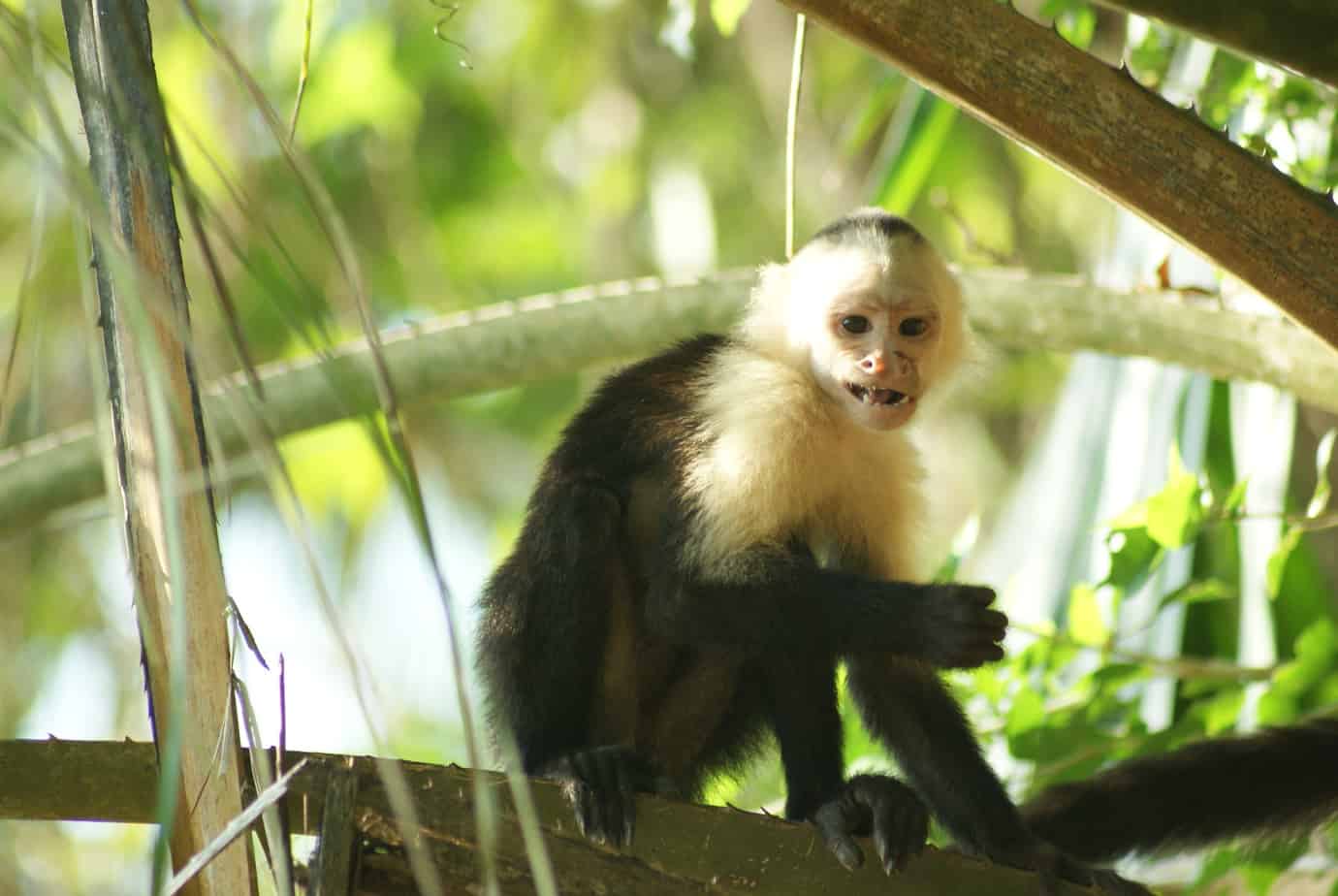
Wild white-faced capuchin monkeys in Costa Rica are learning to use a touchscreen in the middle of the forest, giving researchers a new way to study animal intelligence without taking the monkeys out of their natural environment. The system, called CapuchinAI, combines artificial intelligence, cameras, a touchscreen and an automatic food dispenser at the Taboga Forest Reserve in Guanacaste.
When a capuchin approaches the station, the technology can detect the animal, record its interaction and present a task on the screen. Successful interactions can trigger a food reward, typically a slice of dried banana. During a two-week field test involving two groups of wild capuchins, 16 monkeys voluntarily interacted with the device. Ten learned how to trigger food rewards, while eight developed and retained a clear association between touching the screen and receiving food.
Some figured it out faster than others. The first monkey to seriously investigate the device was a large male named Trompudo. After initially hitting different parts of the apparatus, he touched the screen and received a piece of banana. He quickly repeated the action.
Other monkeys eventually began using the station as well, with some discovering that the touchscreen responded not only to their hands but also to their mouths. A few learned to effectively “kiss” the screen to get a reward. The research, published in the American Journal of Primatology, is intended to solve a longstanding problem in animal cognition studies: scientists can tightly control experiments in laboratories, but captive conditions do not fully reproduce the social pressures, competition and environmental challenges that animals face in the wild.
CapuchinAI is designed to bring some of that experimental control into the forest. An early facial-recognition model trained on images of six known capuchins was able to identify individual monkeys with more than 97% performance across still images, video and live field footage. During the latest field deployment, the system was adapted to recognize when a capuchin approached the station, allowing researchers to automatically collect more video and build a larger database for identifying individual animals.
That distinction is important as the pilot study primarily tested whether wild monkeys would approach the technology, interact with the touchscreen and learn the connection between touching it and receiving a reward. The next stage is intended to recognize individual monkeys automatically and give each one cognitive tests suited to its progress.
Researchers are developing experiments covering learning, impulse control, cognitive flexibility and short- and long-term memory. Once an individual is recognized, the system could eventually determine which test that particular monkey should receive and track its performance over time.
The portable unit is built around a Raspberry Pi computer and includes a webcam, touchscreen, motorized food dispenser and battery. It can operate for about eight hours on a lightweight battery pack, making it practical for field conditions where normal laboratory equipment would be difficult to use.
The work is particularly well suited to Taboga since the reserve contains about 2.97 square kilometers (1.15 square miles) of protected tropical dry forest and supports one of Costa Rica’s larger concentrations of white-faced capuchins. More than 14 groups have been identified in the area, while long-term researchers concentrate on four groups.
Years of observations also mean scientists already know the histories, social relationships and behavior of many individual monkeys. Combining those records with controlled cognitive tests could help researchers examine why some capuchins learn faster than others, whether social experiences influence problem-solving and how different environments shape intelligence.
The technology is not intended to replace researchers following monkeys through the forest. Instead, it gives them another way to collect standardized information while the animals continue moving freely through their normal habitat. If the approach proves successful, similar systems could eventually be adapted for other wild primates, allowing scientists to compare cognition across animals and environments without relying as heavily on captive populations.
For Costa Rica, the experiment puts one of our most familiar wild animals at the center of an unusual meeting between conservation research, artificial intelligence and behavioral science.





