

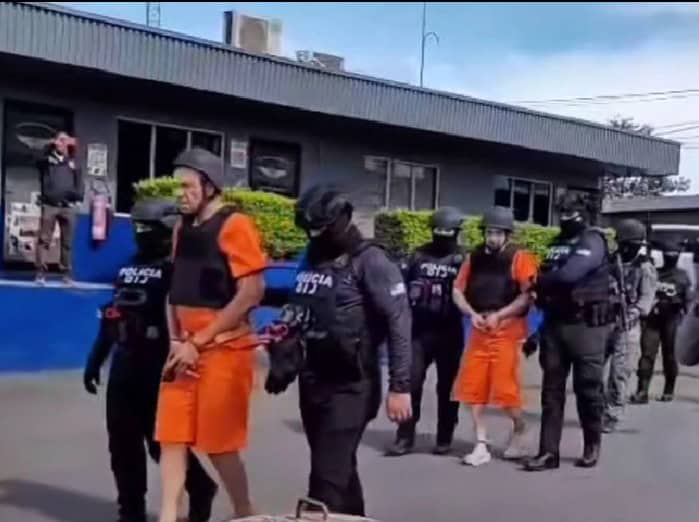
Costa Rica surrendered two men wanted on United States drug trafficking charges to American agents on this morning, closing extradition proceedings that had run for months and opening a fresh dispute over conditions inside the maximum-security prison.
Gilbert Bell Fernández, known as “Macho Coca,” and Gabriel Lozano Bonilla, known as “Compadre,” left Juan Santamaría International Airport at approximately 8:58 a.m. aboard an aircraft registered N387SC and operated by the United States Drug Enforcement Administration.
The flight plan filed for the aircraft listed a stop in Nassau, Bahamas, before continuing to New York. Both men are wanted by the United States District Court for the Southern District of New York in separate but parallel proceedings. Neither has been convicted, and the allegations against them remain untested in court.
Agents of the Unit for Special Intervention of the Directorate of Intelligence and Security escorted both men out of the La Reforma prison complex in San Rafael de Alajuela shortly before 6:40 a.m. Each wore the orange uniform recently introduced by the Ministry of Justice and Peace for maximum-security inmates, along with a ballistic vest and helmet. The formal handcuff exchange conducted minutes before boarding transferred both men to United States jurisdiction.
United States prosecutors allege that Bell, 63, led a structure that stockpiled and shipped large quantities of cocaine from Costa Rican territory to the United States between March 2022 and August 2023. According to the Public Ministry, Bell held contacts with undercover agents that included the sale of a drug sample and negotiations toward a shipment of 700 kilograms (about 1,540 pounds) of cocaine bound for New York. In November 2023 he became the first Costa Rican designated by the United States Treasury Department’s Office of Foreign Assets Control, which described him as a major trafficker operating out of Limón.
Lozano, 52, was named by Costa Rican investigators as the alleged head of the organization at the center of the case known as Corona, which authorities say converted cocaine to liquid form at a clandestine laboratory and moved it out of the country concealed in beverage bottles bound for Europe and Asia.
As part of that investigation, authorities intercepted a shipment of 150 liters (about 40 gallons) of liquid cocaine at the Israel-Jordan border in June 2023, a load that investigators traced to the APM Terminals dock in Moín. United States prosecutors allege his participation in trafficking operations running from Venezuela and Colombia toward American territory. He is the first naturalized Costa Rican surrendered under the constitutional reform.
Both handovers required prosecutors to set aside pending domestic cases. The Public Ministry applied a criterio de oportunidad to the fuel-theft investigation in which Bell had been held since October 11, 2024, and requested the same measure in the Corona file, in which Lozano had been ordered to trial alongside five other men.
A Limón tribunal initially rejected the United States request for Bell in March, ruling that the conduct alleged predated the May 28, 2025 amendment to Article 32 of the Constitution. An appeals court in San José reversed that finding in June. The final diplomatic assurances arrived on July 31, committing United States authorities to try Bell only on the charges for which extradition was granted and not to seek life imprisonment or a term exceeding 50 years, the maximum available under Costa Rican law.
In the hours before the handover, both men told prosecutors they had been tortured in the high-containment unit at the Jorge Arturo Montero Institutional Care Center, the facility widely known as La Reforma. Attorney General Carlo Díaz confirmed the complaints and said he took the men’s statements on video after obtaining their consent.
According to Díaz, the men described being woken every hour through the night and being told the practice was ordered by the attorney general. Díaz rejected any involvement, stating that his office holds no authority over the prison system. He said he would forward the recording to the Fiscalía de Ejecución Penal, the Ombudsman’s Office and the National Mechanism for the Prevention of Torture for whatever action each considers appropriate.
Speaking on camera before boarding, Bell said he had lived alongside rats and pigeons in his cell, described a diet of rice and eggs, and claimed he had lost 45 kilograms (about 99 pounds) in custody. He called on President Laura Fernández, judges and prosecutors to examine conditions in the unit.
Manrique González, Bell’s attorney, said he was unaware of the formal complaint but confirmed that his client had repeatedly reported mistreatment that had damaged his physical and emotional condition. The Ministry of Justice had not responded publicly to the allegations as of Thursday afternoon.
The complaints reflect those raised by former security minister and magistrate Celso Gamboa, whose account of treatment in the same unit prompted the Fiscalía de Probidad, Transparencia y Anticorrupción to open an investigation on its own initiative into the penitentiary staff involved.
Bell and Lozano bring to five the number of alleged traffickers surrendered by Costa Rica since the constitutional reform took effect. Gamboa and Edwin López Vega were flown to Texas in March in the first handover of Costa Rican nationals in the country’s history, and José Johnny Angulo was delivered to Italian authorities in April. Roughly 20 more people remain in custody in Costa Rica awaiting transfer to foreign courts, the large majority of them requested by the United States





