

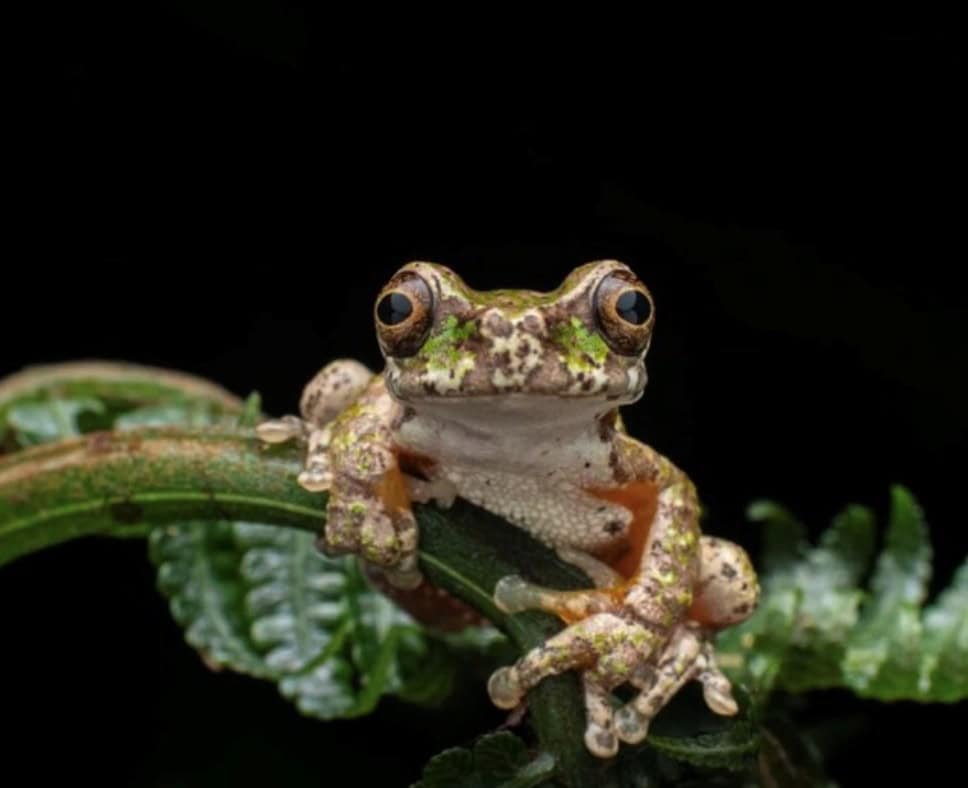
A tiny green tree frog that sings from coffee bushes at night has been confirmed as a species new to science, and it lives in one of Costa Rica’s most important coffee-growing regions. Researchers have named it Isthmohyla nacientes and call it the coffee frog.
“At night, when they are mainly active, you hear them singing and perched on the coffee bush,” said Wagner Chaves-Acuña, a postdoctoral researcher with Argentina’s CONICET and a co-author of the study. The frogs are not drawn to the cherries. They come for shade, humidity and the small insects that make up most of their diet.
The coffee frog is a metallic green amphibian found in rivers, creeks and coffee plantation landscapes in Dota, Tarrazú and León Cortés, at elevations between 1,400 and 2,000 meters, or about 4,600 to 6,560 feet. The area is known for high-elevation coffee farms, but researchers say its streams and springs also hold species that are still poorly understood.
The frog is small even by the standards of Costa Rican tree frogs, measuring under four centimeters, or about 1.6 inches. Large irregular dark blotches mark its back, and the limbs carry a yellow-orange wash. Males have a translucent throat that inflates when they call.
Its common Spanish name, Rana de las Nacientes, refers to the springs and headwaters that feed local rivers and supply water to surrounding communities. The species was confirmed through a combination of physical traits, vocalizations and genetic analysis. Researchers found that the frog differs from closely related species in the Isthmohyla tica group, a set of stream-dwelling tree frogs found in Central America.
Although the new frog closely resembles the Green Spiny Tree Frog, Isthmohyla tica, it has distinguishing features, including scattered dark spots on its flanks and a distinctive high-pitched call usually produced as a single note or in short series.
The frog also has a varied acoustic repertoire. Scientists documented advertisement, release and courtship calls, including a courtship call emitted underwater. That behavior gives researchers a fuller picture of how these mountain frogs reproduce in fast-moving streams.
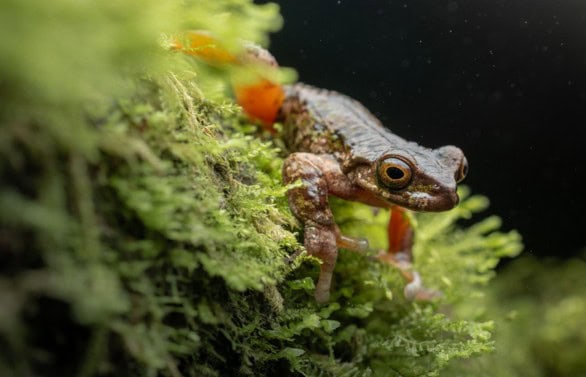
The discovery has roots stretching back more than half a century. The species was first observed in the 1960s but was mistakenly identified as a different frog, according to the National Alliance for the Conservation of Amphibians and Reptiles. It was not until 2021, when individuals were again seen in a stream near San Lorenzo de Tarrazú, that researchers began a closer investigation.
The nickname stuck because of where the frog turns up. Coffee in Los Santos is planted at the same elevations as the streams the species depends on, and most of the streams where the frog is known to live are now surrounded by coffee plantations.
Specimens have also been recorded well away from plantations, so the species is not confined to farmland.
The overlap makes the finding especially important in Los Santos, where coffee production, water protection and habitat conservation are tightly connected. Researchers say the frog faces threats from pesticide contamination, waste dumped into waterways, loss of vegetation used for shelter and the reduction of protected forest along rivers, streams and springs.
Chaves-Acuña described how that contamination reaches the animals. “Those poisons travel through the air, they seep through the soil, and that is where they fall into the water systems where the tadpoles develop,” he said. He noted that no study has yet confirmed the effect of agrochemicals on this particular species.
The frog’s survival in a heavily farmed region shows resilience. It also raises a harder question for Los Santos which is how to protect fragile freshwater habitats while maintaining the coffee economy that defines much of the region. A group of residents in Los Santos has begun studying and monitoring the species, while working with local groups to design conservation strategies for the frog and its habitat.
“We are convinced that this discovery is of great importance for the Los Santos region and could mark a turning point in civil society’s awareness of the natural treasures found in this area,” said Juan G. Abarca, a researcher with the National Alliance for the Conservation of Amphibians and Reptiles.
The name nacientes was proposed by members of the San Lorenzo de Tarrazú community aqueduct and accepted by the study’s authors. The name honors the local aqueduct associations that protect springs, rivers and creeks while also supplying drinking water to nearby communities.
Those community groups played a key role in the discovery and scientific description of the frog. Their work also underscores a broader point: the same forests and streamside vegetation that help keep water clean for people can also protect rare and newly identified wildlife.
“Its name also reminds us of the importance of protecting rivers and streams, as well as the forests that grow around them, so that water reaches people in good quality and quantity,” said Jonathan Navarro, a researcher at the National University’s International Institute for Wildlife Conservation and Management and co-author of the study. “It also tells us that these forests can hold an enormous and incredible biodiversity of species.”
The research also expands scientific understanding of Central America’s mountain frogs. Chaves-Acuña, who is based at the Bernardino Rivadavia Argentine Museum of Natural Sciences in Buenos Aires, said the recognition of Isthmohyla nacientes is part of a broader review of these frogs’ diversity.
“The results suggest that the diversity of this group of frogs in Costa Rica and Panama is greater than previously thought,” Chaves-Acuña said. “It is likely that in the coming years we will better understand how many species really exist and where they are found.”
The study involved researchers from Costa Rica and abroad, including the National University, the University of Costa Rica, CONICET, the Bernardino Rivadavia Argentine Museum of Natural Sciences and the National Alliance for the Conservation of Amphibians and Reptiles.
For Costa Rica, the discovery is another reminder that even well-known, heavily cultivated landscapes can still hold species unknown to science. In Los Santos, the coffee frog is living in the same streams and springs that sustain the region’s communities and its coffee farms.





