

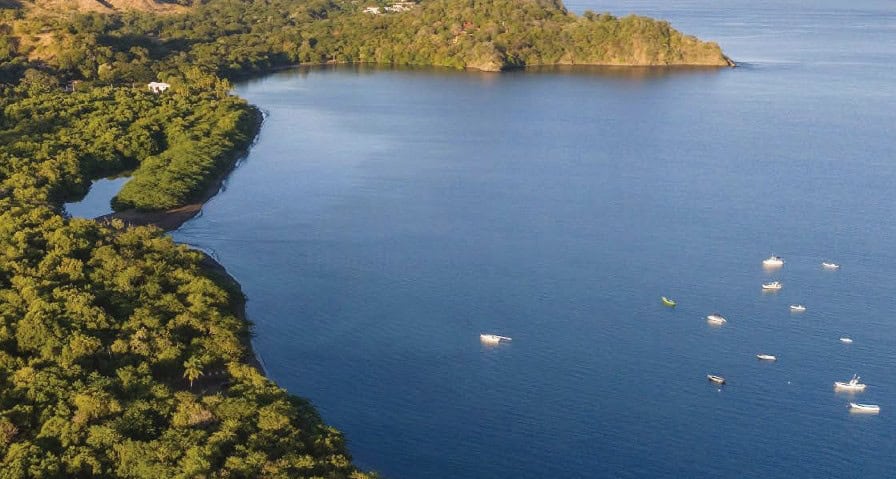
Costa Rica as thrown out a contested building rule at the center of a court fight over development in the Gulf of Papagayo. The rule had let developers combine their construction rights across separate plots of land.
Executive Decree 45823-MP, signed by President Fernández and Minister of the Presidency Rodrigo Chaves Robles, was published Tuesday in the official gazette La Gaceta (Alcance No. 76 to Gazette No. 110). It removes the “density and coverage compensation” rule from the regulations covering the Golfo de Papagayo Tourism Pole in Guanacaste. The change takes effect right away, and there is no grace period for permits or applications already filed under the old rule.
The rule being scrapped, created in January 2024 under former President Chaves — who now serves as Fernández’s minister of the presidency — let a developer with more than one plot of land in the tourism zone move leftover building allowance from one plot to another, even if the two plots weren’t next to each other. In practice, a developer could take up to 30% of the building rights from one plot and add it to a second plot, packing more construction onto that single property than the usual limit of 20 rooms per hectare would normally allow.
The new decree changes two parts of the tourism zone rulebook (the first paragraph of Article 12 and Article 17 ter) and deletes a section of its annex titled “Requirements for density and coverage compensation in concessions.” The government said the old rule had been read too many different ways, which created legal confusion and slowed things down for both developers and the technical staff at the Costa Rican Tourism Board (ICT). With the rule gone, Papagayo goes back to the strict low-density limits laid out in its original Master Plan.
That building rule is the main thing under fire in a constitutional challenge filed in August 2025 with the Constitutional Chamber, known as the Sala IV. The Attorney General’s Office (PGR) told the court in October that the rule was unconstitutional because it weakened the environmental protections of a project that was meant to stay low-density and be controlled plot by plot. In April, magistrate Fernando Cruz Castro temporarily froze construction and tree-cutting permits linked to the rule. In May, the court clarified that the freeze applied only to projects that had used, or planned to use, the rule.
A lot of the fight has focused on the Bahía Papagayo project by Enjoy Hotels & Resorts at Playa Panamá, where the National System of Conservation Areas (Sinac) had signed off on cutting down 748 trees and clearing the brush beneath them. That permit is now being challenged in a separate appeal the Sala IV recently agreed to hear.
Getting rid of the rule doesn’t end the case. The decree only applies going forward — it doesn’t undo any approvals already granted under the old rule since 2024 — and the underlying constitutional challenges are still open. The Association of Concessionaires of the Golfo de Papagayo Tourism Pole (AsoPapagayo) said it had “taken note” of the decision and was open to meeting with the ICT to go over what the decree means. Tourism Minister and ICT President William Rodríguez López has defended the zone as a major economic driver that supports more than 6,000 jobs, directly and indirectly, in Guanacaste.





