

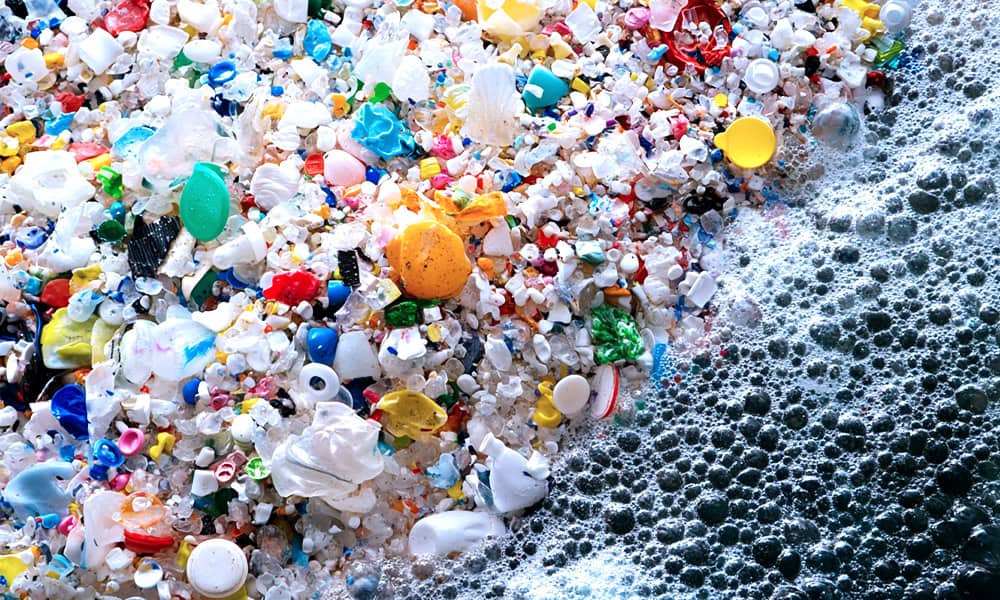
Costa Rica’s microplastics problem is no longer limited to plastic bottles, bags, and debris washing up on beaches. Local research has found tiny plastic particles in coastal sand, marine sediments, fish, mollusks, crustaceans, cattle, pigs, chickens, and even Isla del Coco, one of the country’s most remote protected areas.
Researchers said microplastics have appeared in more than 70% of the samples analyzed in Costa Rican studies, a finding that pushes the issue beyond beach cleanup and into food safety, marine conservation, agriculture, and public health.
Microplastics are plastic fragments smaller than five millimeters. Some are manufactured that way, including industrial pellets and particles used in certain products. Others come from larger plastic items that break down over time through sunlight, waves, friction, and weathering. Bottles, bags, packaging, fishing gear, synthetic clothing, tires, and other materials can all become part of the problem once they fragment.
The particles are difficult to control because they move easily. They can travel through rivers, storm drains, ocean currents, wind, and rain. Once they reach marine or freshwater environments, they can be eaten by small organisms and then move through the food chain as larger animals consume smaller ones.
One of the clearest warnings came from Isla del Coco. Studies there found microplastics in marine and freshwater sediments, as well as in marine fish, freshwater fish, lobsters, and shrimp. The finding was especially striking because Isla del Coco sits more than 500 kilometers from Costa Rica’s mainland and is one of the country’s most tightly protected natural areas.
The presence of microplastics there suggests that distance and legal protection are not enough to shield ecosystems from plastic pollution. Ocean currents, discarded fishing gear, tourism activity, airborne particles, and rainfall can all play a role in moving plastic fragments into places that appear isolated from direct human pressure.
Costa Rica’s mainland studies point in the same direction. Research by the University of Costa Rica’s Center for Marine Science and Limnology has identified thousands of microplastic particles on beaches along the Pacific and Caribbean coasts. Puntarenas has ranked among the most affected sites in previous sampling, while other areas showed lower but still measurable levels.
The concern is not only environmental. Studies in Costa Rica have also found microplastics in species linked to human consumption. Research in Las Baulas Marine National Park detected particles in a high percentage of fish and crustaceans analyzed. Other recent work found microplastics in bovine and porcine livers sold in local markets, and in chicken livers and gizzards collected from butcher shops.
Those findings do not mean every seafood or meat product is unsafe to eat. They do show that plastic pollution has entered systems that people rely on for food. That changes the public conversation. Microplastics are not only floating offshore or scattered in beach sand. They are showing up in animals, organs, and products tied to the national food chain.
International studies have also detected microplastics in human blood, placenta, breast milk, brain tissue, semen, and other tissues or fluids. Scientists are still studying what those findings mean for long-term health. Current research points to possible links with inflammation, endocrine disruption, reproductive effects, cardiovascular concerns, and other biological changes, but researchers continue to warn that more evidence is needed before drawing firm conclusions about disease risk.
That uncertainty is not the same as safety. The main concern is that exposure appears constant and widespread, while the particles themselves can carry chemical additives, pesticides, hydrocarbons, and microorganisms. Some microplastics may pass through the digestive system, while smaller particles may enter circulation or tissues.
Costa Rica has taken steps to reduce some forms of plastic waste, but researchers say the regulatory gaps remain wide. Much of the current focus has been on visible items such as bags, bottles, and single-use packaging. The microplastics problem is broader. It includes synthetic textile fibers released during washing, tire particles from roads, industrial pellets, fishing gear, cosmetic ingredients, and plastics marketed as biodegradable that may only break down under specific industrial conditions.
The challenge is that once a bag, bottle, net, or tire fragment becomes microplastic, it is nearly impossible to remove at scale. A large plastic item can be collected from a beach. Thousands of invisible fragments mixed into sand, water, sediment, and animal tissue are a different problem.
For Costa Rica, the issue touches tourism, conservation, fishing, agriculture, and public health. Clean beaches and healthy marine life are central to our country’s image and economy. The new research shows that plastic pollution is already present from protected ocean waters to food-producing animals.
The practical response begins before plastic reaches the environment: reducing single-use plastics, improving waste collection, controlling industrial pellets, managing fishing gear, limiting unnecessary microplastic additives, and expanding monitoring from beaches and rivers to farms, markets, and food products.





