
A friend who lives in New York City was all over social media in the wake of the 4.8 earthquake that hit the east coast of the US on Thursday. The sensation of the earth moving, and the building he was in swaying was a first for him. All I could think was, ‘Welcome to the club’.
According to the University of Costa Rica’s page on seismic history, there have been 31 quakes of 5.0 or better here since 1990. And countless smaller tremors. Ovsicori, the organization that keeps tabs on volcanic and seismic activity, records all the tremors throughout Costa Rica. Their website features a map that shows all recorded movements over the past 15 days.
It is mind-boggling (or maybe earth-shattering would be the better adjective) to look at this map and see the underground activity. We easily average a dozen tremors daily, mostly concentrated in the Central Valley and Central Pacific regions, but with all provinces well represented.
When it comes to the sensation of the earth moving beneath your feet, we are jaded. The first historically recorded earthquake in Costa Rica was in the Cartago region in 1756. (Cartago was also the epicenter of the 1910 quake that killed 700 people and left thousands homeless). There have been hundreds of thousands of all magnitudes since.
While they will be talking about the 4.8 for a long time in New York and New Jersey, our next 4.8 plus shaker will just be the latest in a list stretching back centuries.
The first time I felt a tremor was my second day in the country, while eating breakfast in a San Jose hotel. I have lost count of how many times I have felt the shock of the tectonic plates grinding away kilometers below the surface. But not all earthquakes are equal. I have created my own unscientific groupings, and all activity falls under one of four types:
1) Unfelt– this makes up the majority of activity. The imperceptible 1.5 to 2 tremors, 50 or more kilometers beneath the surface. Just the slightest earth belch, undetected by humans.
2) A slight tremble of the earth– Usually brief and with just enough force to make you wonder if you just felt a tremor.
3) The jolt– Felt immediately, followed by several long seconds of the inanimate objects in every house coming to wobbly life. Once the quake subsides, people are on the phone or on Facebook, inquiring as to who else felt it nationwide.
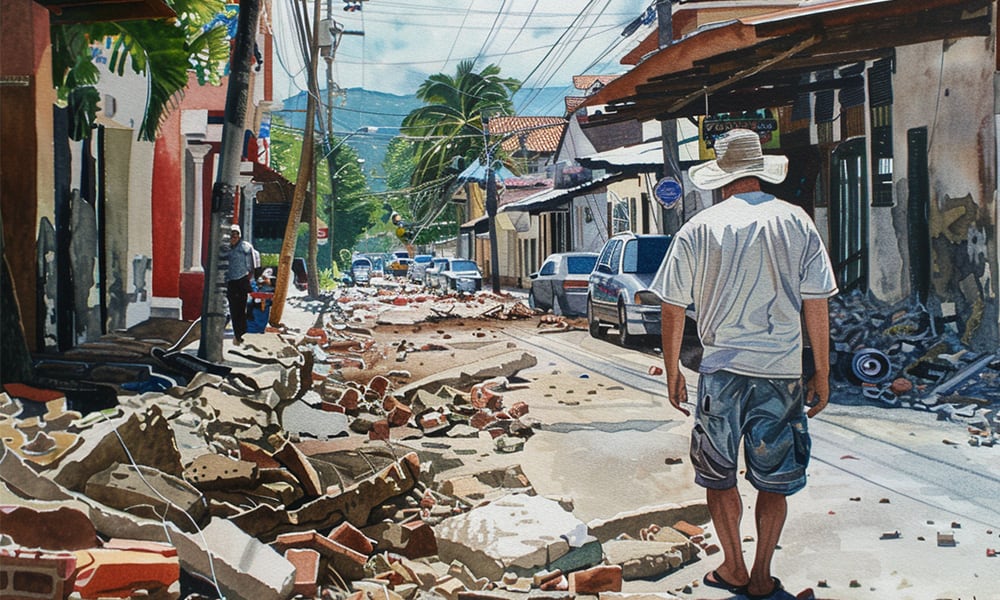
4) The ones you remember where you were when they hit– Limon 1991, Cinchona 2009, Samara 2012. What distinguishes the most massive quakes is the initial jolt, the duration, and the shallowness of depth beneath the earth’s crust where the plates are hitting. The jolt hits hard, and is followed by several seconds of shaking.
In the first few seconds the expectation–hope– is that it will be brief. But in the moment of these eternal seconds, the quake gains in intensity instead of dissipating. The most powerful quakes also occur at a shallow depth beneath the earth’s crust, from 5 to 15 kilometers below. Typically, the shallower the depth, the more it will be felt. It is that combination that adds up to a major, memorable earthquake.
We live along the Ring of Fire, where 90 percent of earthquakes occur. Right now, somewhere in Costa Rica, there is a rumbling kilometers below the surface. It may be imperceptible, and it may be the next big one. The one inevitability is that someday, sooner or later, there will be another big one. Stay tuned.
First published in 2024