
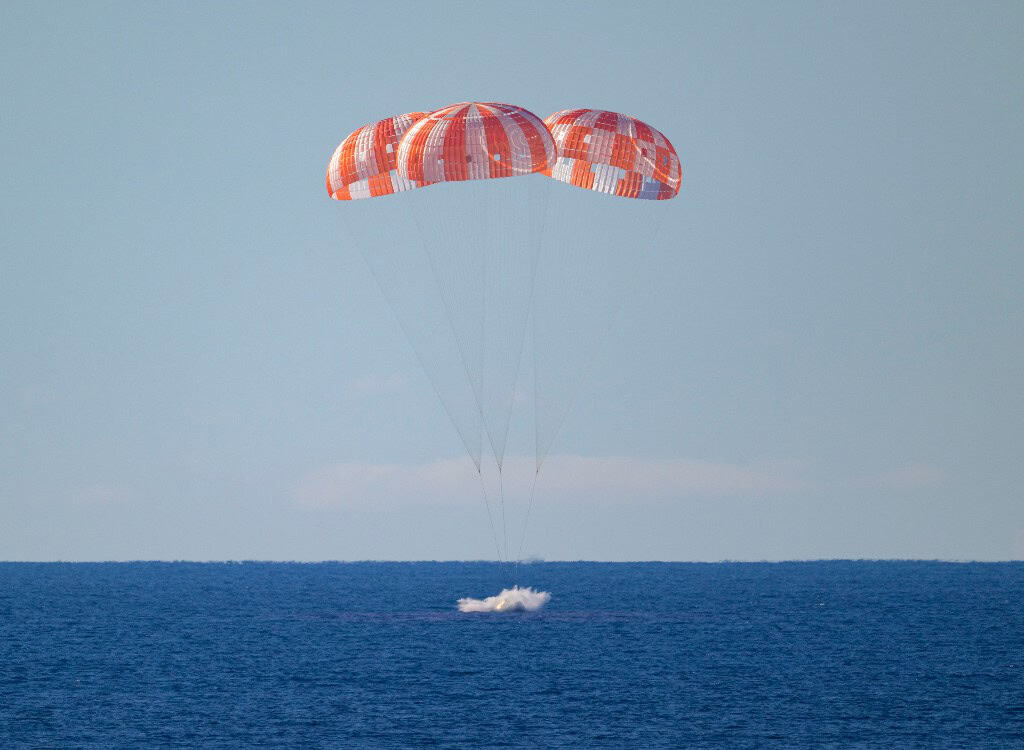
The four astronauts of the Artemis II mission splashed down Friday off the coast of California, right on schedule, after completing a test mission around the Moon that NASA described as flawless, marking a major milestone more than 50 years after the Apollo era. “Houston, this is Integrity. We hear you loud and clear,” commander Reid Wiseman said after the spacecraft passed through the most dangerous phase of reentry, traveling at more than 38,000 kilometers per hour.
Wiseman reestablished contact with mission control in Houston shortly after a brief but tense communications blackout during reentry. “What a ride. We are stable,” he added, reporting a “green” code for all four crew members, meaning they were in good condition.
After launching from Florida on April 1, Americans Reid Wiseman, Christina Koch, and Victor Glover, along with Canadian Jeremy Hansen, traveled farther into space than any humans before them. They returned carrying hundreds of gigabytes of data from the first crewed lunar voyage since the final Apollo mission in 1972.
Earlier in the week, the crew flew behind the Moon and captured a high-definition image of Earth rising beyond the lunar horizon, with the Moon’s surface shifting in tone between gray and brown. Their Orion capsule made a smooth splashdown in the Pacific Ocean near San Diego at 5:07 p.m. local time Friday, descending at about 30 kilometers per hour under massive parachutes, exactly as NASA had planned.
The U.S. Navy recovered the astronauts from the capsule, first transferring them to a boat and then lifting them one by one by helicopter to the USS John P. Murtha. After arriving aboard the ship, they walked slowly but in good spirits to the vessel’s medical area.
“The crew is in good health and ready to return to Houston,” flight director Rick Henfling said during a press conference at Johnson Space Center.
A Turning Point for NASA
NASA officials framed the successful return as a major moment for the agency after years of delays, mounting costs, and questions about the future of the lunar program.
“I think this is the most important space mission we have carried out in many decades, both for its historical significance and for what it represents for the future of the agency,” said Amit Kshatriya, NASA’s associate administrator. “For much of our staff, this is only the beginning. It is undoubtedly a turning point.”
NASA administrator Jared Isaacman called the journey “a perfect mission.” “This is only the beginning,” Isaacman said. “We are going to do this again frequently, sending missions to the Moon until we land there in 2028 and begin building our base.”
President Donald Trump also congratulated the crew, writing on Truth Social that he hoped to see them soon at the White House and adding that Mars would be the next step.
Heat Shield Passes Crucial Test
One of the biggest questions surrounding Artemis II involved Orion’s heat shield, which had raised concerns at NASA after fragments broke away during an uncrewed test flight in 2022. This time, the shield appears to have withstood temperatures of about 2,700 degrees Celsius generated during atmospheric reentry.
NASA chose to proceed with the same heat shield design but adjusted the spacecraft’s trajectory to reduce the risk, a decision that sparked debate. The NASA chief had recently admitted he would be thinking about the issue constantly until the crew was safely back in the water.
NASA Eyes Lunar Return in 2028
The Artemis II flight was designed to confirm that the Orion spacecraft, the Space Launch System rocket, and related systems are ready to support a return of astronauts to the lunar surface and eventually future missions to Mars. NASA plans another mission in 2027 to test technologies before sending astronauts to the Moon in 2028 on Artemis IV, during the final year of Trump’s presidency and, theoretically, before China’s planned crewed lunar mission in 2030.
Still, experts have expressed doubts about whether the lunar landers being developed by companies linked to Elon Musk and Jeff Bezos will be ready in time for the 2028 target.
Future international participation in Artemis also remains uncertain. A Japanese astronaut and later a German astronaut had been expected to join upcoming missions, but those slots no longer appear guaranteed after NASA restructured the Artemis program, with the European Space Agency acknowledging it must negotiate to preserve them.