

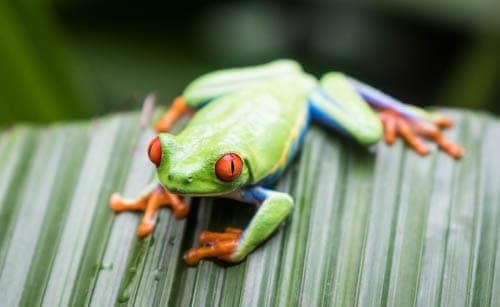
Three Central American frog species have gone extinct and many others may soon follow as their populations are ravaged by a fungus that is spreading faster because of climate change, conservationists said Thursday.
In an update to its “Red List” of threatened species, the International Union for Conservation of Nature (IUCN) noted some positive developments, including for the European bison, but warned that the world is seeing a worrying number of extinctions.
“The growing list of extinct species is a stark reminder that conservation efforts must urgently expand,” IUCN chief Bruno Oberle said in a statement.
Among the 31 species added to the “extinct” category in the latest Red List update was the often magnificently colourful Chiriqui harlequin frog — which is actually a toad — and two other frog species once found in Central America.
The Chiriqui harlequin used to be extremely abundant in Costa Rica and western Panama, but suddenly began disappearing in the late 1980s. No specimens have been seen since 1996.
Twenty-two other frog species found across Central and South America have meanwhile now been listed as “critically endangered” — just one step from becoming extinct.
The main driver of the drastic declines in these species is chytridiomycosis disease, caused by the deadly chytrid fungus.
‘Enormous crisis’
“This is an invasive species which has impacted large numbers of frogs in different parts of the world,” Craig Hilton-Taylor, who heads IUCN’s Red List unit, told AFP.
“Climate change seems to be helping the spread of the fungus and creating the right conditions for the disease to flourish, and that then is wiping out the frog populations,” he said, describing the situation for frogs and other amphibians as “an enormous crisis”.
Kelsey Neam, who works on the Red List’s amphibian section, told AFP most harlequin species were particularly vulnerable to the fungus, since they breathe through their skin, which has become weakened by increasing droughts.
“It attacks their skin so they can’t breathe,” she said.
Many other harlequin toads are listed as critically endangered and possibly extinct.
“There is a large possibility that others are gone,” Neam said.
Among the other species that have ceased to exist are all 17 freshwater fish endemic to Lake Lanao in the Philippines — 15 of them were declared extinct while two were listed as critically endangered and possibly extinct.
This devastation, according to Hilton-Taylor, was mainly caused by two predatory fish species introduced accidentally to the lake half a century ago.
In addition, overfishing, pollution, deforestation and other factors have wrought “massive changes” for the lake’s ecosystem.
“As a result, it has now finally tipped over,” he said, decrying the large number of endemic species that “have just gone overnight.”
Many more species are vulnerable or threatened.
All freshwater dolphins threatened
The Red List now includes 128,918 animal and plant species from around the world, including 35,765 threatened with extinction.
Among them is the tucuxi, a grey dolphin found in the Amazon river system, which has been moved to the “endangered” category after its population has been depleted by getting caught in fishing gear, the damming of rivers and pollution.
With this move, all four of the world’s freshwater dolphin species are now considered threatened, including the baiji, found in the Yangtze River, which is possibly extinct.
Hilton-Taylor meanwhile highlighted positive developments for the tucuxi, with authorities across Peru, Ecuador, Colombia and Brazil banding together to take action to save it.
That “is really good news for the conservation of the species,” he said.
The latest edition of the Red List contained a number of further examples of the positive impact that concerted conservation efforts can have, with 26 species showing signs of recovery.
Perhaps the most dramatic about-face was enjoyed by the European bison, which has moved up from “vulnerable” to “near threatened”.
Europe’s largest land mammal disappeared completely from the wild in the early 20th century, but thanks to continued breeding in zoos it could be reintroduced to the wild in the 1950s.
Intense conservation efforts have helped the population, found mainly in Poland, Belarus and Russia, to grow from around 1,800 individuals in 2003 to more than 6,200 last year, with 49 free-ranging bison herds across the continent.
“That is positive news and shows that conservation actions can turn things around,” Hilton-Taylor said.





