

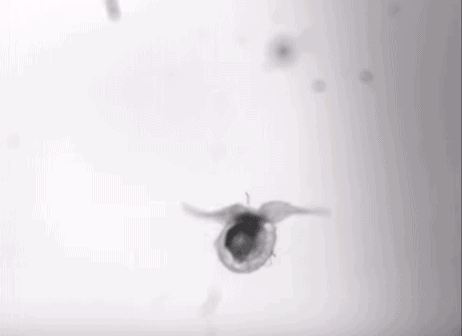
Is it a butterfly? A bee? An alien? Nope! It’s a sea snail. A sea snail. From the sea. This aptly-named Arctic “sea butterfly” (Limacina helicina) is the subject of a new study in the Journal of Experimental Biology. It turns out that its way of swimming doesn’t just look like flying — the mysterious creature really does use the same biomechanics as animals that fly through the air.
“In a remarkable example of convergent evolution, we show that the sea butterfly Limacina helicina ‘flies’ underwater in the same way that very small insects fly in the air,” the authors write in the study. Convergent evolution is when the same trait evolves more than once in unrelated organisms.
“Both sea butterflies and flying insects stroke their wings in a characteristic figure-of-eight pattern to produce lift, and both generate extra lift by peeling their wings apart at the beginning of the power stroke,” the study states.
Gelatinous save for their shells, helicina snails sprout their “wings” where most snails grow feet. Most other zooplankton drag themselves through the water using a paddling technique. But the 3 millimeter-long helicina manages an “insect-like figure-of-eight wing stroke.” The mechanics of its “flight” are quite similar to that seen in a fruit fly.
To analyze their swimming patterns, the researchers used a complex system of 3-D cameras, lasers and light-reflecting particles to trace the flow of water as the creatures moved.
“The more we looked into it, the more we found that the sea butterfly is an honorary insect,” study co-author David Murphy of the Georgia Institute of Technology told Live Science.
The snails even use a common insect trick to get extra lift: It’s a maneuver called the “clap and fling,” where a creature slaps its wings together at the end of a stroke, then snaps them back apart.
“This sucks fluid into that V-shaped gap as the wings open up, and creates tiny vortices at the tips of each of the wings. Those vortices are useful in generating extra lift,” Murphy told the BBC.
Understanding the biomechanics of this little snail could help engineers design some nifty sea-faring robots, and it could also help with ecological studies: Zooplankton like helicina move upwards to the surface of the ocean each night to eat (and avoid being eaten), and this mass migration of tiny organisms is one of the biggest biomass movements on the planet.
But even ignoring any potential practical applications, the findings are pretty cool: This little sea creature manage to evolve the same flight patterns as a fruit fly while living underwater. It just goes to show you that when something works once, evolution is bound to churn it out again somewhere else.
© 2016, The Washington Post





