

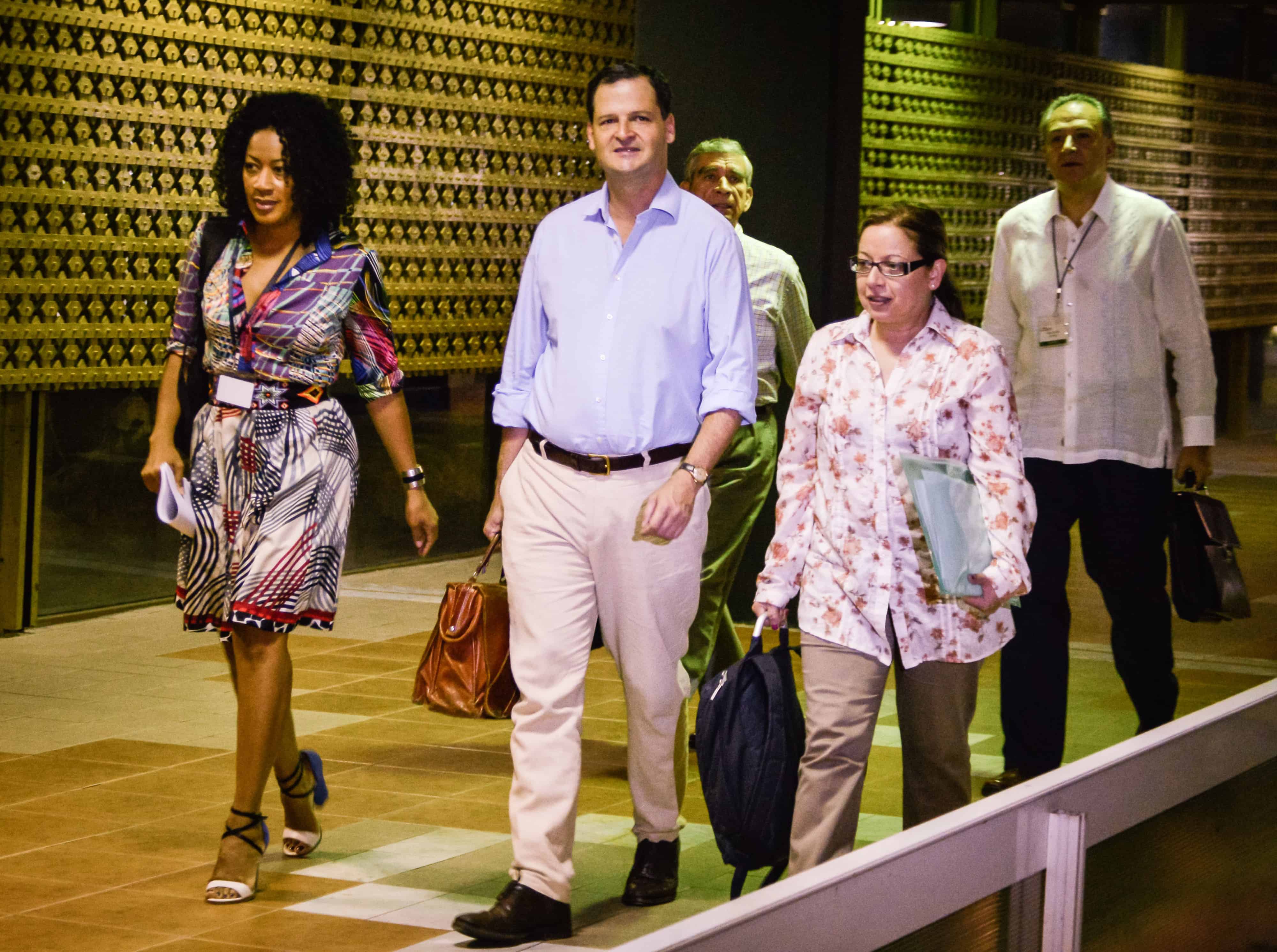
BOGOTÁ, Colombia – Four years ago, when Colombian President Juan Manuel Santos agreed to open a secret channel to the Revolutionary Armed Forces of Colombia (FARC) guerrillas, only three people knew. One was Sergio Jaramillo, Colombia’s high commissioner for peace, who was the government’s strategist for peace talks with the guerrillas. In a rare interview this month, Jaramillo talked with The Washngton Post. Excerpts follow:
When did the negotiations begin?
In December 2010, the FARC said they would send two secretariat members to a meeting. Only the president, myself and his brother knew. We agreed [to go] so long as the meeting was secret and abroad.
Why did President Santos decide to go ahead with these talks?
It was the right moment. We spent most of September 2011 discussing where the meeting would be. The FARC wanted security guarantees.
How did the meeting actually take place?
We had to take one of the FARC commanders from the middle of the jungle and bring him to Havana.
… We said we thought there was a window of opportunity. We made clear that we were there on the basis of our position of wanting to end the conflict. But we’re only going to go into a negotiation if you are serious about ending the conflict — which the FARC had never been. We spent six months of secret negotiations in Havana.
How did the FARC react?
They said they were serious. I think they realized it was the right moment and that President Santos was willing to have an agenda that wasn’t simply about laying down their weapons, which was a condition. It included other things, [such as] developing the countryside. [Without that] the likelihood that violence is going to continue is high.
We said let’s try and work toward a framework agreement that will establish the conditions for a peace process so that you know what you’re getting into and we know what we’re getting into.
That was in 2012?
Yes. The secret negotiations ended in 2012 [when] President Santos announced the general agreement for the termination of the armed conflict. It is a real miracle that this did not leak. We had actually created a road map. Without that, there is no way we would have gotten anywhere because the FARC are very legalistic. …
That October, we started developing this framework agreement in public in Oslo.
Then we went back to Cuba, where we’ve been ever since. We reached an agreement by May 2013 on the agrarian issue. It is a mixture of some land reform, distribution of land, access to land and lots of investment in rural development.
Then we started [agenda item] number two, which is political participation, [including] security guarantees for those who participate in politics.
We talked about the creation of political parties in the transitional phase. The FARC would constitute a new political party.
Then you started negotiating the drug issue?
We reached an agreement by May 2014. They agreed to cooperate in concrete ways to the solution of the drug problem. It means helping with the coca eradication and crop substitution programs and cutting any links they have to drug trafficking.
Now we are talking about [the issue of] victims.
What do you want to come out of this negotiation?
We need some very clear commitments from the FARC to help with victims’ reparations and truth. For example, this country is covered with mines. If they want to show the communities that they are serious, why not participate in a de-mining program?
There is a window of opportunity. Unless you do it now, the whole thing is receding. Until we got to this process, nobody thought that the FARC were going to give up their weapons.
Will all the paramilitaries who are soon getting out of jail try and kill the demilitarized FARC?
Excellent question. No, I think the paramilitaries who are getting out of jail will want to behave.
What makes you think so?
Because they risk a lot of things — being extradited to the U.S., for example.
Extradition to the U.S. is such a huge issue here. Are the FARC worried they will end up in a U.S. jail?
Of course.
Are they saying that they won’t agree to a deal unless they know they will be protected from both Colombian and U.S. sentences?
There are two parts to this: What is the U.S. going to do about this and what is Colombia going to do? You can send them to the U.S. or you cannot. You need to have a serious dialogue with the U.S. about how to manage this, which we are doing.
Is the Colombian government willing to say that if the FARC agrees to a deal, they won’t be extradited?
I can’t say that. But I can say that we are going to work hard on that issue.
For the U.S. [a negotiated peace] would be huge. If this works, you will have a program based on bipartisan support in the U.S. and a local government at the front pushing the FARC back and getting a handle on the drug issue. A happy ending. What more do you want?
Recommended: Victims’ issues come to the fore in Colombia peace talks
Weymouth is a senior associate editor of The Washington Post.
© 2014, The Washington Post





