
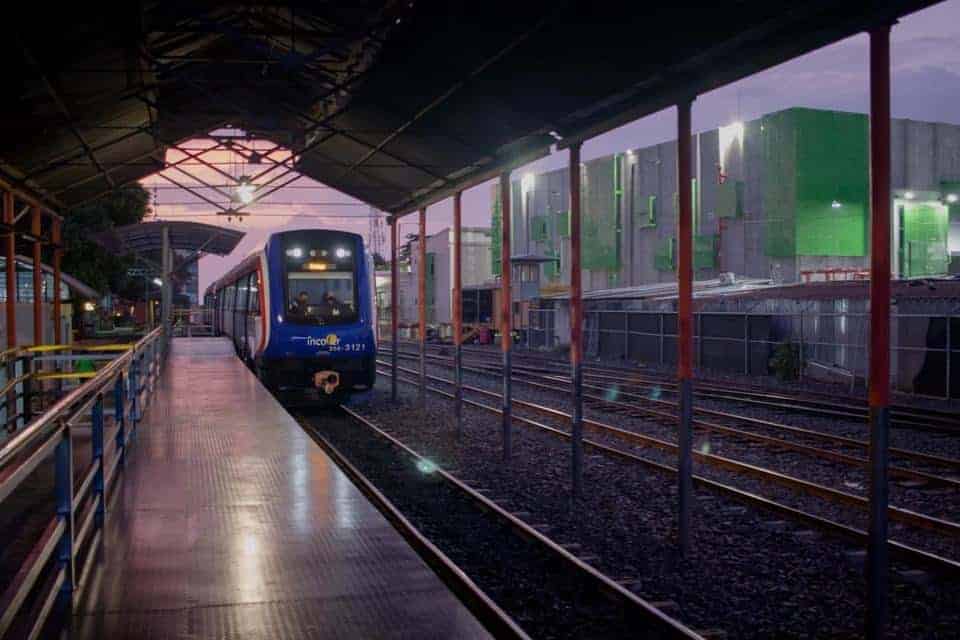
The Costa Rican government expects the Greater Metropolitan Area (GAM) Electric Train project to be approximately 80% complete by the end of the Laura Fernández administration in 2030, leaving the remaining 20% to be finished by the next government. The target is included in the National Development and Public Investment Plan for the 2027-2030 period and provides one of the clearest timelines yet for the construction of the long-awaited passenger rail project.
Minister of Public Works and Transportation Efraím Zeledón said the government has already begun the process of hiring a firm to establish a project management office that will support the Costa Rican Railway Institute (Incofer) in developing the initiative. According to Zeledón, additional technical and management support is necessary because Incofer currently has limited institutional capacity due to a lack of resources and decades of underinvestment in the railway system.
The next major step will be starting the tender for the design and construction of the electric train. Under the government’s current schedule, design work would begin in 2027, while construction would take place throughout 2028, 2029 and 2030. “The projection is to reach approximately 80% progress, so it would not be 100% completed by the end of the administration. Around 20% would remain for the future,” Zeledón explained.
The minister noted that the timeline depends not only on civil works but also on the acquisition and delivery of rolling stock and other specialized equipment. “It is not just about construction, but also about importing the rolling stock, the trains, locomotives and equipment, and all of that requires production time,” Zeledón said. “We will leave the project not only awarded but already under construction and underway, although it will not be 100% completed.”
The project received a major boost on May 11, when the Legislative Assembly unanimously approved $800 million in international financing for the construction of the first two lines of the rapid passenger train system. The approval came after the Constitutional Chamber rejected a constitutional challenge filed by lawmakers from the previous legislative term, clearing the way for Congress to move forward with the financing.
Of the $800 million loan, $550 million will be provided by the Central American Bank for Economic Integration (CABEI), while the European Investment Bank will contribute another $250 million. The project will also receive $178 million in additional financing and a $21 million grant from the Green Climate Fund.
The funding will be used to build two electric rail lines connecting some of the GAM’s most populated areas. One line will run between Paraíso, Cartago, and San José, while the second will connect San José with Alajuela through Heredia. The system, known as Tibi, will cover approximately 51 kilometers of double-track railway across the two lines.
Incofer plans to publish the international tender during the second half of 2026, award the project in 2027 and begin construction in 2028. The project also includes the acquisition of 28 new electric train units. Once operational, authorities estimate that more than 100,000 passengers could use the service each day, providing a new public transportation option for commuters across Costa Rica’s most densely populated urban region.