
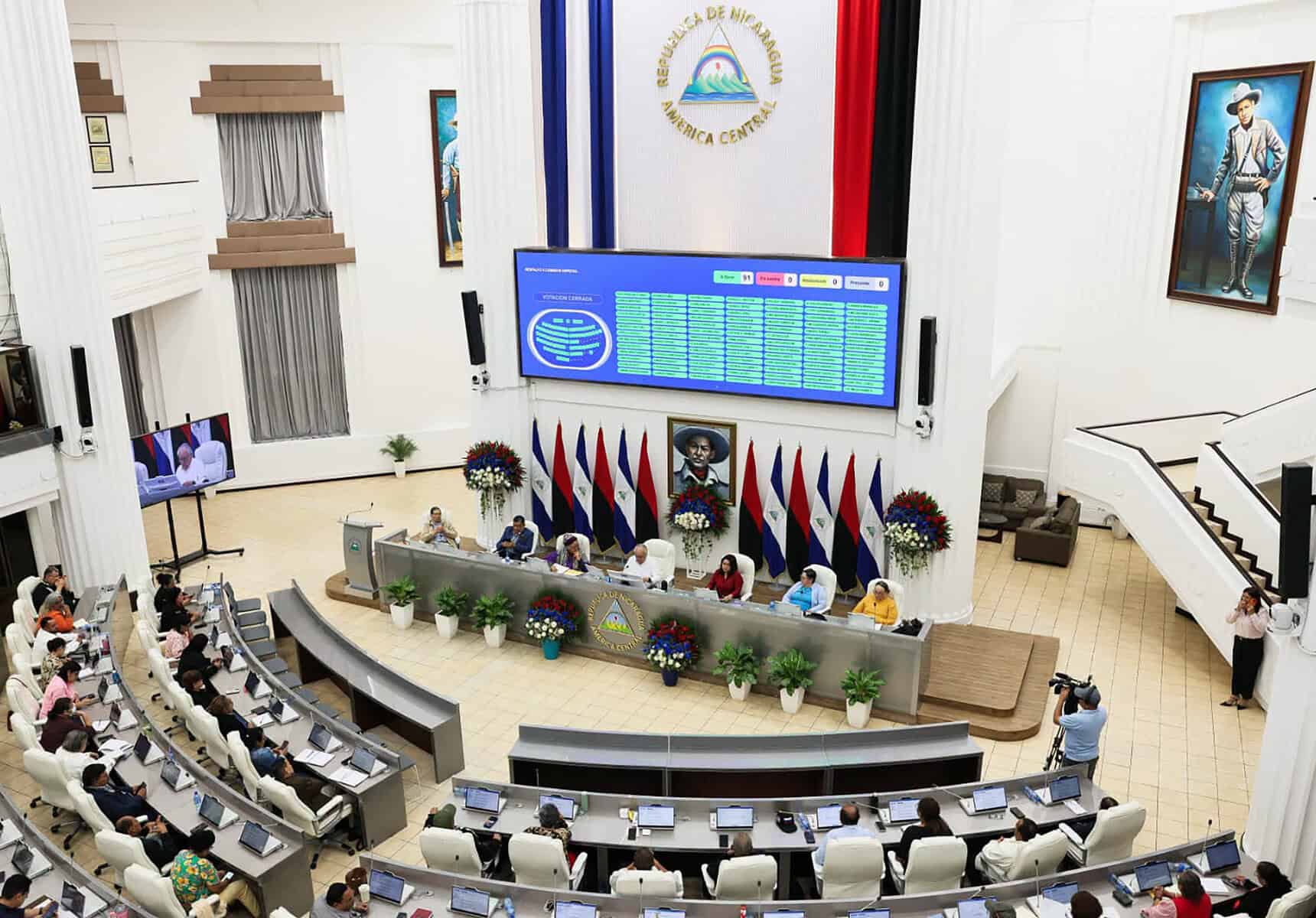
Nicaraguan President Daniel Ortega warned Friday that he will move forward with a constitutional reform aimed at excluding the opposition from elections, despite objections from several countries and international organizations. The National Assembly, controlled by the government, is expected to approve the constitutional changes requested by Ortega in early September.
The reforms would prevent the participation of opponents whom he claims are working on behalf of the United States.“They will have no choice but to shout, no choice but to bark,” the president said while announcing progress on the proposal during the 47th anniversary of the Air Force. Ortega, who has made few public appearances this year, resurfaced on July 19 to present the reform for the first time after a two-month absence from official events.
Several countries and international organizations have rejected Ortega’s intention to exclude opponents whom he describes as “coup plotters” and “traitors to the homeland” from elections. The reform would also extend the presidential term from six to seven years and make it “renewable,” a measure that opposition leaders say would effectively bury competitive elections.
The full text of the proposal has not yet been released by either the National Assembly or Ortega’s government. The United States warned that it would not remain “with its arms crossed” in the face of the “dictatorship,” while the European Union urged the Nicaraguan government to hold elections “in accordance with international standards.”
Ortega said the reform is intended to “strengthen peace,” while “others continue conspiring to find a way to bring war back to Nicaragua,” an apparent reference to the United States. “We have to fight to strengthen peace, and strengthen it through laws, strengthen it through reforms that leave no room for terrorists and coup plotters,” he added.
“The U.S. government should be clear about that. Nicaragua does not want war. It wants peace, and we will continue fighting for peace,” Ortega said. Ortega, 80, and his wife, Rosario Murillo, 75, govern with virtually absolute power and maintain tight control over Nicaraguan society, especially since the 2018 protests, whose repression left more than 300 people dead, according to the United Nations.
The presidential couple considers those demonstrations an “attempted coup d’état” sponsored by the United States.