

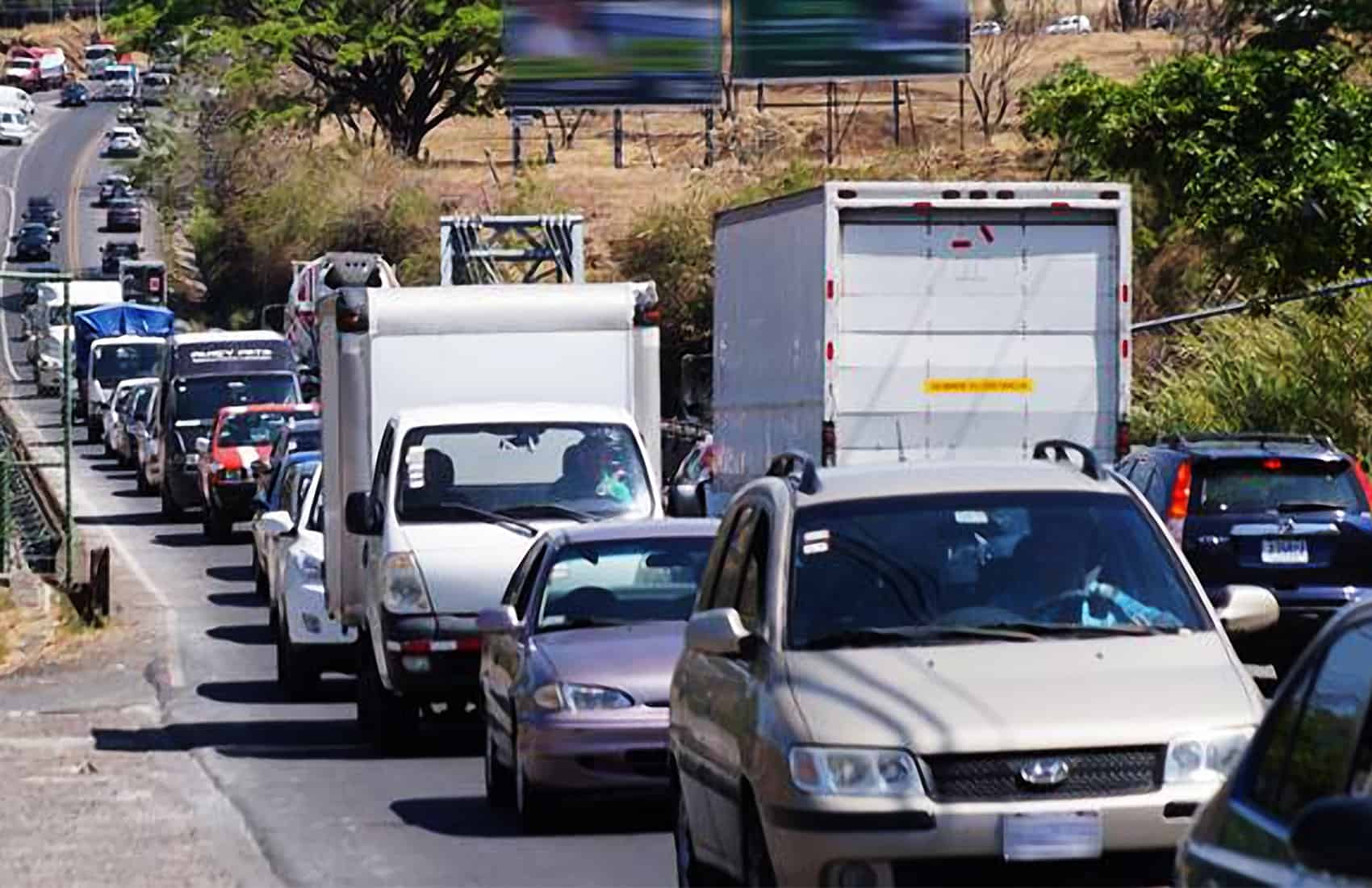
Costa Rica’s traffic problems are no longer limited to rush hour in San José. Mobility experts warn that key roads in and around the Greater Metropolitan Area have reached the point where a single crash, closure, or roadwork project can trigger hours of gridlock across several major routes.
The most fragile area is west of the capital, where the Ring Road, General Cañas Highway, and Route 27 are now so interconnected that a problem on one route quickly spreads to the others. Mobility expert Mario Durán said the sector has exhausted its reserve capacity, meaning the road network has little room left to absorb diverted traffic when something goes wrong.
Durán warned that Costa Rica is at risk of prolonged or even recurring traffic collapse because of the continued rise in the vehicle fleet and the lack of traffic management measures by the Ministry of Public Works and Transportation. He said the issue is no longer only about building more roads, but about managing the movement of vehicles when the system is under pressure.
Recent incidents have shown how vulnerable the network has become. A fatal accident on Route 27 last week reportedly caused traffic chaos across connecting roads for more than five hours. The 2024 closure of the Bajo Los Ledezma bridge also exposed the weakness of the system, with the diversion of about 1,000 vehicles enough to worsen congestion on the Ring Road.
The problem is being driven in part by the growth of Costa Rica’s vehicle fleet. The number of insured vehicles in the country surpassed 2 million in 2025, rising from 1,913,266 in 2024 to 2,087,356, an increase of more than 174,000 vehicles in one year. Private vehicles and motorcycles accounted for most of that growth.
That increase is putting pressure on roads that were already struggling to handle daily traffic. Even on normal days, drivers using Route 27, General Cañas, Circunvalación, and other major access roads into San José face long delays. When an accident, construction project, or closure occurs, the system often has no practical way to keep traffic moving.
Durán said authorities need clear protocols for managing incidents, especially crashes involving fatalities. At present, some roads remain closed for hours while judicial authorities process the scene and remove bodies. He said faster coordination between the judiciary, Traffic Police, Red Cross, Fire Department, and other emergency responders could help prevent full closures and keep at least one lane open when possible.
The placement of emergency vehicles also needs to be reviewed. In many cases, ambulances, fire trucks, patrol cars, and other units arrive at a scene and block all lanes, even when a partial opening might be possible. Durán said the country needs a traffic management plan that treats road closures as events with national consequences, not isolated incidents.
Experts have also called for better use of technology. A recent CFIA discussion on congestion recommended expanding traffic control infrastructure, using smart traffic lights, installing more CCTV cameras, improving traffic data collection, and creating stronger systems for incident response. The same discussion also recommended free-flow tolling on Route 27, beginning in San Rafael de Escazú.
Manual toll collection remains one of the most visible bottlenecks. Durán pointed to Route 27 as an example, where multiple toll booths narrow into fewer lanes just beyond the payment area. He warned that new highway concession projects should not repeat that model, arguing that wider roads can lose much of their benefit if drivers are forced back into a toll bottleneck a short distance later.
Other transport specialists have raised similar concerns. Proposals discussed this month include automated enforcement, electronic tolls without stopping, stronger traffic monitoring, and better coordination with public transportation. Experts also said Costa Rica needs to reactivate collective transport, especially buses, and link them more effectively with the rail system.
The cost of congestion is also becoming harder to ignore. A recent mobility study cited by local media estimated that traffic jams cost Costa Rica around 4% of its gross domestic product when productivity losses, health costs, material damage, and emergency response are included. The same report said nearly half of the road network is saturated during peak hours.
For drivers its more of the same as trips that should take minutes can stretch into hours, with little warning and few alternatives. For the country, the impact is broader. Traffic congestion affects work schedules, cargo movement, emergency response, public transportation, fuel use, and quality of life.
Durán said the first step is for authorities to recognize that Costa Rica cannot solve the problem through road construction alone. Our country needs active traffic management, faster incident response, electronic toll systems, better public transportation, and coordinated decision-making before the next accident or closure brings key routes to a halt again.





