There’s always room for improvement. I can confidently say that I am better at wildlife monitoring using camera traps than I was five years ago, but that’s just the result of many small increases in competency over a long period of time. One of the things I’ve been trying to improve upon lately is allowing the forest to tell me where to place my camera traps. I feel as though the forest, through its structure, the animals that live there, and how those animals use that environment, is whispering to me, pointing out all of the very best locations for cameras, and it’s my job to pay attention enough to hear what it has to say.
A few months ago, I had a whole day available to hike several kilometers through the tropical dry forest of Guanacaste on a series of trails that I hadn’t fully explored before and find locations for seven camera traps. I was trying my very best to listen to the forest’s clues about where to place the cameras and after a few hours I think I had done a pretty good job. There were a series of rocks across a stream where the forest said, “Hey, wildlife is probably going to cross here.” There was a large tree leaning on an angle across a pond that said, “If I were a monkey, I’d use this as a bridge.”
As the day moved forward, I had one camera trap left to deploy. I was crunching down a forested trail when I saw a white-tailed deer emerge from some brush and walk across the trail, quickly followed by a second deer. The forest said, “I wonder what they were doing?” To find out, I took a few swings at the brush with my machete and started walking in the direction that the deer had come from. A few meters in I came across a nice-sized watering hole in an otherwise dry streambed. The deer had been taking drink. This was an excellent location for the last camera. Just I was about to take off my backpack and dig around for my camera gear the forest whispered, “What do you think is farther down the streambed?”
I was in no particular rush, and you never know what amazing natural wonder is around the next corner, so I shouldered my backpack and continued. Eventually the sides of the streambed became steeper, like little walls on either side, and as I turned a corner the dried stream ended in an enormous hole. I was standing at the top of what would have been a waterfall a few months earlier in rainy season. As I peered over the edge to get a good look at the large swimming pool worth of water a few meters below, I frightened a mud turtle at the edge of the pool, and it jumped into the water with a splash.
The deer puddle was an excellent location for a camera trap, but this hidden pool was remarkable. To get the videos I wanted, I’d have to climb down and get the camera trap directly above water level. The quickest way down was a tangle of vines that dangled over the edge I was standing on that led down into the water. I considered using them to scoot down but then I pictured myself falling backwards while gripping recently snapped vines and falling into a pool of murky water that potentially hid a crocodile and decided to take the long way. I eventually got the camera trap into the perfect location with the camera mount screwed into some strangler fig roots, allowing the lens to peer across the water of the pool and record the opposite bank.
With the camera set, all I had to do was wait for it to record all of the amazing creatures that call that forest home. I spent the following weeks imagining wild cats coming to the pool to take a drink, tapirs entering the water for a swim, and birds splashing at the water’s edge, taking a bath.
Last week, I was working on the same property installing an underwater camera trap with Canadian fisheries research scientist Dr. Christopher Bunt. I needed to retrieve the seven cameras that I had previously placed, and I thought it would be a nice opportunity to take Chris out to see the wildlife that the cameras had recorded. As we walked down the dry streambed, I yammered on about how two deer told me about this spot a few months earlier.
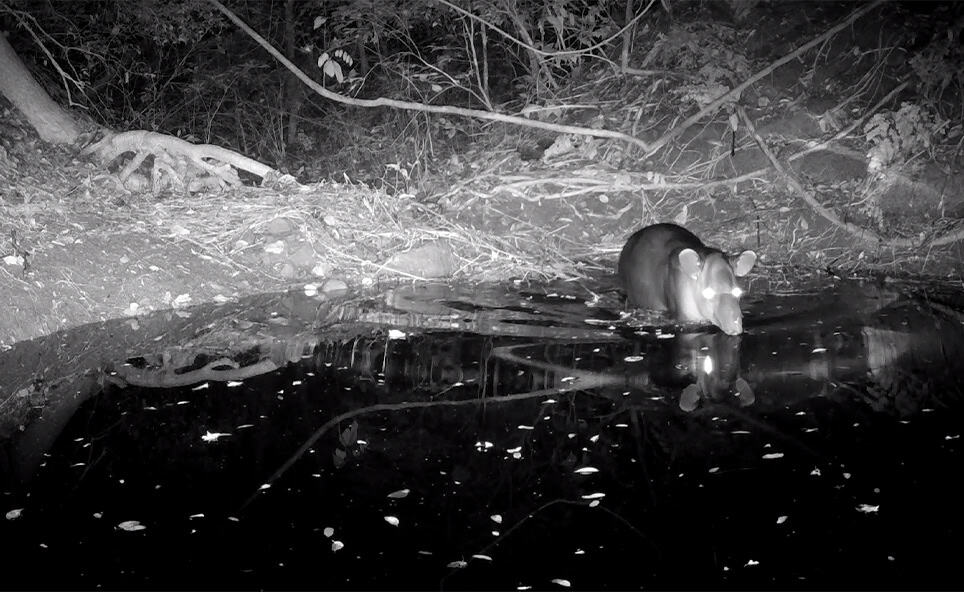
I retrieved the camera from the edge of the pond, hiked back up to the streambed, and stuck the SD card into my laptop. Chris and I scrolled through the videos. There was a video of a tapir walking into the pool and swimming around. There were videos of a spectacled owl splashing at the water’s edge, taking a bath. There was even a video of a jaguar walking along the edge of the pond away from the camera with something in its mouth. We played back the video, scrunched our noses, and peered even closer at the laptop screen to see what it was. We were able to determine that there was a turtle in the jaguar’s mouth, most likely the same one I had frightened months earlier.
The camera recorded some amazing videos in the short time that it monitored the pool. When I can, I’ll place another camera in the exact same spot. It’s an epic location for a camera trap. I wish I could take credit for finding it, but the truth is, the forest told me about it.
Take a look at some of my favorite videos from the pool in the video below.
About the Author
Vincent Losasso, founder of Guanacaste Wildlife Monitoring, is a biologist who works with camera traps throughout Costa Rica.