

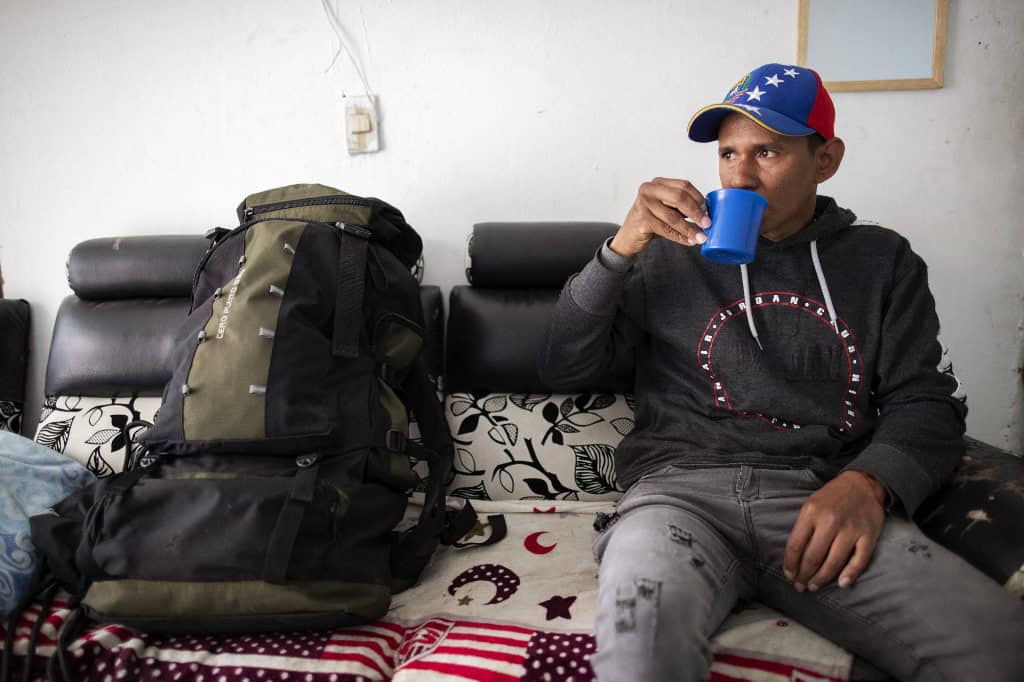
When Nicolás Maduro was proclaimed the winner of the elections, José Ochoa began packing his bags to walk from Colombia to the United States through the Darién jungle. Like other migrants, his hope of returning to Venezuela vanished after the elections. Ochoa, 38, was counting on the opposition’s victory on July 28 to return to his native state of Carabobo (north-central), four years after leaving Venezuela fleeing the economic crisis.
But amid allegations of fraud, Maduro was re-elected for a term until 2031, in a country from which more than seven million people have left, according to the UN. Of these, three million have arrived in Colombia, the main recipient. “I’m going to take the road to the United States… I didn’t want to do it but it’s a tough decision,” Ochoa said in Madrid, a municipality near Bogotá.
There he lived alone in a small room. When he was visited, days after the elections, he had already sold the bed and a bicycle he used to get to his job in a flower field. He had a backpack prepared with clothes to face the journey of about 15 days. Venezuelan opposition leader María Corina Machado has warned of an unprecedented “wave” of migration if Maduro continues in the presidency.
After the interview, contact was lost with Ochoa.
End of hope
On election day, Ochoa felt “very upset”. “I’m not going to tell you that I cried, but I was very angry because we all had hope that this would change,” he confessed. Despite pressure from multilateral organizations and several countries to reveal the voting records, the electoral authority has not yet published the results, citing an alleged hacking of the counting system.
A victory for the opposition’s Edmundo González Urrutia would have motivated Ochoa to return home and reunite with his father. His mother and a sister died in his absence. Now he will face the dangers of crossing the Darién, a jungle that divides Colombia from Panama where paramilitaries and gangs of thieves operate.
For Ronal Rodríguez, from the Venezuela Observatory at the Universidad del Rosario, “we are already having” a new migratory wave that will aggravate the humanitarian situation in that inhospitable corridor. In 2023, more than half a million migrants crossed that jungle according to official Panamanian figures, most of them are Venezuelans.
Uncertainty and powerlessness
In Brazil, Yajaira Deyanira Resplandor felt “defeated” seeing the triumph of Chavismo. She was “sad, powerless for my country, for the people who have died and those who are imprisoned,” said the 56-year-old woman, who works in a textile factory and lives in a favela in Rio de Janeiro.
Seven years after arriving by land with her two daughters, she still hasn’t adapted to life outside Venezuela and yearns to return, “as long as the president leaves.”
For William Clavijo, president of the NGO Venezuela Global, which supports the integration of Venezuelans in Brazil, the election result plunged migrants “into a situation of great sadness.” “It creates uncertainty about the possibility of returning, of being able to reunite with their country, of having stable lives again, decent salaries,” he explained.
According to official figures up to June 2024, almost 600,000 Venezuelans have entered and remained in Brazil since 2017, where language is a difficult obstacle to overcome. Despite the discouragement, Resplandor assured that she doesn’t lose hope, and stated: “God will get him out of there” (referring to Maduro).
Dying in Venezuela
While the governments of Mexico, Colombia, and Brazil try to mediate between Maduro and the opposition to solve the crisis unleashed after the elections, migrants in the south of the continent remain expectant. “I’m here with an eagerness for everything to change there and return soon. I want to reclaim my life in Venezuela,” pleaded Alba Olivero, 70, in Montevideo.
In the Uruguayan capital, Olivero cannot collect her pension of about 25 dollars a month, as the Venezuelan government broke the agreement that governed this in 2015. “As soon as Maduro’s government falls, I’m going back to help in the reconstruction” of the country, she maintained. I want to “live and die” in Venezuela.





