
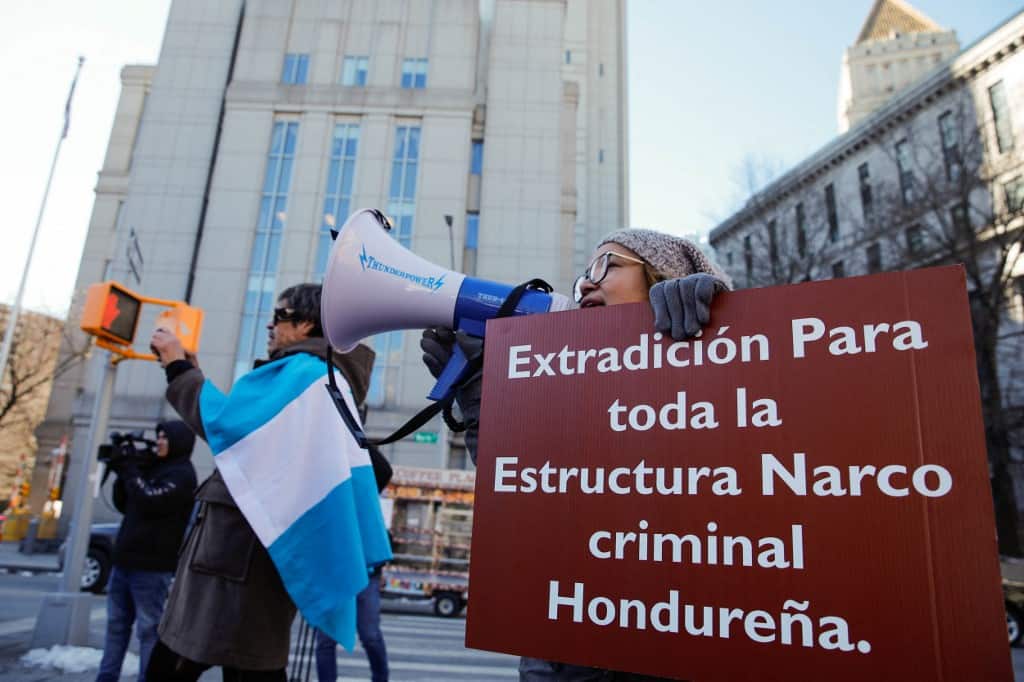
“I was not going to kill my partner,” drug lord says at trial of former Honduran president in US. “Killing my partner, whom I had bribed (for protection) was not on my mind, and secondly, I was already working with the DEA,” drug trafficker Devis Leonel Rivera said before the US justice system when explaining that he did not participate in a plan to assassinate then-President Juan Orlando Hernández, on trial for drug trafficking in New York.
Rivera, founder together with his brother Javier of the Honduran Los Cachiros cartel, outlined the links with the Honduran political class, including the former president, whom he helped get into public office with his financial contributions in exchange for protection for the cocaine trafficking coming from Colombia.
Author of 78 confessed murders, the drug lord began collaborating with the US Drug Enforcement Administration (DEA) in 2013 before surrendering to US authorities in January 2015.
Rivera recalled that the Valle brothers, Arnulfo and Luis, from the Valle-Valle cartel, wanted to kill Juan Orlando Hernández and his brother Tony Hernández because the authorities had “seized several properties” from them and had stopped answering their phone calls.
Then deputy of Cortés department Reynaldo Ekónomo spoke with Rivera, whom he had known since 2004, and Rivera told him that although the Valle brothers had asked him to participate in the planned assassination at the beginning of Hernández’s first term (2014-2018), he did “not accept.”
“I was not going to kill my partner, whom I had bribed (for protection) and secondly I was already working with the DEA,” Rivera told the prosecution. He is currently serving life plus 30 years for importing more than 5 kg of drugs into the United States, arms trafficking, being the leader of a drug trafficking gang, 78 murders and money laundering.
In another phone conversation with Ekónomo in which the then president was supposedly on the call, Rivera would have reassured Hernández by saying, “At no time did I mean to harm you.” After that conversation, Ekónomo told Rivera that “Juan Orlando was satisfied with the explanation.”
In exchange for the mediation, Ekónomo would have asked the drug lord for “60,000 dollars, a truck and a house in Tegucigalpa” and the latter gave him “between 40,000 and 60,000 and a white truck.”
Repentant
Throughout his questioning, which began on the afternoon of Tuesday, Rivera has highlighted the links between drug traffickers and Honduran politics.
In the defense’s cross-examination of Hernández, attorney Raymond Colon asked Rivera if he regretted the murders he perpetrated or ordered.
“At the time no, but now I regret having killed but I also regret having bribed the corrupt politicians of my country’s government, like (former president) Pepe (Porfirio) Lobo, Juan Orlando Hernández, the military (…) police who instead of taking bribes should have arrested us,” the drug traffickers, the capo said. “They became drug traffickers like us,” said the drug lord seeking to reduce his sentence by cooperating with the prosecution.
In his 13 years as a drug trafficker, he said he had amassed some “55 million dollars” despite having to pay “250,000 dollars to bribe” JOH, as former president Hernández is known in Honduras, who would have given it to his sister Hilda Hernández.
Another “50,000” went to his brother Tony Hernández, “800,000 to Juan Orlando’s allies,” “about 600,000 to Pepe Lobo,” among other politicians who protected him, Rivera detailed.
Before the jury that will give its verdict, the defense seeks to undermine the credibility of the witnesses seeking benefits in exchange for their testimony by insisting on their criminal record, getting them to contradict themselves, and the lack of evidence for the payment of bribes they allege.
“The only proof the drug traffickers had was their word,” Rivera told the lawyer sarcastically. According to the DEA, between 90% and 95% of the cocaine consumed in the United States comes from Colombia and since 2004 around 92% to 94% passes through Central America (Costa Rica, Nicaragua, Honduras and Guatemala) before crossing Mexico.
San Pedro Sula, the economic capital of Honduras, is the main “hub” or center of operations on the route, Jennifer Taul, a DEA drug trafficking specialist, testified during the trial of the former president of Honduras.
Hernández faces charges of conspiring with drug traffickers and weapons trafficking and possession, which could lead him to spend the rest of his days in jail, like his brother Tony Hernández, another central figure in organized crime and the drug trade multinational.