
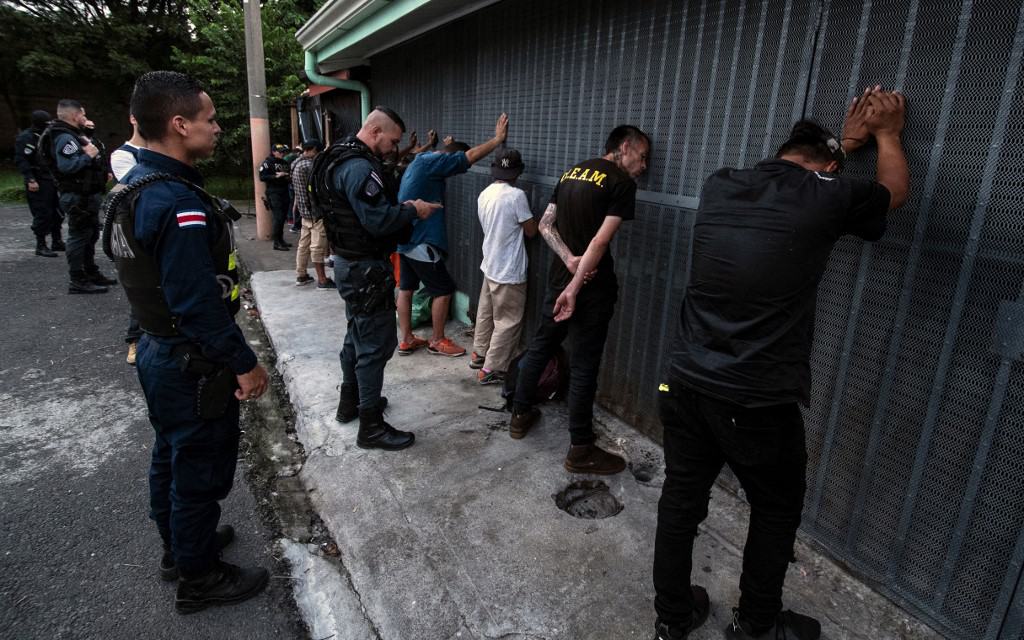
A man is shot at the door of a hospital, another on a soccer field where several children were playing, and shooting drills are conducted at a school: Costa Rica is suffering an escalation of violence by organized crime linked to drug trafficking.
The year 2023 is already the most violent year in this Central American country since records have been kept, with 777 homicides through November, 238 more than in the same period in 2022, according to data from the Judicial Investigation Agency (OIJ, police).
It is a “cancer” that “was not detected in time,” Minister of Public Security (Interior) Mario Zamora said. “We have to prevent it from metastasizing,” he added.
According to the Center for Research and Political Studies at the University of Costa Rica, insecurity is now the main concern of Costa Ricans. “It is a novel fact,” historian Hugo Vargas said.
Two people arriving on a motorcycle, a hitman firing shots, and someone dying. The story is repeated practically every day in the news. “There are killings all the time. It’s what we see in the news every morning when we wake up,” said Mario Rodríguez, a 74-year-old retiree.
The septuagenarian misses the calm in a country that for a long time was considered an oasis in a Central America that went from decades of war and civil conflict to the violence of drug trafficking and gangs.
“It’s a little scary, mostly for the kids. Maybe they have to go to school or do group work with their classmates… they can’t even play ball in a park because there could be a shootout,” said Alexa Mujica, 37, a merchant.
Fighting between gangs
Costa Rica is, like the rest of Central America, a bridge for drugs going from South America to the United States and Europe.
Along the way, money, drugs and weapons reinforce small cartels that are increasingly organized. Two-thirds of homicides are score settling in disputes between gangs over territories for the drug market. 81% of the deaths were committed with firearms, sometimes military rifles like AK-47s or AR-15s.
“It is not a widespread general insecurity crisis,” Zamora said. The government began an anti-crime operation in May that dismantled some 10 criminal structures.
In the Caribbean city of Puerto Limón (Limón province, east), historically depressed and where the homicide rate is 35.3 per 100,000 inhabitants, scanners were installed at the port to detect drugs in cargo containers destined for the United States and Europe.
According to projections, Costa Rica will close 2023 with around 900 violent deaths and a homicide rate of 17 per 100,000 inhabitants, in a country of 5.1 million.
Last year, a record rate of 12.6 homicides per 100,000 was already reached. The world average is 8 per 100,000 people, according to the UN. Given the worsening situation, seven bills to strengthen public security await analysis in Congress.
Perfect storm
Zamora said that upon taking over the Ministry of Security in May, there were the same number of officers and resources as in his previous tenure (2011-2014).
In 2013 there were 407 homicides, so the figure has more than doubled in a decade. It is necessary to “build the foundations of a professional, trained police force” to obtain results in the medium and long term, he considered.
With 17,000 officers, the Fuerza Pública (national police) faces a criminal phenomenon that is “professionalized” and “highly violent,” according to Zamora.
“The police normally know and are familiar with the 340 gangs operating in the country,” he said.
Randall Zúñiga, director of the OIJ, agreed that to balance this “unequal fight,” resources, training and agents are lacking. An additional 1,080 officers to the current 3,500 are needed in this judicial police.
“We can’t hide from the sun with one finger,” Zúñiga emphasized, describing the situation as a “perfect storm.”
Former Security Minister Álvaro Ramos, for his part, stressed the need to invest in education, health, prevention, police presence to wage a “direct attack on the jugular” of organized crime.
“If we abandon the population (…), organized criminals will replace the state,” he warned. For Rafael Rojas, a 62-year-old painter, the solution is clear: “Invest in the poor and get them out of poverty. That’s the main weapon. It’s not buying weapons, patrol cars, or jails. It’s building schools, school cafeterias, and playgrounds,” he said.