
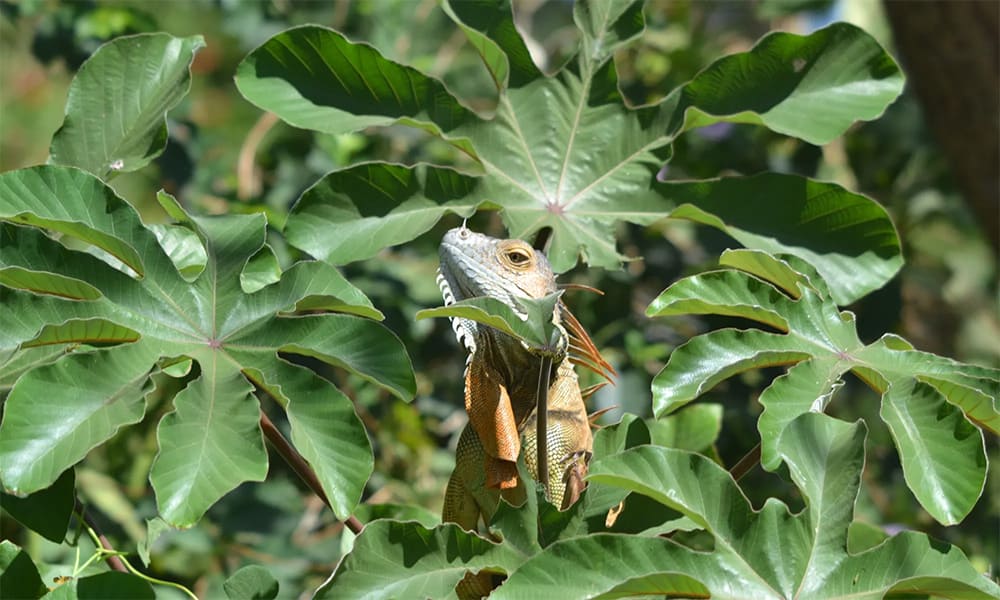
Let’s do a mental exercise. First, picture Costa Rica in your mind’s eye. Now, think about its biodiverse, tropical forests and beaches. Now I want you to think of one species of lizard that calls Costa Rica home. I bet I know which species popped into your head. Let’s learn a little more about the green iguana.
The green iguana is well named in English because it’s green (a lot of time). The Spanish name is the same but it’s in Spanish, iguana verde. Normally, scientific names are some impossible to remember combination of crazy words with way too many vowels. This isn’t the case for the green iguana. Its scientific name is Iguana iguana. Even I can remember that.
As for the physical description, one of my reptile books gets right to the point with the first sentence describing green iguanas – “A huge lizard.” Green iguanas are the largest lizards in Central America. They can grow to over two meters long and weigh as much as 20 pounds, with males generally being larger than females. That’s a hefty lizard.
Both males and females have a row of dragon-like spines running down their backs. The males sport a large flap of skin that hangs down under their neck called a dewlap. As the name implies, green iguanas are frequently some shade of green. However, during the mating season, males can turn from green to bright yellow or orange.
Green iguanas are common in much of Costa Rica. They tend to be found near bodies of freshwater either on the ground along the banks or up in the trees. They are both excellent climbers and excellent swimmers. Sometimes they put both of those skills into practice at the same time.
If you take a hike near a treelined lowland river in Costa Rica, eventually you will hear a rustling in the leaves of a branch that is overhanging the river followed by a loud splash. You just frightened a green iguana that you probably never saw into diving into the safety of the water below. There it can either hold its breath and chill on the bottom until you leave or use its powerful tail to hightail it out of there submarine-style.
Adult green iguanas are mostly herbivorous, but they lack the ability to breakdown the cellulose in the plant matter that they consume. They depend on the microorganisms in their digestive tract to do that work. These microorganisms require a specific temperature range to do their work efficiently so green iguanas must work to find the right amount of sun during the day to keep their intestinal tenants happy and productive.
I encounter green iguanas in the field and with my camera traps very frequently. One project in particular at Taboga in Cañas, Guanacaste, is particularly full of green iguanas. I have several camera traps placed along the Río Cañas, and as I walk along the forested trail that follows the river, I cause an unending series of splashes as iguanas dive out of trees into the river.
I actually have to be mindful of where I place my cameras along this river. If I put a camera on a sandy bank or on a log that crosses the river in a particularly sunny area, the result will inexorably be hundreds and hundreds of green iguana videos. Several of which will be included in the video below.
About the Author
Vincent Losasso, founder of Guanacaste Wildlife Monitoring, is a biologist who works with camera traps throughout Costa Rica. Learn more about his projects on facebook or instagram. You can also email him at: vincent@guanacastewildlifemonitoring.com