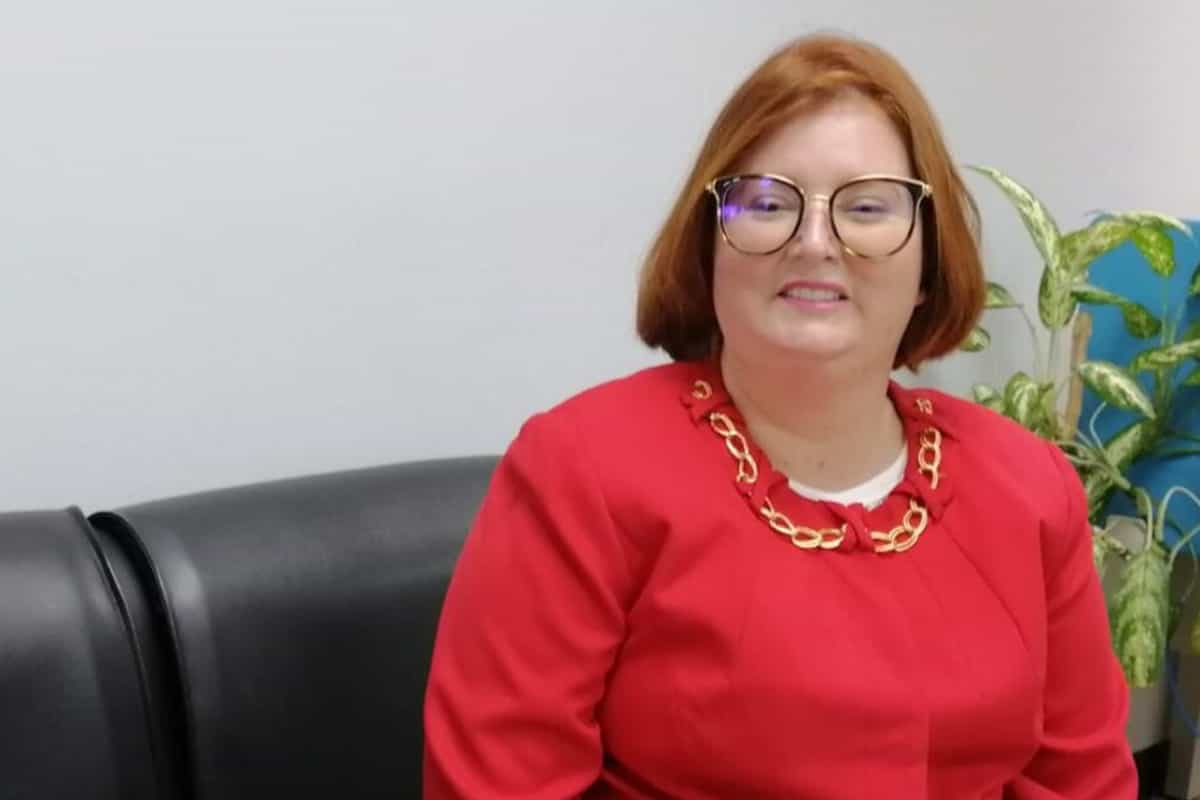
Uncovering the mysteries of sky and the seas has led Ana María Durán Quesada to explore Spain, Norway, Italy, Japan and the most remote regions of Costa Rica. Ana María is an expert in atmospheric modeling, development of observation campaigns and international experiments to understand the origin and formation of atmospheric phenomena affecting Costa Rica.
She was recognized as the outstanding scientist of 2022 by Costa Rica’s Ministry of Science and Technology. Her work focuses on many areas including atmospheric dynamics, the hydrological cycle, atmospheric transport and climatic variability. She currently works as a teacher and researcher at the School of Physics and at the Center for Geophysical Research at the Universidad de Costa Rica.
Ana Maria earned a bachelor’s degree in physics at the Universidad de Costa Rica and a master’s degree in Meteorology, Oceanography, Physics and Climate Change at the Universidad de Vigo, Spain where she also completed her PhD.
Ana Maria conducted research during her stay at the Norwegian Institute for Air Research at the Italian National Agency for New Technologies, Energy and Sustainable Economic Development and at the Atmospheric and Ocean Research Institute at the University of Tokyo.
What did you have to sacrifice to achieve your professional goals?
I consider myself lucky to not have had to make great sacrifices to achieve my professional goals. I believe that some of the challenges have been overcoming fatigue which is the product of long working hours, and sometimes reducing the time spent with family on weekends.
However, thanks to the support from family and close friends everything is compensated by the satisfaction of the work accomplished. The nucleus of close people are those who give me very important support for the development of a scientific career. I recognize that it would be difficult to get ahead with all of my activities if I did not have the support I receive at home, which optimizes my use of time.
When did you realize that you wanted to study physics, meteorology, oceanography and climate change?
From my childhood I was interested in science. Initially I was interested in botany and later I made the decision to study physics. My inspiration was the interest in trying to understand how the processes of nature occur. There were many times when I dismantled objects to see how they worked. I also liked to collect fireflies to see how their light changed.
What have been the high and low points of your career?
Receiving the reality check that academia can have an ugly side that tends to bring out the worst in people. Learning that envy sometimes takes the place of healthy competitiveness was a big disappointment for me. Fortunately, there were many good moments that I treasure with affection, which have filled me with great satisfaction, such as the support of colleagues who not only focus on their projects, but on supporting the development of other researchers.
Among those good times, a recent and very special one was an academic discussion with Professor Kazimierz Rozanski, and starting an academic collaboration with his group. Professor Rozanski is a researcher at the AGH University of Science and Technology in Krakow.
He is a person that I have admired since the beginning of my career, and spending time with someone like him was inspiring. Knowing those legends of science that, in addition to knowledge, are full of humility and the desire to continue generating knowledge is very motivating.
What have been the main achievements of your career so far?
To execute activities and advance projects focused on the development of new research areas. To show people that knowledge has no geographic or developmental boundaries when people get together to work wanting to get things done.
My aspiration is based on the fact that the country’s potential is huge and it is necessary to support the strengthening of work groups. I would like to see a better articulation of institutions and continue reducing the scientific colonialism to which national research is often exposed.
There have been so many great experiences.The interesting thing about the work has been that many times I had no idea what I was going to end up doing. There are too many anecdotes, from hiking deep in a wetland in northern Costa Rica to touring the country from coast to coast, several times, in a single week.
Visiting places where information is collected gives us a better vision of the national reality and motivates us to work on ways to generate knowledge that can affect it.
How do you face the challenges and limitations you encounter in your work?
The challenges are faced with patience and dedication. The limitations are overcome with effort and the support of the work groups. There is a lot of pressure, the workload with many tasks at the same time can be difficult to handle. However, it helps me a lot to focus on improving those aspects and try to optimize time management.
What recommendations would you give to young people who want to pursue a career like yours?
Dedication is essential to achieve goals. The barriers we often place on ourselves when we allow the system to take the lead. The secret is to identify those obstacles, remove them and continue. By removing them we open the way for people who are walking the path behind us. Science must work more and more with community spirit.
Do you think the contributions of women to science and technology are different from that of men?
They are different without a doubt. Especially due to a circumstantial issue and discrimination. The gender roles assigned to us by society have an impact that can be very negative in the development of women’s academic careers. There are very marked differences in terms of support for academic careers themselves.
In addition, access to lead research groups and participation is very limited in decision-making processes in scientific and technological development at the national level. One of the biggest problems is the invisibility of sexism in academia, as well as the tolerance of this behavior, because harmful behaviors have been normalized as a result.
What do you consider to be the main challenges facing humanity today?
To assimilate information: too much is available to people, making it easy to lose focus on its use. We went from a historical moment in which there was an enormous need to learn and specialize, to another in which the data is in the hands of people. Then it is very easily confused to have access to information with having knowledge in the different specialty areas.
What initiatives, public or private, would you recommend to encourage female participation in science and technology?
The development of a substantially funded mentoring program, a strategy to disseminate information, and the strengthening of programs that support the transfer of knowledge. Science is still a little disconnected from the national reality and that makes it difficult for young people to be interested in science. We cannot focus development in specific places, but rather, we should leave comfort zones and go to work with communities that for a variety of reasons have conditions that limit access to education for young people.
Learn more about Ana Maria in the book The Intrepids in Science & Technology published by Editorial Tecnologica: