

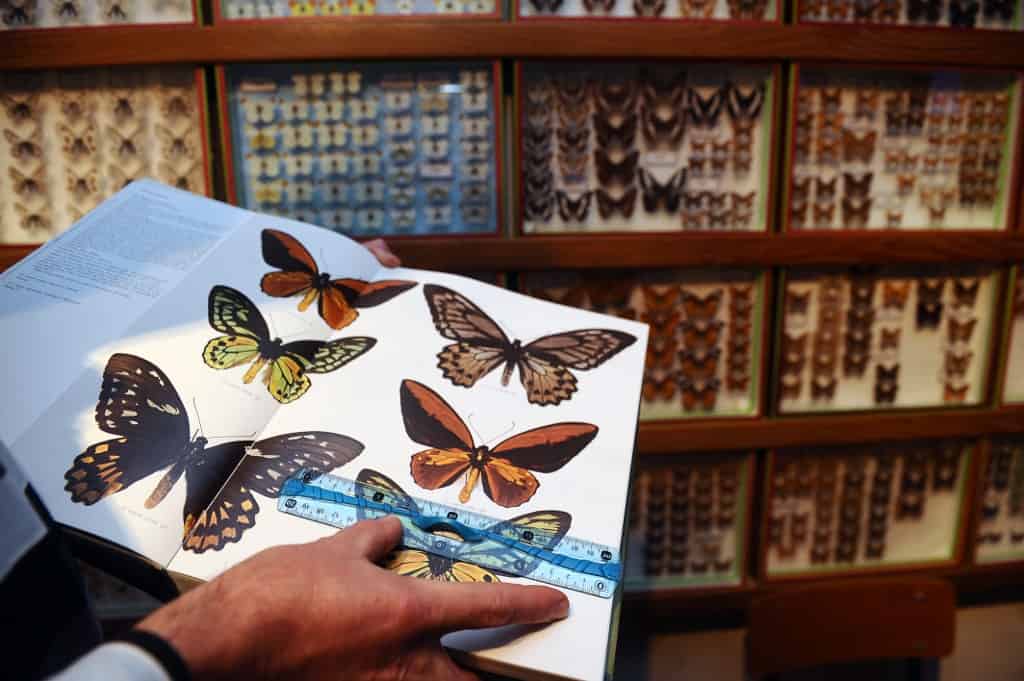
The theory of evolution does not rhyme only with Charles Darwin. The principle of natural selection was co-discovered by another British naturalist: the forgotten Alfred Russel Wallace, who was born two centuries ago.
In 1858, while collecting thousands of animal specimens in the isas of the Malay Archipelago, his observations, combined with a bout of malaria, led to what he would call “an intuition.”
This brilliant autodidact understands how species evolve. Faced with limited resources in a given territory, only the individuals best adapted to their environment survive and reproduce, passing on their superior characteristics to their offspring.
For the expert Ciryl Langlois of the Ecole Supérieure de Lyon, an idea – with an air of “stroke of genius” – that he communicates to his compatriot Darwin in an article.
The latter found the gist of his own theory – which he had been perfecting for 20 years without ever publishing anything – and was “deeply moved,” says the associate professor.
Subsequently, a co-presentation and publication of their work on natural selection was organized in London. However, the two scientists did not attend the event. In fact, Wallace did not even know about it, even though both names were well highlighted.
Readings and evening classes
Wallace, who became an explorer, collector, naturalist, geographer and anthropologist, was born on January 8, 1823, in Wales, into a poor family. He was the eighth and penultimate son of a jurist who never practiced, a literary enthusiast and a quickly ruined rentier.
Forced to drop out of school at the age of 14, the young Wallace was formed through night classes and subtle readings that led him to set sail at the age of 25 to the Amazon, with the aim of mapping and collecting butterflies, insects and birds.
He paddled by canoe up the Rio Negro, farther than any other European, with great curiosity, collecting mysterious specimens and blackening dozens of notebooks. But back in England in 1852, his boat caught fire and sank.
Despite the loss of his collection, Wallace would publish two books about his expeditions and set off in 1854 for Asia, a continent he would meticulously traverse for eight years.
On the other side of the globe, under pressure of time (and Wallace’s mail), Darwin published “On the Origin of Species” in 1859, a true revolution. The first printing (1,250 copies) sold out the same day, as did the second edition.
Darwin thus eclipsed Wallace, but the two men respected each other.
Wallace became one of the greatest defenders of Darwinism. Although he will oppose sexual selection (linked to the struggle for reproduction) and will refuse – he is a follower of spiritualism – to see Man as the product of the only natural selection.
“Thinking that spirits could influence Man, he rejected the idea that Man was an animal like the others,” convinced that “human evolution was progressive,” explains Langlois.
Visionary
However, he will remain one of the most famous British scientists of his time, especially for his work on the Malay Archipelago, from which he reported in 1862 more than 125,000 specimens of insects, birds and mammals, among others, mostly unknown in Europe.
He was also one of the founders of biogeography – a discipline that attempts to understand the geographic distribution of species – and highlighted the existence of a boundary (called “Wallace’s line”) between the animal and plant species of the islands of Bali and Lombok.
Despite his enthusiasm for spiritualism or his opposition to vaccination, “Wallace was a visionary on many issues,” says Laurence Talairach, co-director of the translation of Wallace’s story “The Malay Archipelago, home of the orangutan and the bird of paradise”.
A supporter of greater social justice and defender of women’s right to vote, he warned about the aberrations of capitalism and the consumer society and the impact of colonization in the regions he visited.





