
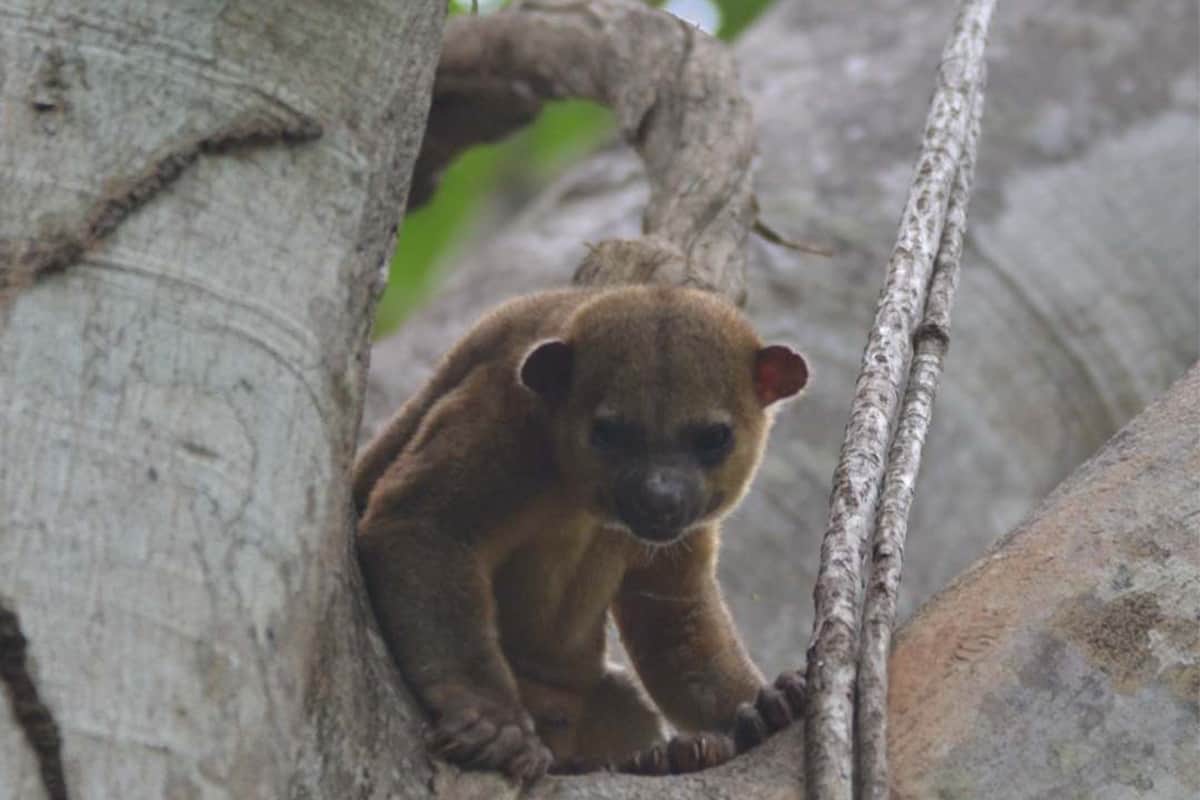
The cutest raccoon-teddy bear-monkey that you’ve probably never heard of.
What exactly is a kinkajou? At first glance you’d be forgiven for thinking that it’s a monkey. Afterall it can hang by its tail and it spends a huge majority of its time galivanting in the treetops. But it is much more closely related to another adorable, if not more mischievous mammal, the raccoon.
Kinkajous belong to the order Carnivora (think carnivore) and the family Procyonidae (good luck pronouncing that). Procyonidae (pro-see-on-a-day) is a family of mostly omnivorous animals that includes the likes of raccoons, coatis and olingos (What’s an olingo you ask? We’ll get to that someday).
So, they’re classified in the order Carnivore and have the canine teeth to prove it. They’re related to omnivores like coatis and raccoons, so they must be running around the canopy tearing up birds and monkeys to satisfy their hunger, right? Wrong.
It turns out kinkajous subsist mainly on fruit. A study in Panama found that kinkajous spent 90% of their foraging time eating fruit. What kind of fruit? All kinds of fruit. The same study found kinkajous eating 78 different varieties of fruit including figs, palm fruits and cecropia fruits.
Though their teeth appear to be designed for a more meat-heavy diet, the rest of their bodies seem to fit their tree swinging, fruit eating ways. They have prehensile tails which they use as another limb, allowing them to reach the sweet treats that they desire hanging in the treetops. Their back feet can reverse direction 180 degrees allowing them to descend head first down tree trunks.
They also feature a 5-inch tongue which they use to probe flowers for nectar.
All of this fruit munching and nectar swigging has a surprisingly positive impact on the tropical forests that kinkajous call home. Many of the seeds in the fruit that they eat pass through their digestive system unharmed. By the time the seed is ready to make its reappearance (along with some kinkajou ‘compost’), it has most likely been dispersed far from its tree of origin.
In this way kinkajous act as gardeners, one seedy-fruit-poop at a time. On top of that, their taste for nectar gives them a similar role to bees. When they stick their fuzzy faces into flowers hunting for nectar, they move pollen from one flower to the next.
While they are quite common, you wouldn’t know it because they’re nocturnal. I’ve had the good fortune of one daytime kinkajou encounter. I found a male napping in a Panama tree on my way to check cameras. I took the photo that accompanies this article. He gave me a grumpy look for a few minutes and went back to sleep.
Due to their arboreal ways, I don’t record them often on camera traps. In the last few years, I have more frequently placed cameras in trees that lend themselves to climbing, so I have a few clips to share in the video below. Enjoy.
About the Author
Vincent Losasso, founder of Guanacaste Wildlife Monitoring, is a biologist who works with camera traps throughout Costa Rica. Learn more about his projects on facebook or instagram. You can also email him at: vincent@guanacastewildlifemonitoring.com