

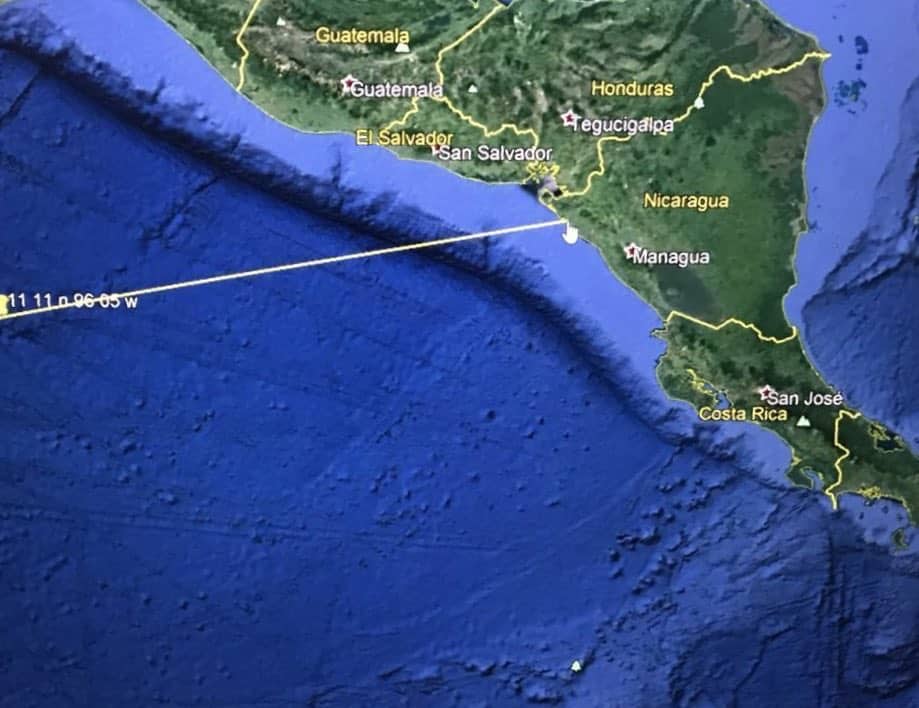
A tweet that warned of a potential tsunami on the Pacific coast caused alarm Monday in El Salvador, where President Nayib Bukele first asked the population on the coast to “mobilize” to protect themselves, before clarifying there was no impending emergency.
The confusion began with a message on Twitter from the US embassy in El Salvador. The tweet warned of a “possible tsunami,” and Bukele followed with a message calling for precautions — although later the president also said the threat had been ruled out.
“A plane from the US Department of Defense detected a possible tsunami approximately 600 miles from the border between El Salvador and Nicaragua,” the US embassy in San Salvador warned.
DOD aircraft observed possible tsunami approx 600 miles from El Sal – Nicaragua border. Personnel in the area should move to higher ground. pic.twitter.com/nAJc0tVX70
— Embajada EEUU en ES (@USEmbassySV) November 11, 2019
Bukele echoed the message and asked residents in the coastal zone to “move to higher ground,” as well as to “take small boats out of the water.”
Following Bukele’s indication, Civil Protection entities in El Salvador declared themselves in a “state of emergency,” although they did not carry out evacuations.
Subsequently, the Ministry of Environment clarified in its Twitter account that “for the moment we have not detected any abnormal activity” in its monitoring center.
President Bukele then assured that “thank God there is no threat of a tsunami for El Salvador” after the alarm generated in social networks.
The US embassy said it chose to publish the information of the possible tsunami “as a precaution (…) given the speed with which they move.”
The 🇺🇸 & 🇸🇻 continue to monitor the possible tsunami observed by a military aircraft. Monitoring centers have not detected activity that could result in a tsunami. But, given the speed with which tsunamis can move, we considered it prudent to share this information promptly.
— Embajada EEUU en ES (@USEmbassySV) November 11, 2019
The warning caused reactions in other Central American countries, whose warning systems denied the emergency.
In Costa Rica, the National Tsunami Monitoring System ruled out that there was imminent danger and explained that the U.S. military aircraft had probably seen a storm surge.
Meanwhile, the Nicaraguan Institute of Territorial Studies (INETER) described the report of the alleged tsunami as “false.”
The Central America Tsunami Advisory Center (CATAC), based in the INETER of Nicaragua, clarified that “it has not registered any event that could generate a tsunami.”





