

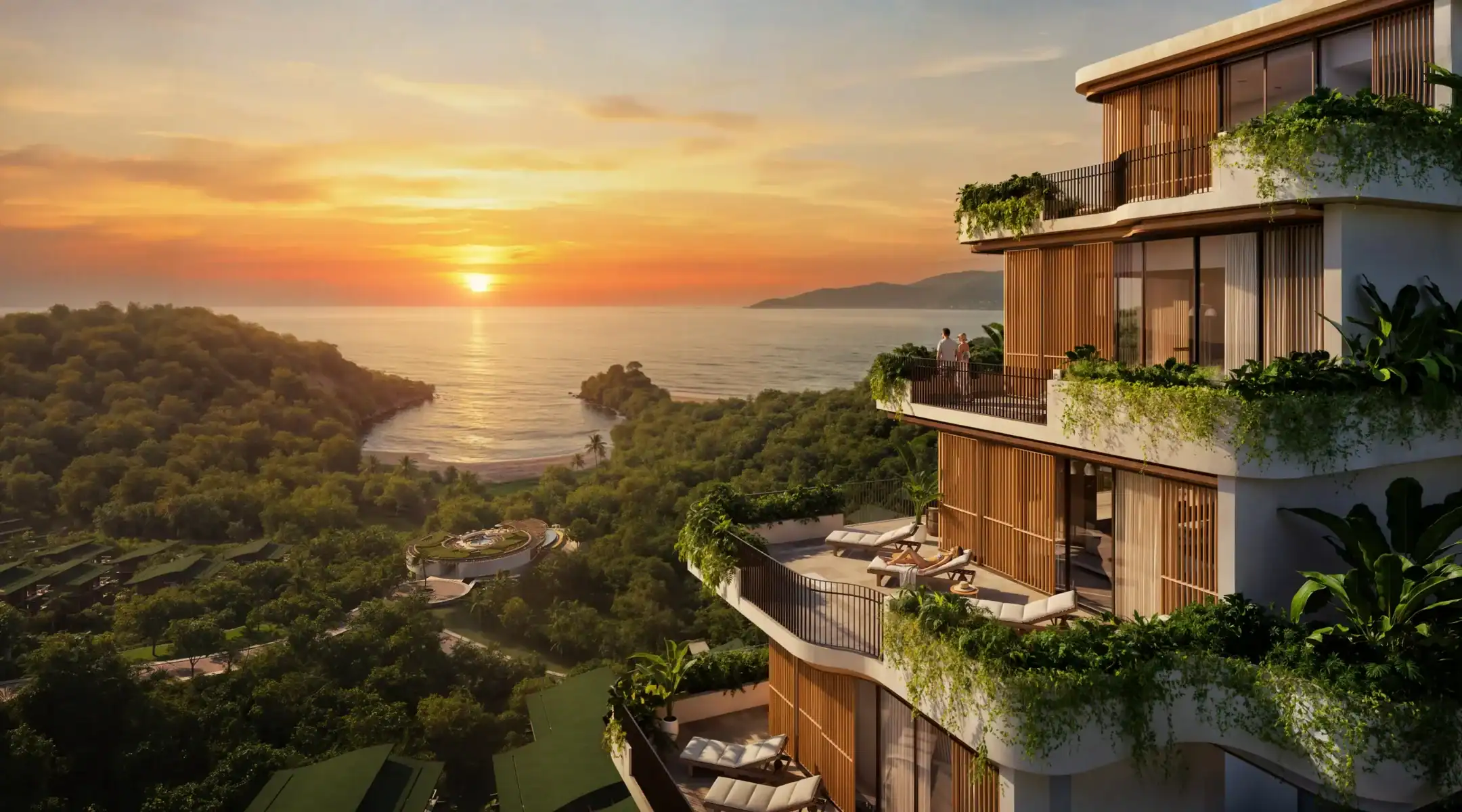
Hilton has signed an agreement for its first LXR-branded property in Costa Rica, a seven-story luxury resort paired with 116 private residences on a beachfront estate minutes from our most visited national park. The company announced the signing of Maravé Manuel Antonio, LXR Hotels & Resorts yesterday. The property is scheduled to open in 2029.
The site covers roughly 16 hectares (40 acres) and descends from a rainforest ridge to about 198 meters (650 feet) of Pacific shoreline. Hilton describes the land as rare, titled beachfront. The resort component will hold 57 accommodations, made up of 42 ocean-view guest rooms and 15 bungalows set on the hillside, each with its own plunge pool. The residential component adds 66 villas, 46 oceanfront condominiums and four penthouses, bringing the total to 173 accommodations.
Hilton said construction should finish in late 2028, with sales of the residences opening this fall. The resort was designed by Costa Rican firm Carazo Arquitectura with interiors by Chicago-based Curioso and is expected to include the largest mass timber structure in Costa Rica.
The announcement identifies the developer as Ocean Cove MA Development One S.A. and quotes its president, Bruce Begia, who said the project is designed to connect guests with Costa Rica’s natural environment while delivering luxury and service. A tourism and residential project called Ocean Cove, in Manuel Antonio, has been under a works stoppage since 2024.
The Municipality of Quepos and the National System of Conservation Areas confirmed that suspension in January. Both institutions said it followed citizen complaints filed roughly two years earlier, which prompted joint inspections and an order to temporarily halt the project.
Those authorities said at the time that the developer had complied with the directives issued by the local government and the Ministry of Environment and Energy. They also said they had received a further complaint alleging possible environmental damage in the area, and that the case remained under judicial review.
That complaint was filed late in, 2025 by attorney Wálter Brenes with the National System of Conservation Areas, the Municipality of Quepos and the National Environmental Technical Secretariat. Brenes said the work was damaging forest and vegetation cover and was proceeding without the required permits. Quepos Mayor Patricia Bolaños said she had not been aware of the complaint.
Hilton’s announcement makes no reference to environmental viability or construction permits for the site. The development would add rooms and homes to a district that is already admitting more visitors to its protected area than the ceiling the courts set for it. The Constitutional Chamber ruled in 2023 that daily admissions to Manuel Antonio National Park be cut from 3,000 to 1,120, finding that the higher number lacked technical support and placed an excessive burden on the protected area.
The Ministry of Environment and Energy raised the daily cap to 1,800 in May 2024. Water is the other constraint on coastal building as the executive president of the national water utility, Lourdes Suárez, said in June that there are places where the systems no longer permit new water availability letters to be issued, pointing to a combination of urban, tourism and real estate growth. Upgrades to the Quepos and Manuel Antonio aqueduct are still at the design stage.
Hilton’s description of the land as titled beachfront is itself worth pausing on. Under Law 6043, the 200 meters (656 feet) inland from the ordinary high tide line belong to the state. The first 50 meters (164 feet) are public and cannot be occupied under any title, and the following 150 meters (492 feet) are available only through a municipal concession, which is a time-limited use right rather than ownership.
Properties registered before the law took effect in 1977 are among the narrow exceptions it allows. That is why titled oceanfront land is uncommon along the Costa Rican coast, and why the distinction matters to anyone buying into a beachfront development. Hilton said its Caribbean and Latin America portfolio now exceeds 315 hotels across more than 35 countries and territories, with more than 150 properties in the pipeline. Maravé would be the first LXR Residences in Latin America.
The company did not disclose an investment figure. Sales of the residences are due to open within weeks, and no public resolution of the Quepos environmental case has been announced since January.





