
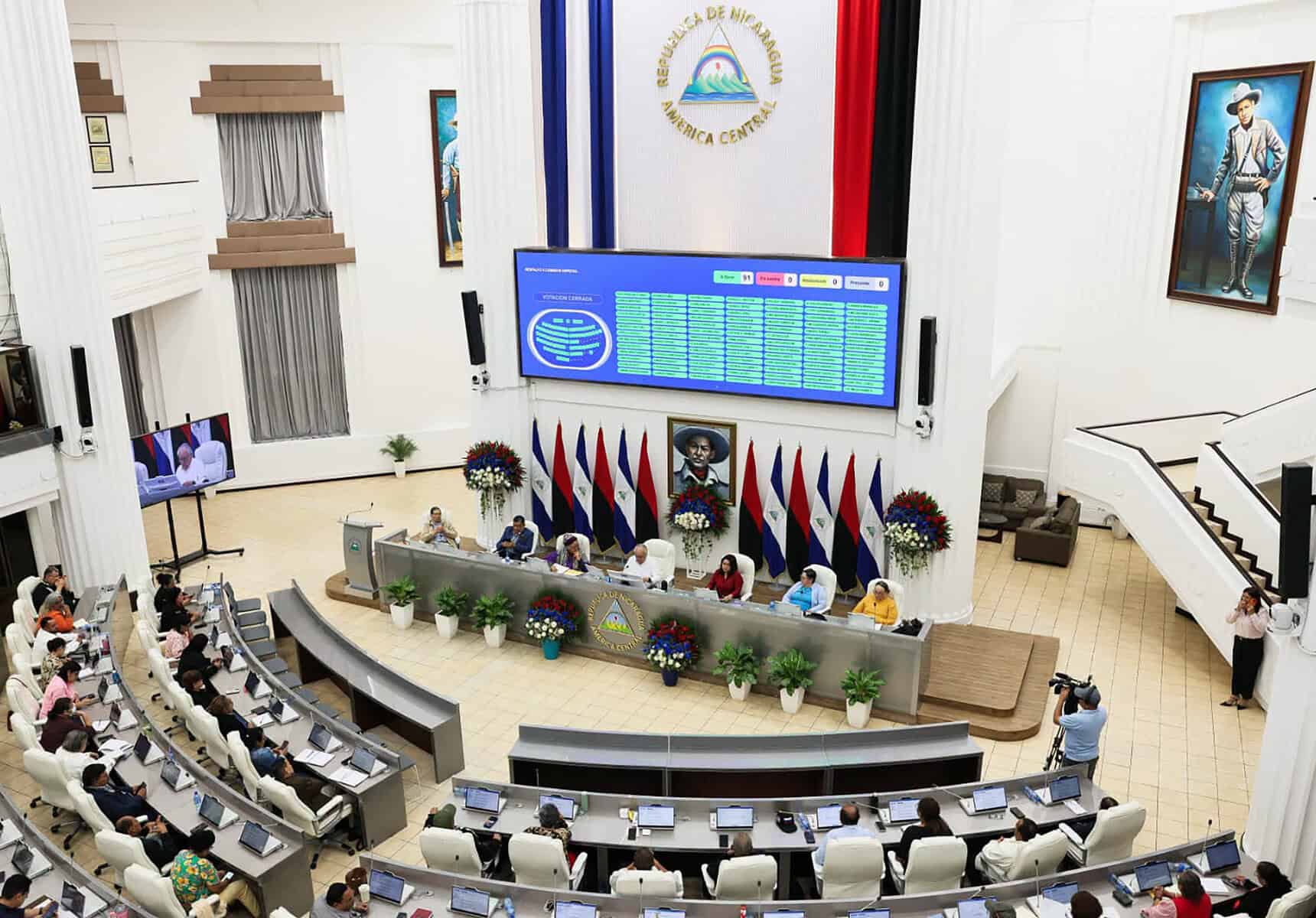
Nicaragua’s Parliament on Saturday approved a proposed constitutional amendment aimed at rejecting international rulings and foreign laws. It will be put to a vote in September alongside another initiative seeking to exclude the opposition from elections. The measure, approved during a special session of the National Assembly, will be incorporated into the broader reform package that has drawn international condemnation.
On Wednesday, the Organization of American States (OAS) approved a US-backed resolution calling for an “urgent” meeting of foreign ministers to discuss possible action over the Nicaraguan government’s plan to eliminate competitive elections. However, Congress, which is controlled by co-presidents Daniel Ortega and his wife, Rosario Murillo, on Saturday approved the addition of a paragraph stating that Nicaragua “prohibits and therefore does not permit the extraterritorial application of foreign laws,” according to the text read by National Assembly President Gustavo Porras.
“No law, regulation or rule issued by another state, group of states or international organization that undermines or threatens the independence, sovereignty (…), peace of the people or the Nicaraguan nation shall have legal effect within the national territory,” the text adds. It clarifies that “only” agreements signed on behalf of the Nicaraguan state will apply.
“Nicaraguan laws are for Nicaraguans, and there is no law, no foreign law, that will come here to interfere and take effect in Nicaragua,” Porras declared before the vote. Exiled media outlets said the article was added to the reform so the government would not have to “comply with possible resolutions” issued by the OAS or the United States.
The OAS has held dozens of sessions on Nicaragua in recent years, resulting only in statements of condemnation. A meeting of foreign ministers, however, could lead countries to break or downgrade diplomatic relations or impose economic pressure. Following the vote, Murillo lashed out at government opponents, calling them “mercenaries,” “traitors” and “cowards.”
“What a lack of legitimacy!” she said, without mentioning the OAS. Several countries and international organizations have rejected Ortega’s plan to exclude opposition figures from elections. The government describes its opponents as “coup plotters” and “traitors to the homeland.”
Ortega, an 80-year-old former leftist guerrilla, and his wife, who is five years younger, rule with virtually absolute power and tight control over Nicaraguan society. Their grip on the country intensified following the 2018 protests, whose suppression left about 300 people dead, according to the United Nations, and forced hundreds of thousands into exile.