

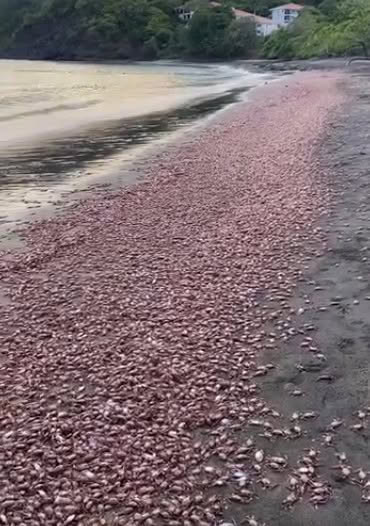
Thousands of dead crabs have washed up along some of Guanacaste’s best-known beaches, and nobody yet knows why. The animals have turned up at Playa Conchal, Brasilito, Flamingo, Potrero, Playa Negra, Ocotal, Guacamaya and Carrillo — a stretch covering much of the province’s northern tourist coast. Photos and video circulating online show them piled along the tide line in places.
They appear to be Euphylax dovii, called jaiba mora here and known in English as a pelagic swimming crab. That detail matters more than it sounds. This is not a beach crab since it lives out in open water, often well offshore, and travels in large groups. So these crabs did not crawl onto the sand so something carried them there.
The most likely candidate is the ocean itself. Costa Rica is in an El Niño, and the Pacific off the coast is running much warmer than it should. Readings from the University of Costa Rica’s Oceanographic Information Module show some sectors sitting about 3°C (5.4°F) above normal, with warmth reaching down to roughly 100 meters (330 feet). In April the figure was close to 4°C (7.2°F) above the long-term average.
Warm water changes how currents move and Marine biologist Jeffrey Sibaja, a researcher at the university’s Center for Research in Marine Sciences and Limnology, has said large gatherings of this species have shown up before during El Niño years in the eastern tropical Pacific, and that shifting currents can push them toward shore, where they get stranded. One possibility is that the crabs had massed to breed before the water moved them the wrong way.
None of that is proven yet, and scientists have been careful to say so. Warm water is context, not a verdict and there is a striking parallel further south. In Ecuador, the same species has proliferated so heavily this year that fishing crews report it destroying or tangling more than 90% of their nets, a surge researchers there tie to the same El Niño warming.
Costa Rica has seen the species behave strangely during an El Niño before. Researchers working at Isla del Coco in May 2015 found large numbers of them in surface waters just as that El Niño was beginning. For anyone heading to these beaches in the next few days, the practical picture is straightforward.
Dead crustaceans on the sand are unpleasant and can smell, but no health advisory has been issued and no beach has been closed. Municipal crews typically clear this kind of material within a day or two. Samples and water data now go to the lab. Until those results come back, the cause remains open.





