
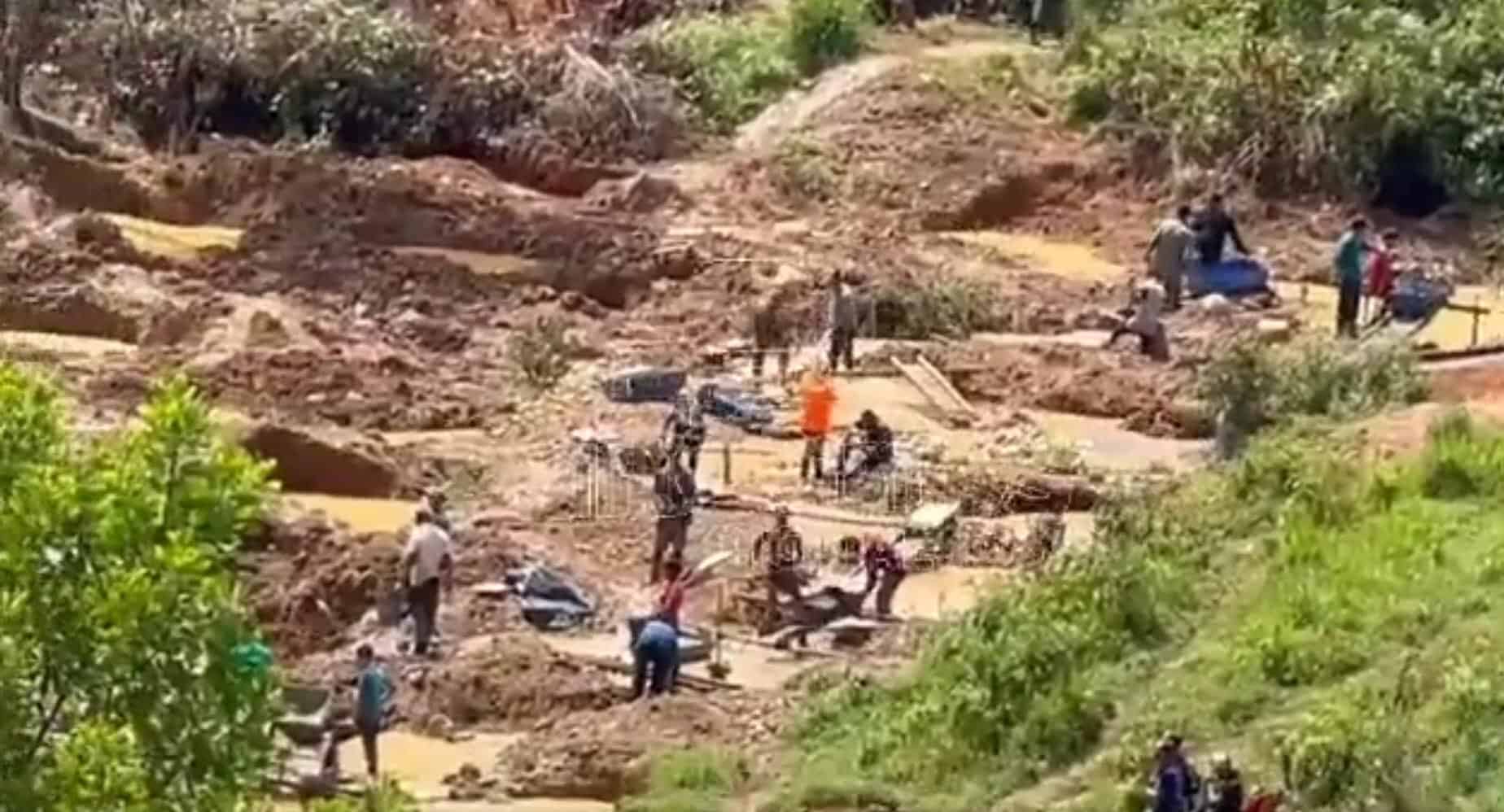
A forensic technique Brazilian federal police are using to trace illegally mined Amazon gold points to a capability Costa Rica has conspicuously lacked in its own long-running fight over Crucitas, where prosecutors have struggled for years to prove in court where seized gold actually came from.
Inside Brazil’s National Institute of Criminalistics in Brasília, federal police have built what they call a gold lab, where forensic experts analyze samples collected in raids across the country. Gold flakes are stored in small coin-shaped vessels, and their value to investigators lies not in the metal but in the data it carries.
As gold forms inside rock or a riverbed, it absorbs trace particles from the surrounding geology, including silver and copper, leaving each speck with a distinct chemical signature. That signature can be compared against stored geological data from protected areas, allowing investigators to determine whether a seized sample came from the mine its owner claims or from an Indigenous territory or national forest where extraction is banned.
Gustavo Geiser, a federal police forensics expert who has worked on the method since 2019 in collaboration with Brazilian universities, said the examinations have grown steadily more complex while the underlying question has stayed the same: where did this gold come from? His team relies on X-ray fluorescence spectrometry, scanning electron microscopy and laser ablation mass spectrometry.
Where the analysis establishes that a sample was illegally extracted, police can build a case and move toward charges rather than resting on the circumstances of the seizure. Geiser also argued that a full ban on mercury in gold mining would strengthen forensic work, since his lab can detect mercury traces in samples and their presence would in itself point to illegality.
The technique addresses a specific evidentiary problem. Brazil’s Federal Court of Accounts, its top audit institution, reported last year that there were indications mining permits issued to small-scale operators were being used to pass off gold taken from protected areas in the Amazon.
Greenpeace described the mechanics in a report in May, drawing on public records, satellite imagery and aerial surveillance: the holder of a legally authorized mine declares tonnes of production, satellite images show no activity at the permitted site, and imagery of adjacent Indigenous land where mining is prohibited shows large-scale extraction.
A federal court in the northern state of Pará ordered institutions including the Central Bank and the National Mining Agency this month to establish effective traceability for all gold from mine to market. Federal prosecutors separately sued the mining agency seeking tighter control of permits, and prosecutor André Porreca, who is leading that case, said the permits have become a front for laundering gold pulled from Indigenous territories and protected areas by criminal organizations.
Costa Rica faces a version of the same problem on a far smaller geographic scale but with comparable institutional strain. Illegal gold mining has spread across roughly 30 square kilometers (about 11.6 square miles) of northern Alajuela around Crucitas, in the area of Cutris de San Carlos, affecting some 15 communities and contaminating water sources with mercury and arsenic while driving deforestation and the growth of informal camps.
Costa Rican authorities have described the situation as a national emergency and, at times, as a matter of national sovereignty. Activity has since expanded to the nearby Cerro Conchudita, where reporting in March documented tunnels dug tens of metres into the hillside and cyanide processing pools, damage police sources characterized as worse than Crucitas because it appeared in under eight months.
In March, the Constitutional Chamber partially granted an appeal filed over what it found to be systematic and repeated failures by the state and ordered urgent measures from five institutions: the ministries of Public Security, Health, Environment and Energy, and the Presidency, along with AyA. The Ministry of Public Security was ordered to maintain a permanent and indefinite police presence in Crucitas, reinforce migration controls at border crossings and guarantee the personnel and budget to do so.
AyA was given 18 months to complete a drinking water supply project for the communities of Llano Verde, Crucitas, Jocote, Chorreras, El Roble and Chamorro, and must continue supplying potable water while the contamination risk persists. MINAE and the Presidency were given three months to submit a detailed plan. The court also ordered the state and AyA to cover costs and damages.
Enforcement has continued through the year without resolving the underlying trade. Officers have detained groups of miners, dismantled camps and seized equipment, cyanide and thousands of sacks of sediment, and in one operation in late May encountered roughly 150 people who responded with firearms, machetes and iron bars.
Access is part of the difficulty. Reaching the mining sites requires a walk of about three hours from the nearest point vehicles can reach, and lookouts warn miners by radio or messaging app in time to cross the Río San Juan into Nicaragua. Costa Rican and Nicaraguan authorities have traded accusations over the cross-border dimension, with reporting alleging Nicaraguan and Chinese interests are extracting gold on the Costa Rican side while Managua denies responsibility for damage on its own territory.
What has proved hardest is the part Brazil’s lab was built to solve. Environmental groups tracking Crucitas for close to a decade say the state has been unable to demonstrate conclusively in court where seized gold originated once it enters domestic laundering networks, and investigative reporting has found that gold taken illegally from the area is frequently moved and processed elsewhere in the country before export, obscuring its source by the time a buyer receives it. Chemical fingerprinting is designed to close precisely that gap, tying a sample to a specific geological origin rather than to the location of a seizure or the testimony of a witness.
Whether Costa Rica could build a comparable capability is unresolved. Brazil’s lab reflects years of investment, a national geological sampling programme and sustained partnership with universities, and any Costa Rican equivalent would have to be far narrower in scope, though the country’s own geological survey and university laboratories already hold relevant expertise.
Regional cooperation offers another route: Brazil’s method has spread through the Amazon International Police Cooperation Center in Manaus and through Interpol’s Gaia Project, which trains police agencies elsewhere to catalogue gold the same way. With the courts now demanding results, operations in the north absorbing significant public money, and the gold price continuing to make the trade worth the risk, the question of whether Costa Rica invests in scientific tools alongside boots on the ground is one the state will have to answer.