

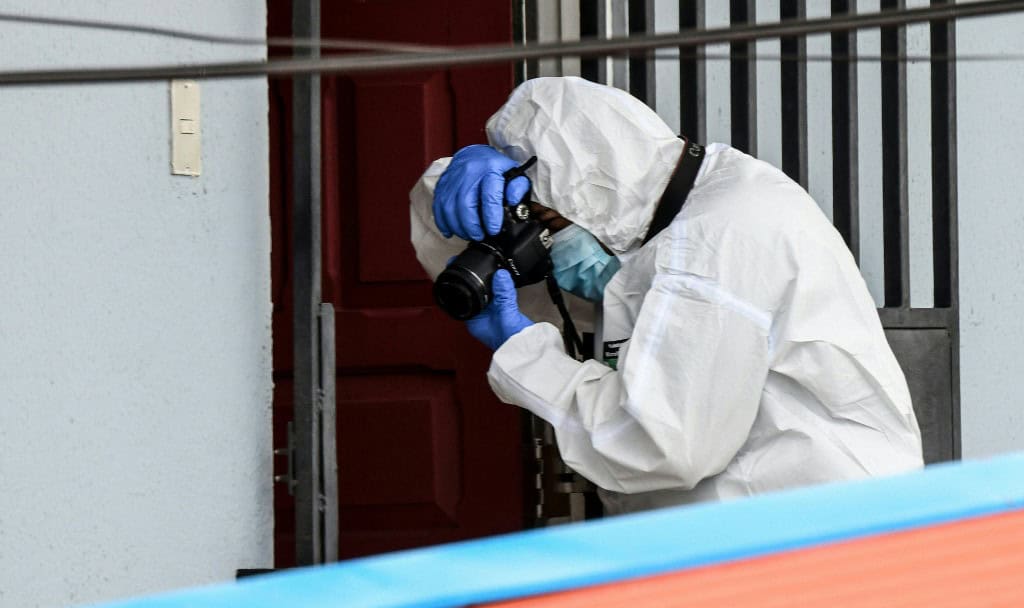
The U.S. Bureau of Western Hemisphere Affairs marked the first anniversary of Roberto Samcam’s assassination in San José by calling for accountability in a case that remains one of the most politically sensitive killings of a Nicaraguan exile in Costa Rica.
Samcam, a retired Nicaraguan military officer, political analyst and outspoken critic of Daniel Ortega and Rosario Murillo, was shot dead on June 19, 2025, inside the condominium where he lived in San Vicente de Moravia, San José. The U.S. office said Friday that Samcam had not been forgotten and that justice requires accountability for both those who carried out the killing and those who ordered it.
The message adds fresh international pressure to a Costa Rican criminal case that has advanced in recent days. On June 10, the Goicoechea Prosecutor’s Office filed a formal accusation against five suspects in Samcam’s homicide and requested that the case move toward an oral trial. A judge must still decide at a preliminary hearing whether the evidence is strong enough to send the case to trial.
Samcam’s killing shocked the large Nicaraguan exile community in Costa Rica and revived fears that political persecution from Nicaragua may be reaching opponents abroad. Human rights groups have described the case as part of a broader pattern of threats, surveillance and attacks against Nicaraguans who fled the Ortega-Murillo government.
Costa Rica’s Judicial Investigation Agency, known as the OIJ, has treated the case as a contract killing with possible political motives. CRHoy reported that investigators believe the murder may have been coordinated by Kenny Hosman Navarrete Vallecillo, a Nicaraguan inmate held in La Reforma prison, and carried out through a network of hired gunmen.
According to earlier information from Costa Rica’s Public Prosecutor’s Office, prosecutors alleged that one suspect was hired to kill Samcam, that others helped execute the attack, and that another suspect provided logistics for the escape after the shooting in Moravia. The case remains listed under file number 25-001025-0053-PE.
The political dimension remains the central question. Costa Rican investigators have pointed to persecution against Nicaraguan opponents living in Costa Rica as a possible motive. The OIJ investigation references people in Nicaragua being designated as targets and alleges possible involvement of structures connected to Nicaragua’s defense intelligence apparatus, though those findings still have to be tested in court.
El País reported in April that the OIJ case file suggested the killing had an ideological background and may have been planned in Managua. The report said Samcam’s work with United Nations experts on abuses committed during Nicaragua’s 2018 crackdown was one possible motive identified in the investigation.
Samcam had lived in exile in Costa Rica since 2018. He had accused the Nicaraguan Army of involvement in repression and extrajudicial executions after anti-government protests erupted that year. He was later stripped of his Nicaraguan nationality and became a Spanish citizen, according to EFE.
On the anniversary, the Colectivo de Derechos Humanos para la Memoria Histórica de Nicaragua also called for investigators to go beyond the direct perpetrators. The organization said justice would remain incomplete unless authorities identify the full chain of responsibility, including those who may have planned, financed or ordered the killing from Nicaragua.
For Costa Rica, the case carries weight beyond one homicide. The country has long been a refuge for Nicaraguan dissidents, journalists and human rights defenders. Samcam’s killing raised uncomfortable questions about whether exiled opponents are safe on Costa Rican soil, and whether local criminal networks are being used to carry out politically motivated attacks.
The trial process, if approved, will determine the criminal responsibility of the suspects now accused. But the larger question remains unresolved: who ordered Roberto Samcam’s assassination, and whether the killing was part of a wider campaign of transnational repression against Nicaragua’s exiles.





