
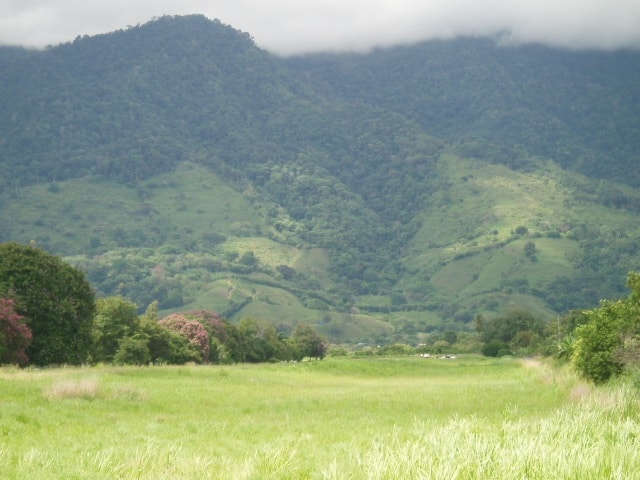
A proposed international airport near Sierpe in Costa Rica’s southern Pacific zone has revived one of the country’s most sensitive infrastructure debates, setting economic development goals against the protection of natural and cultural heritage that cannot be replaced. The project, formally presented by the government as the Aeropuerto Internacional de la Región Brunca, remains tied up in a web of environmental, archaeological, and heritage review that could delay it for years.
The airport has already been scaled back from earlier versions. The Chaves administration has promoted it as a strategic project for the south, centered on a 2,600 meter runway intended to handle medium range aircraft and boost tourism and investment in the Brunca region. It was included in the government’s 2023 to 2026 planning framework, but the project has repeatedly stalled, resurfaced, and changed shape over time, leaving its actual timetable uncertain.
The most immediate obstacle is the location itself. The proposed site lies beside the Térraba-Sierpe wetland system, a Ramsar-listed wetland of international importance covering 30,654 hectares in Puntarenas. The area is one of the most ecologically important coastal zones in Costa Rica’s Pacific south, and any major infrastructure project nearby is bound to face close environmental scrutiny.
But the environmental concerns are only part of the picture. The Diquís Delta is also home to one of Costa Rica’s most important archaeological landscapes. Finca 6, part of the Pre-Columbian Chiefdom Settlements with Stone Spheres of the Diquís, was inscribed as a UNESCO World Heritage Site in 2014.
UNESCO’s World Heritage Committee has already noted that the feasibility of the southern international airport project remains pending and that the required Heritage Impact Assessment has not yet been carried out. It has also requested more information from Costa Rica about airport works near the archaeological sites in order to evaluate possible impacts on their Outstanding Universal Value.
What has sharpened the debate further is the scale of the archaeological material found within the proposed construction area. In 2025, Costa Rica’s Ministry of Culture reported that archaeologists evaluated 131.5 hectares of the project area, planned 3,698 test pits, and excavated 2,752 of them. The work recovered more than 1,000 ceramic fragments and 115 artifacts dating from between A.D. 800 and 1550. The findings were significant enough that officials said archaeological rescue work would have to follow before construction could move ahead.
That does not necessarily kill the airport, but it makes the path forward slower, more expensive, and more legally exposed. Archaeological recovery is not a box to check and forget. Each new phase creates more documentation, more review, and more opportunities for institutions, communities, and preservation advocates to challenge what happens next. In a project already burdened by environmental sensitivity, that matters.
The human dimension is also significant. Families in the area have faced years of uncertainty over land, property status, and the future of their communities. In a project like this, disputes over land rights, relocation, and compensation can become just as serious as environmental litigation, especially in a region where historical land tenure issues have never been simple. This is one more layer of risk for a government trying to present the airport as a straightforward development win.
Costa Rica’s institutional framework gives opponents of the project several openings. Environmental permitting, heritage review, archaeological mitigation, and judicial oversight all create points where delays or legal challenges can emerge. The required studies alone are not quick, and they are subject to scrutiny from both domestic authorities and international heritage bodies. UNESCO has already made clear that it expects to be kept informed about changes in the project and to receive relevant documentation and studies.
Funding remains another open question. The government has pushed the project politically, but that is not the same as having a fully secured, controversy-proof financing structure. A project carrying environmental risk, archaeological complications, and international heritage attention is a harder sell than a standard transport expansion. Even when governments want such projects to move, financial, legal, and institutional friction can slow them down long before the first slab of concrete is poured.
Politics may also matter more than the current headlines suggest. Costa Rica enters a new administration in 2026, and infrastructure priorities can shift quickly in a transition. A project that still lacks completed heritage review, remains exposed to environmental conflict, and carries an unfinished archaeological process is vulnerable to postponement if political backing softens even slightly. In Costa Rica, long postponements often become a form of quiet cancellation.
What makes the Sierpe airport fight unusual is not any single objection, but the accumulation of them. Ramsar wetland protections, UNESCO oversight, unresolved heritage impact review, archaeological rescue requirements, community concerns, uncertain financing, and political transition all converge on the same site. Any one of those could slow the project. Together, they form a serious barrier.
The airport may remain in government plans, and supporters may continue to present it as a path to growth for the south. But plans on paper are not the same as a viable project on the ground. In Costa Rica’s southern Pacific, the case for construction still runs straight into wetlands, history, and a legal system that gives all three real weight.