

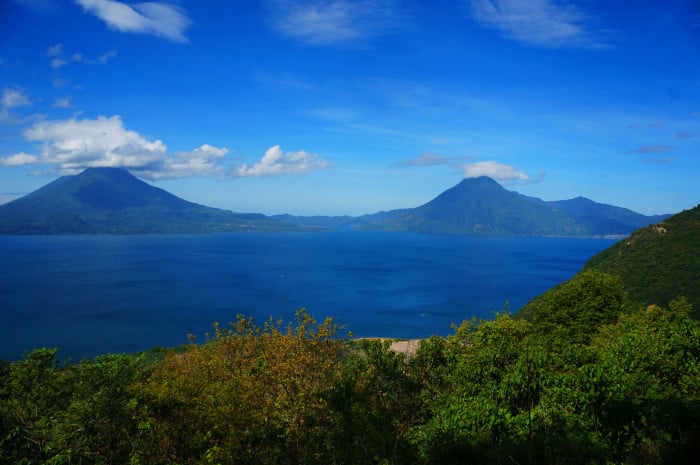
LAKE ATITLÁN, Guatemala — The narrow blue and white boat jumps up and down crossing the choppy waters of Lake Atitlán. The sun shines bright as we make our way across the seemingly endless expanse of blue from the town of Panajachel to San Juan, surrounded by the lush green landscape of volcanoes and the Sierra Madre mountain range.
“The water is dancing again,” says Alejandro Julajuj, a local guide, as a broad smile crosses his face.
A local legend says that two Mayan lovers from opposing tribes once drowned themselves in the lake to avoid being forced to marry other partners. When the water is choppy as it is now, it is said that the lovers have reunited to dance on the water’s surface.
With stunning landscapes, history and unique opportunities to interact with living Mayan cultures, Lake Atitlán is a special place.

Central America’s deepest lake is located in a volcanic crater in the Guatemalan Highlands, roughly two hours from the country’s former colonial capital and modern-day tourism hotspot, Antigua. Circled by three volcanoes, these shores have long been home to Mayans of the Kaqchikel and Tz’utujil nations. Today, indigenous culture still thrives in the 10 towns that surround the lake.
The main stopping point for tourists visiting the lake is Panajachel. From here you can take local boat transportation to the smaller communities around the lake.
San Juan, the unofficial capital
Across the lake from Panajachel lies San Juan, the unofficial cooperative capital of the region. Many of the 8,000 residents in this town support themselves through artisan crafts. Whether it be woven scarves or oil paintings, all the goods sold here are handmade by the locals who sell them, making it a great and ethical place to purchase souvenirs.
One such cooperative is run by 36 women who make scarves and other textile items by hand. The process involves cleaning and removing seeds from cotton, making natural dyes from local ingredients and weaving the cotton thread using looms. The oldest woman who works here is 86 years old. The women here bring their children to work. Steeped in the tradition of their culture, these women have created a system that eludes the modern business world – they are able to care for and provide for their families at the same time.

San Pedro: Mayan traditions and coffee
The neighboring town of San Pedro is a one-mile tuk-tuk taxi ride away from San Juan. In recent years tuk-tuk taxis, or motorized rickshaws, have become a popular form of transportation in the communities of Lake Atitlán, as the narrow streets often do not provide enough space for regular vehicles to pass. These taxis are cheap for visitors, but an expensive investment for owners, as they have to be imported from India.

Along the streets of San Pedro an essential stop is Café Las Cristalinas, a family-owned shop where the coffee is processed in-house using local beans. The volcanic soil surrounding San Pedro is ideal for growing coffee, and many of the locals in this town support themselves through this industry.
Another dominant feature of San Pedro is the modern building of an Evangelical church. Today, 45 percent of Guatemalans are Evangelical. Catholic worshipers in the community say the Evangelical Church has lured worshipers by offering impoverished citizens incentives ranging from medical care to free T-shirts.
Santiago: Catholic history and a local market
Santiago, a town of 45,000 that is steeped in history, is just a short ride away from San Pedro on a “chicken boat.” The boats locals use to travel between towns are called chicken boats because chickens en route to market are often some of the most vocal passengers.
In Guatemala, Mayan women still wear traditional dresses. Each village has its own unique colors and patterns for these dresses. The clothing in Santiago is some of the country’s most vibrant, featuring purple colors and embroidered birds. One of Santiago’s most famous residents is a woman named Magdalena. The clothing she wears is featured on one of Guatemala’s coins, as it is considered the most beautiful of traditional Mayan clothing.

Santiago has a large market that is usually free of tourists. Here local women sell fresh vegetables, fruit and fish that men in the community have caught this morning. The market is also full of candles that are used in Mayan religious ceremonies.
Santiago’s Catholic Church is the main sight to see here. When the Spanish first settled these lands, the Mayans were prohibited from practicing their religious beliefs. Now, as the rise of the Evangelical church has led to a decline in Catholicism, the Catholic Church and Mayans have become allies. Mayan traditions have been blended into Catholic services.
This church is one of the finest visual examples of this blending. A sacred table in the church depicts both scenes from the Bible and Popol Vuh, the Mayan religious text.

This church also contains a memorial plaque dedicated to Father Stanley Rother, an American Priest who lost his life during Guatemala’s brutal civil war. Father Rother worked to incorporate Mayan traditions into the Catholic church and translate services into the local language. He was murdered on July 28, 1981, by a death squad when he refused to follow orders to leave Guatemala, saying, “A shepherd cannot leave his flock.”
In 1990, Santiago was the site of a brutal massacre by the Guatemalan army. Fourteen Mayans were killed. After great protests, the military was forced out of town. Today, the military is still forbidden here, although there is a small local police force.
Unfortunately, the end of Guatemala’s civil war in 1996 did not mark the end of the struggles for Lake Atitlán. In 2005, the region was struck by Hurricane Stan, killing an estimated 1,000 people. In 2009, the lake was plagued by bacteria, and in 2010 Tropical Storm Agatha resulted in more deaths and damage.
The women of Santiago wear cloths of purple hues. Alejandro explains that for them this color is representative of the hard situations they face, and serves as a reminder that they are capable of overcoming tough times.
“This lake is really special,” says Alejandro. “I have been to other lakes, but there is nowhere like this one. To understand the volcanic origin of this lake and see how spectacular it is, is really special for me.”





