
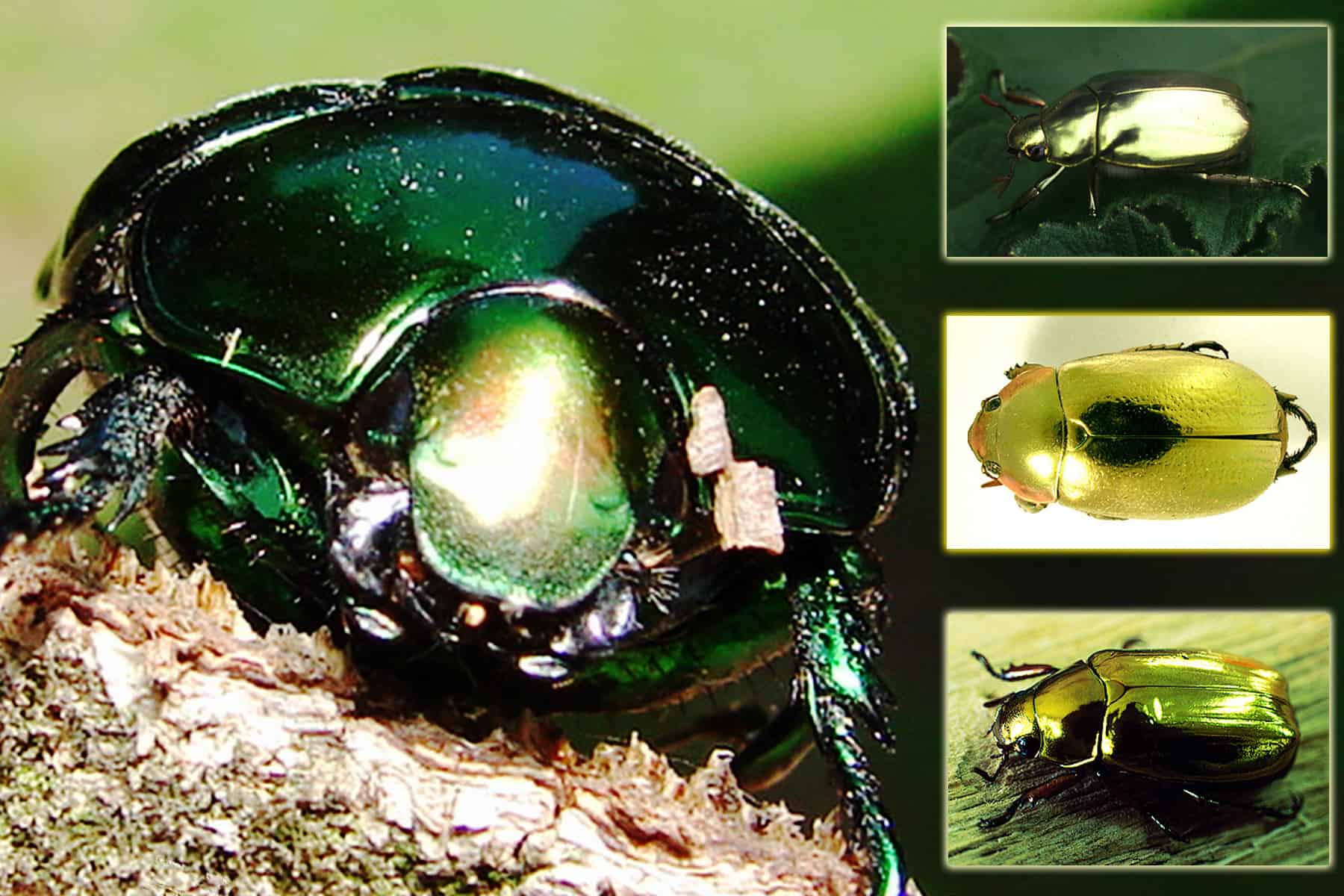
A glitzy beetle native to Costa Rica is headed for the International Space Station. The brilliant, metallic exoskeleton of the jewel scarab will soon blast off as part of a research project to determine how the insect’s peculiar properties might help humans develop better coating for satellites and other space equipment.
Investigators from the University of Costa Rica (UCR) have spent more than five years researching the shiny exterior of jewel scarabs to figure out whether some of the bug’s special characteristics can be replicated.
Experts from the UCR’s Research Center for Materials Science and Engineering (CICIMA) found that the metallic colors of the Chrysina species are not the product of pigmentation but instead the result of optical and mechanical properties. Now they are trying to give these findings a use in space technology.
CICIMA started investigations in 2010 in collaboration with the Central American Aeronautics and Space Administration (ACAE). Experts from both agencies have since conducted various experiments with Chrysina scarabs, including several specimens of a Costa Rica native jewel scarab: Chrysina aurigan.
Andrés Mora Vargas, a Tico scientist based in the U.S., is now part of the next step in these investigations, which consist of sending samples of the hardened forewings, or elytra, of jewel scarabs to the International Space Station in order to evaluate how the insect’s special properties behave in space.
In 2012 Mora presented ACAE with a proposal to develop the Ditsö program, focused on evaluating whether properties in the elytra of jewel scarabs can be replicated in the manufacture of new coating materials for satellites and other devices. Ditsö means “clan” in the Bribri indigenous language.
Mora has a doctorate in aerospace engineering from the University of Tohoku in Japan with a concentration in mobile robotics for planetary exploration.
The first experiment in space will be the Ditsö I, which involves sending a 10 centimeter nanolaboratory to the International Space Station with elytra samples from Tico scarabs. Scientists and students will study how the samples behave in space over the course of a month, Mora told The Tico Times.
“We also hope to interact with ISS astronauts during that period,” Mora said.
Over the past three years, researchers have sent up samples of the jewel scarab in weather balloons. Currently, students and experts from three Costa Rican universities have succesfully conducted four more tests with high-powered, small rockets that reach up to 8,300 meters high.
Scientists hope to understand how nature created the metallic appearance of the jewel scarab and use organic molecules to replicate the material.
“This technology would be biodegradable and inspired by the biodiversity of Costa Rica,” Mora said.
Investigations will also evaluate whether scarabs’ elytra have the ability to store solar energy similar to the way plants do it. This would represent the first known case of this property in the animal world, Mora said.
The team of researchers is currently working on the development of the nanolab to meet the requirements of NanoRacks, a private company that will handle the transport, deployment, maintenance and return to Earth of the tiny lab.
The group is also seeking funding for the project to cover shipping, and the maintenance of the nanolab at the ISS for a month.
Watch Dr. Andrés Mora Vargas explain the Ditsö program during the deployment of a small rocket in Liberia, Guanacaste (in Spanish).