

The Río San Juan runs from Lake Nicaragua to the Caribbean coast on the border between Nicaragua and Costa Rica. Rich in history, the river has been home to famous pirates, colonial battles between the Spanish and British, and steamboats that carried passengers to the gold rush in California.
Mark Twain traveled the San Juan and described it as an “earthly paradise.” The roughly 120-mile river is home to the Indio Maíz Biological Reserve, about 1,700 square miles of virgin rain forest and habitat for many endangered species.
Returning recently to the Río San Juan after fishing here a few years ago, I found many improvements. Getting across the border is easier now, the rivers and towns are cleaner, streets are paved, parks are being built, more areas are being protected and there are more restrictions on commercial fishing. The Nicaraguan government is also helping the area’s residents to develop their tourism potential, by providing classes in English, hotel administration and gourmet cooking with local ingredients.
My trip started with a water-taxi ride from Los Chiles, in northern Costa Rica, to San Carlos, Nicaragua. The ride cost $7 and took just over an hour – a little slow, but safe and very scenic. I was met in San Carlos by Alfonso Agustín Llanes, owner of the Montecristo River Lodge. After going through Immigration, we continued downriver about an hour to the lodge.
Situated on a small bluff overlooking the river, between the towns of Sábalos and El Castillo, the Montecristo has a dozen cabins, a restaurant, bar and a covered area with hammocks and rocking chairs looking onto the river. My cabin was clean and comfortable, with a big, river-view deck from which to enjoy the peaceful sound of the river, the birds and the howler monkeys in the distant trees.
My schedule was the same every day: tarpon fishing in the morning and snook fishing in the afternoon, with some good food, good naps and a good book in between.
The food was delicious and made to order – omelets, pancakes and gallo pinto for breakfast, and steak, chicken, fish, shrimp or river lobster for dinner. The friendly staff seemed more like a family than a group of co-workers.
The tarpon fishing was about a mile upriver from the lodge, where the Río Sábalos meets the San Juan. Sábalo is Spanish for tarpon, so I figured we were in the right spot.
When we arrived, locals were already fishing in their dugout canoes, and the tarpon were rolling (tarpon can breathe water and air, so they occasionally surface for a gulp of air, which is called rolling).
Within a half-hour of fishing, one of the locals had a tarpon on; the kid who hooked the fish was about 12, and the kid with the paddle about 10. I watched them pull anchor and give chase. A boat of adults also pulled anchor to help out the kids, but after a 10-minute battle the tarpon spit the hook.
I couldn’t help but pull for the tarpon, as I knew the locals were fishing for meat. If they are lucky enough to get a tarpon, they divide up the meat among family and friends, sell some and also donate some to a local home for expectant mothers, which the community supports with contributions of food.
During my time on the water, I watched the locals hook about a half-dozen fish and catch one; the currents and their old tackle and canoes are no match for these big tarpon.
The fishermen were all very friendly and must have thought I was crazy to go to all the trouble of catching a big tarpon just to let it go. They laughed, joked around, had fun and fished – like anglers all over the world.
Most tarpon fishing here is done by trolling lures. We pinched down the barbs on the hooks to make the release easier; it may have cost us a fish or two, but better to lose 10 tarpon than kill one because of damage done during the release.
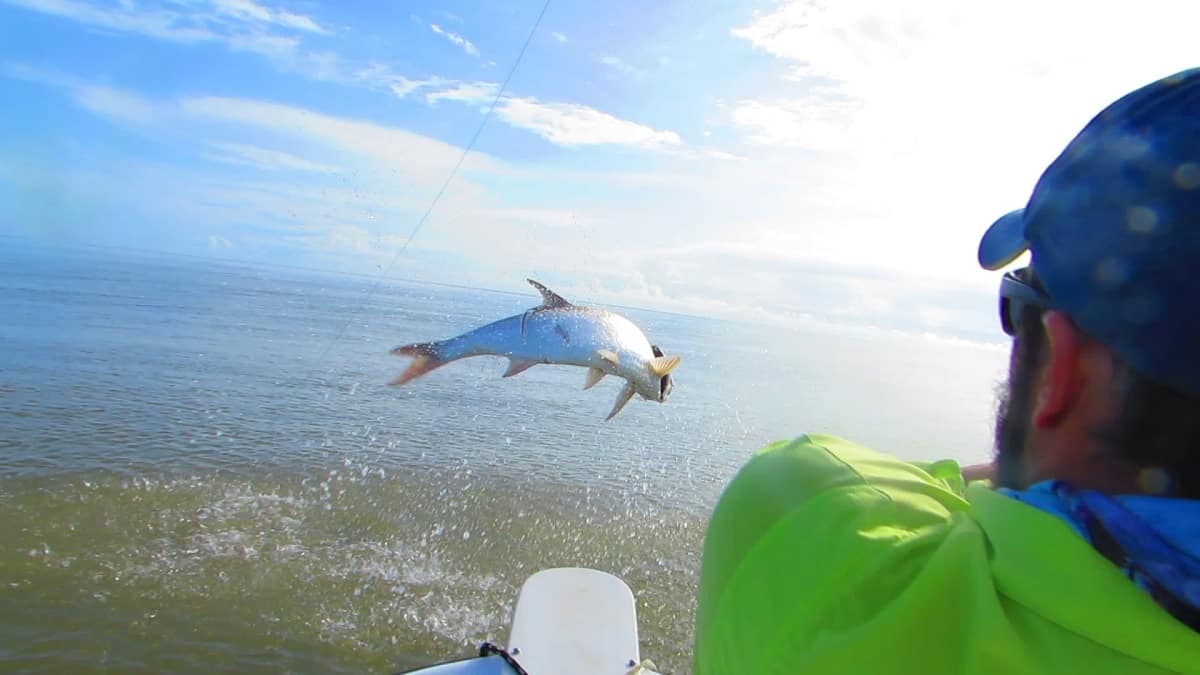
In three mornings of fishing, I caught five tarpon between 100 and 150 pounds.
If you are an angler and have never caught a tarpon, you are missing out. These powerful fish will expose any weakness in your tackle and your angling skills. They fight hard with long runs, leaps and head shakes. It’s amazing to watch a 150-pound fish jump six feet out of the water just a few yards from the boat.
In the afternoons, our attention turned to catching fish for the dinner table. Snook is good eating, and the Río San Juan is loaded with them. Types of snook here include white snook, which is silver with a maroon stripe, and a larger species called yellowtail snook.
We fished a couple of miles downstream from the lodge and each day caught three or four white snook, all five to 10 pounds.
I used my light spinning tackle and had a great time. Of course, the real reward is a nice fillet fried up and served with rice, beans, garden salad, Tabasco sauce and a few cold beers.
My fishing guide was a local named José “Lolo” Sarmiento. A great guy, Lolo is a schoolteacher by day and has four kids, two of whom he adopted. He knows a lot about the history of the river, the area’s flora and fauna, and fishing. Despite my feeble Spanish, we talked about politics, education, health care, the community, baseball, fishing and the world in general.
When we touched on education, I could tell it was his passion. We talked about how education is the only way to break the cycle of poverty in some areas. Lolo told me teachers are not paid much in Nicaragua, and sometimes they have problems getting books and have to buy their own school supplies. (If you are interested in helping out the community, contact me at the e-mail address or phone numbers below, or call Sarmiento at 505 8476-7572.)
Though poverty is an undeniable problem in Nicaragua, to me the Nicaraguan people seem rich in other ways. They are genuinely friendly, quick to offer a smile and a warm greeting, even to strangers, and seem to truly enjoy life, despite the hardships their country has endured.
I’m already planning my next trip to the Río San Juan, and making my wish list from the tackle store. If you are looking for an adventure with beautiful scenery, friendly people and some great fishing, consider a trip to this unspoiled area of Nicaragua. As you sit in a rocking chair watching the river go by, it’s not hard to imagine how things must have been when pirates, colonial armies and Mark Twain explored the area long ago.





