

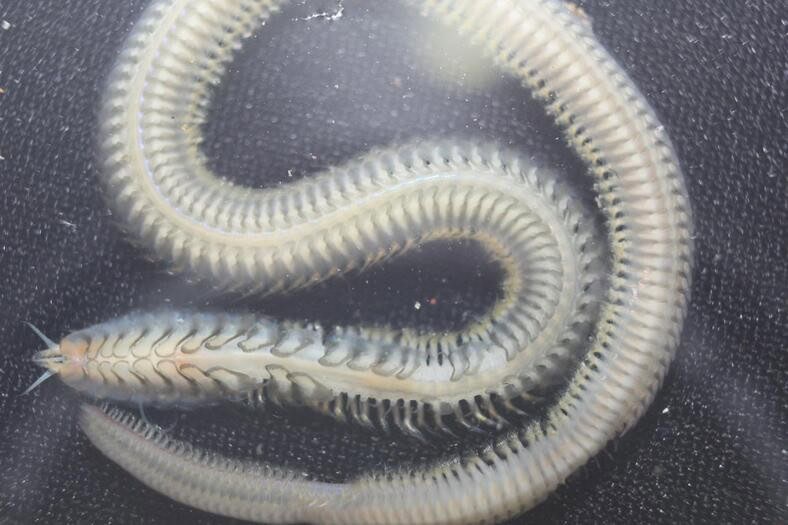
A newly identified marine worm species with coloring similar to a jaguar’s coat has been found on Costa Rica’s Pacific coast, adding another species to our country’s growing record of marine biodiversity. The species, named Sthenelais onca, was found at Playa Naranjo in Santa Rosa National Park, within the Guanacaste Conservation Area.
The find was confirmed through the BioMar-ACG project, a research effort involving the Center for Research in Marine Sciences and Limnology at the University of Costa Rica, the Guanacaste Conservation Area and MINAE. The scientific description was published in the international journal ZooKeys under the title “Sthenelais onca sp. nov. (Phyllodocida, Sigalionidae) from a sandy beach on the North Pacific coast of Costa Rica.” The study was authored by Jeffrey A. Sibaja-Cordero and Waiomi Miranda-García.
Researchers first found the species in February 2016 during fieldwork at Playa Naranjo, where four specimens were collected from moist sand. A second expedition in May 2024 provided additional specimens, allowing scientists to complete the formal description of the species.
The worm immediately drew attention because of its size, coloration and anatomy. It has orange, gray and cream tones that resemble the fur pattern of a jaguar, or Panthera onca. That resemblance, along with the worm’s role as a predator in the marine ecosystem, led researchers to name it Sthenelais onca.
The species can reach up to 11 centimeters in length, making it one of the larger worms recorded in this type of sandy coastal habitat. It lives buried in saturated sand in the area of the beach that is covered and exposed by the tides. To confirm that the worm was new to science, researchers carried out detailed morphological studies, prepared scientific illustrations and used genetic analysis based on COI DNA barcoding. The study also included phylogenetic comparisons with related marine worms from other regions.
The results showed that the specimens belonged to the genus Sthenelais but formed a distinct group. The new species differs from related worms in several anatomical traits, including smooth shafts on certain bristles, structures without papillae and a distinctive notch on the scales covering the front part of the body.
The studied specimens were added to the Annelida scientific collection at the Zoology Museum of the University of Costa Rica. Genetic sequences obtained during the research were also placed in international scientific reference databases, making them available for future studies.
The finding adds to the scientific value of the Guanacaste Conservation Area, one of Costa Rica’s most important protected regions for both terrestrial and marine research. Since 2015, BioMar-ACG has worked to document marine life in the area’s protected zones, while also training university students and working with local parataxonomists.
Scientists said the discovery shows how much remains unknown about Costa Rica’s Pacific coast, especially in sandy intertidal habitats that are often overlooked compared with coral reefs, mangroves and rocky shores. For us here in Costa Rica, the identification of Sthenelais onca is another reminder that protected areas continue to produce new scientific knowledge, even in places that have been studied for decades.





